The Benchmark

“Coppélia”
Bolshoi Ballet
Bolshoi Theatre (New Stage)
Moscow, Russia
February 21, 2026 (evening performance)

by Ilona Landgraf
Copyright © 2026 by Ilona Landgraf
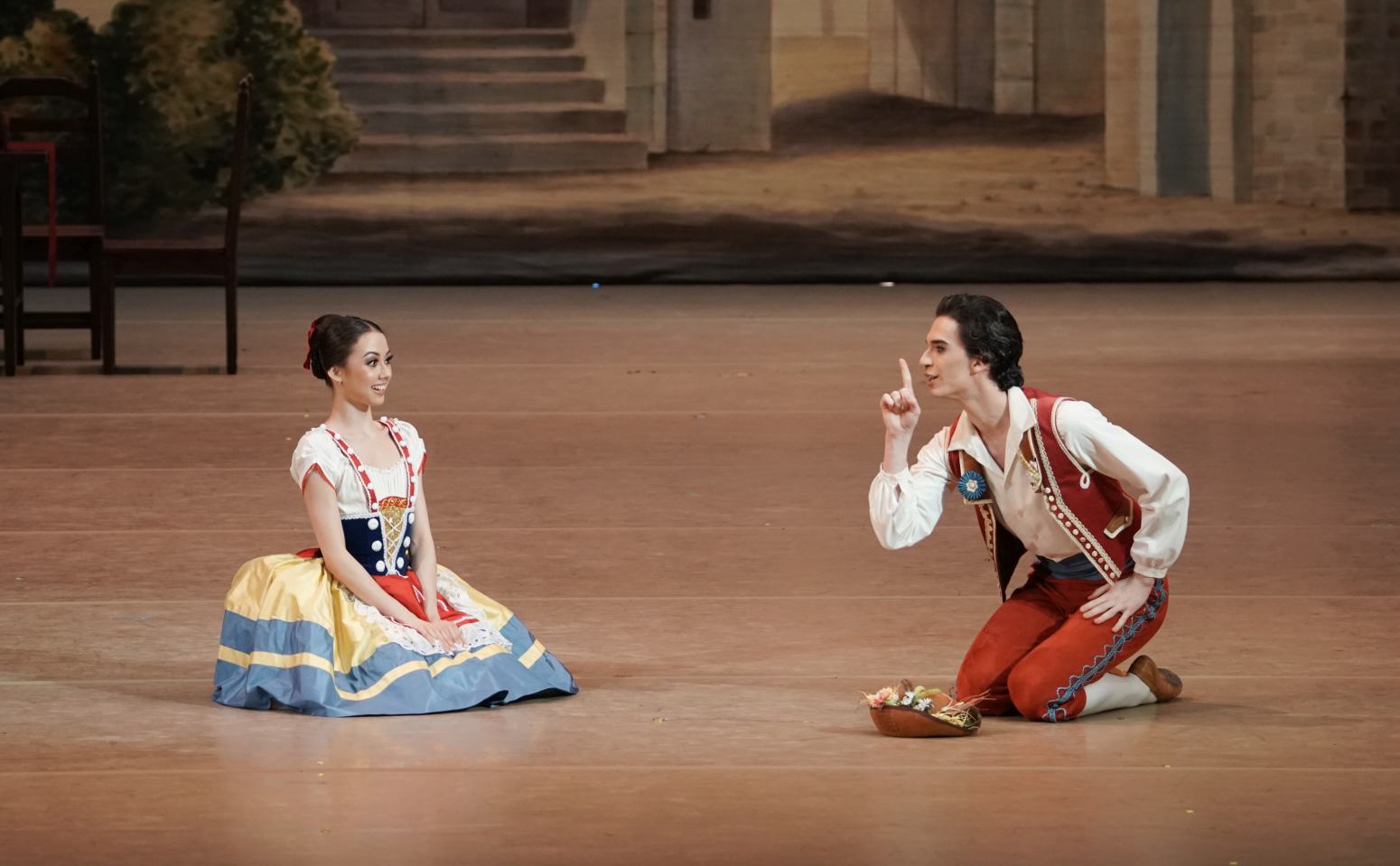
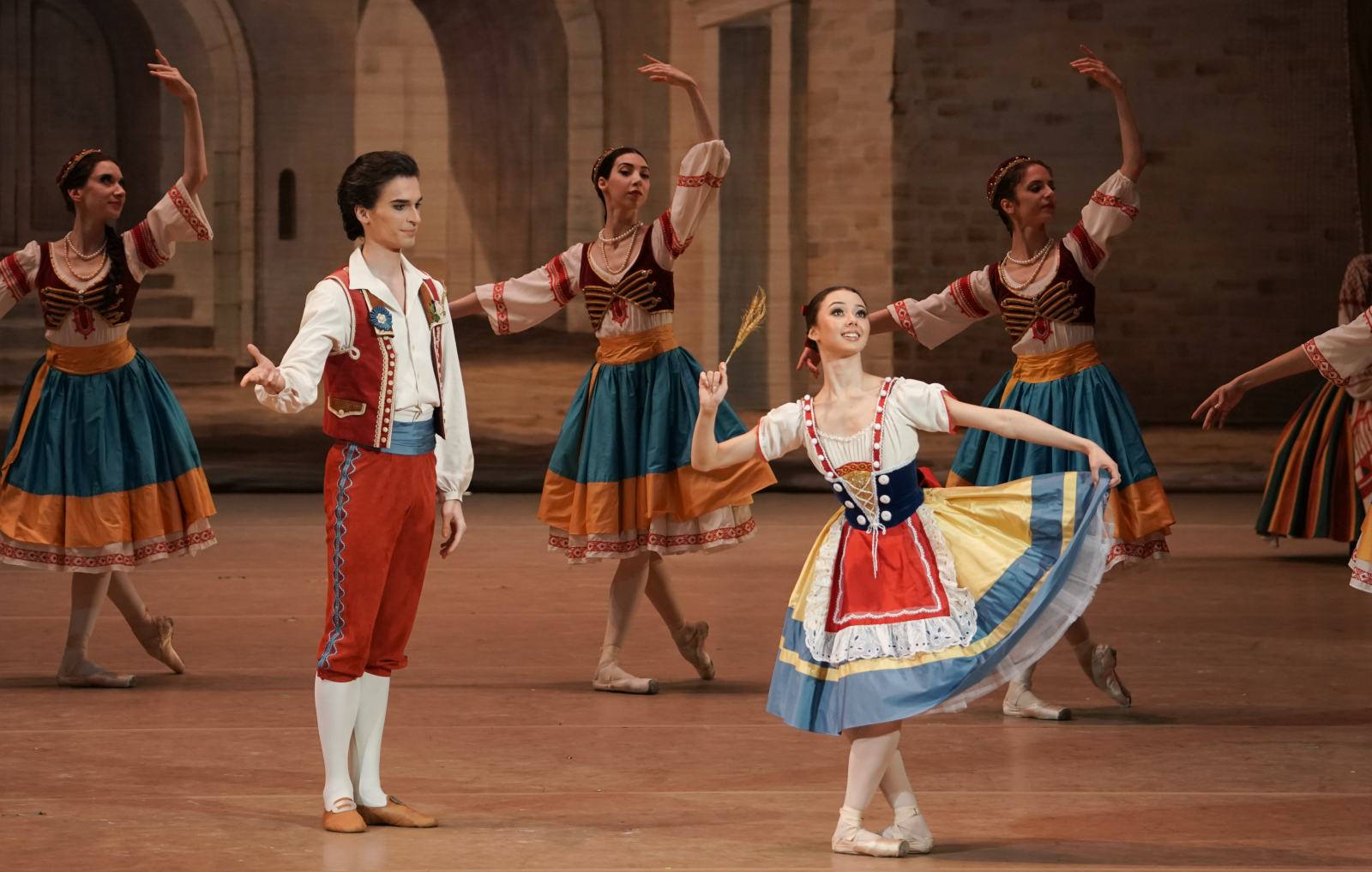
1. E.Kokoreva (Swanilda) and D.Zakharov (Frantz), “Coppélia” by S.Vikharev after M.Petipa and E.Cecchetti, Bolshoi Ballet 2026 © Bolshoi Theatre/P.RychkovMy hopes on a new video release were raised when I noticed the cameraman at the Bolshoi Ballet’s performance of Coppélia, until he explained that the recording was for internal use only. It’ll set the bar high for future generations of dancers.

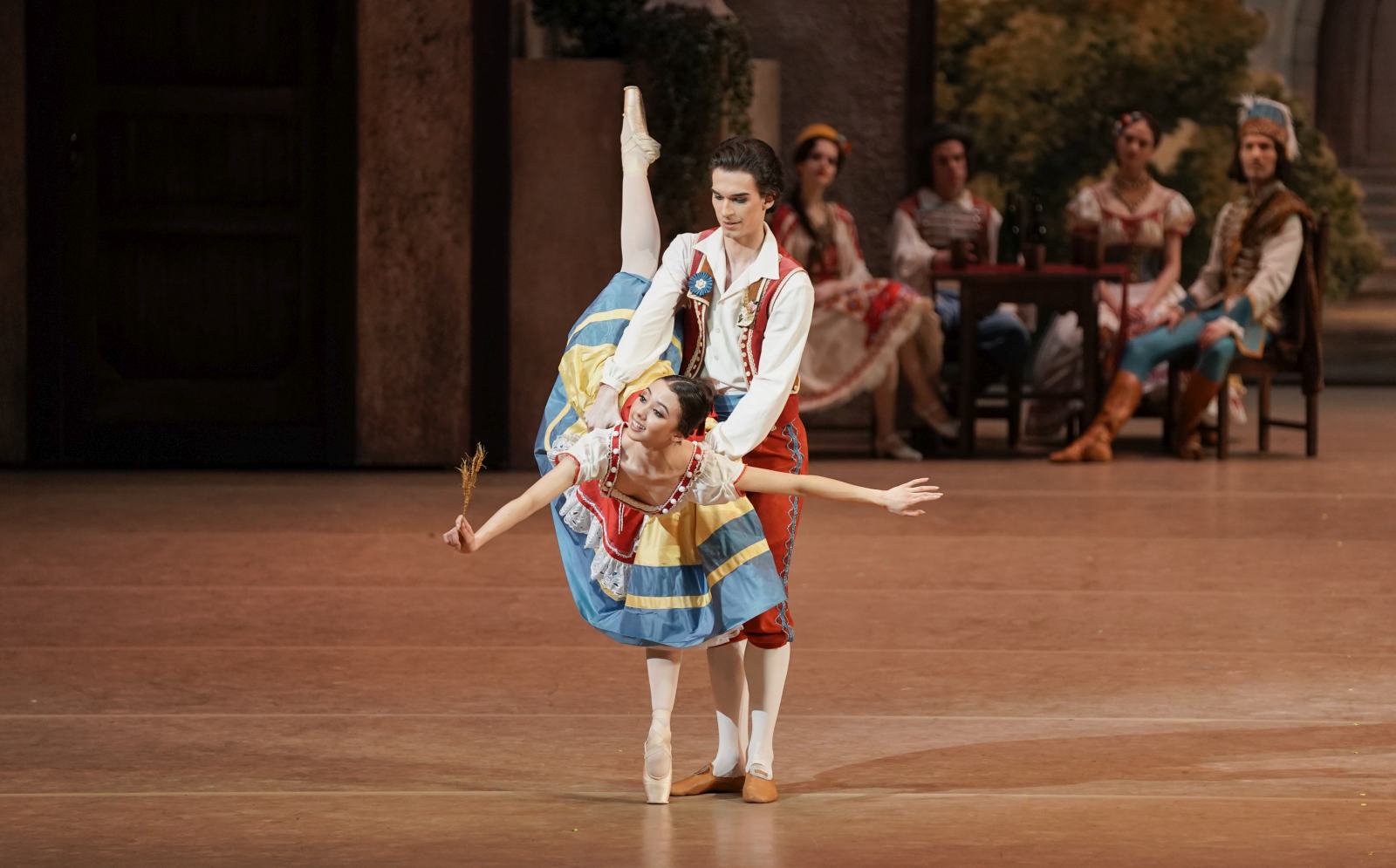
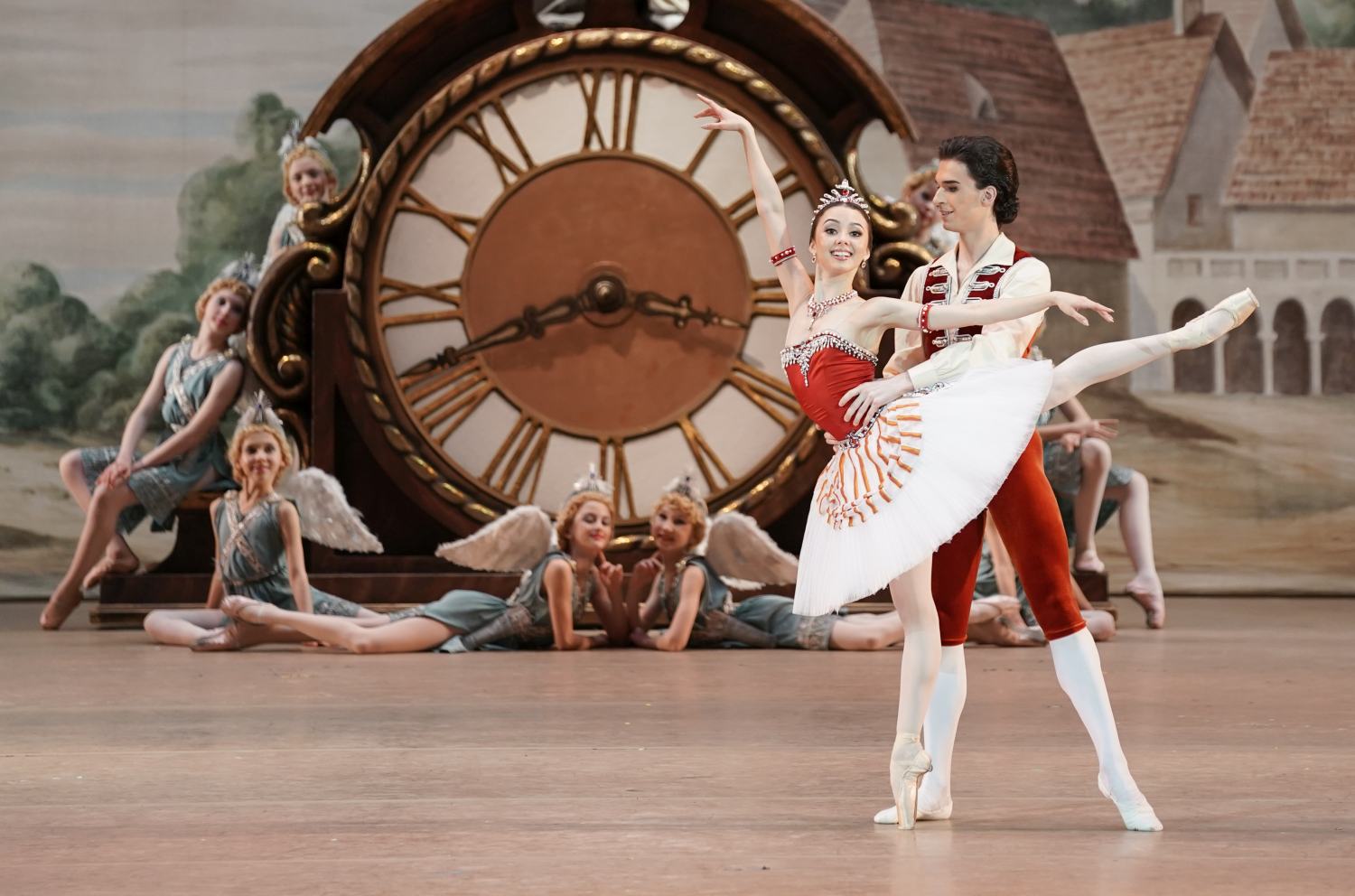
Sergei Vikharev’s production, which he said is the most complete and exact rendition of what Nicholas Sergeyev noted from his St. Petersburg memories (his manuscripts are stored at Harvard University), has been in the Bolshoi’s repertory since 2009. It preserves all the details that fell victim to artistic, financial, and producing conditions in many Western stagings. As designated by the original creators, Marius Petipa and Enrico Cecchetti, the Bolshoi’s Swanilda has eight girlfriends, and Act III’s Waltz of the Hours is danced by twenty-four ballerinas, one for each hour of the day. 2. D.Zakharov (Frantz), E.Kokoreva (Swanilda), and ensemble; “Coppélia” by S.Vikharev after M.Petipa and E.Cecchetti, Bolshoi Ballet 2026 © Bolshoi Theatre/P.RychkovThe order of their four lines of six dancers each (which represent dawn, morning, twilight, and night) is overseen by the old, bearded Chronos (Dmitry Grishin), who rests atop a huge clock that has to stand exactly center stage. The Royal Ballet’s Coppélia, by comparison, employs only eight dancers in the waltz, which subverts the scene’s meaning.
Each time I see a performance of Coppélia at the Bolshoi, the artistic director, Makhar Vaziev, is in the rear auditorium during Act III’s Fete of the Bell, his eyes scrutinizing the corps’ unity, the clarity of its patterns, and the purity of the variations. As tiny as they may be, he usually finds details to hone.
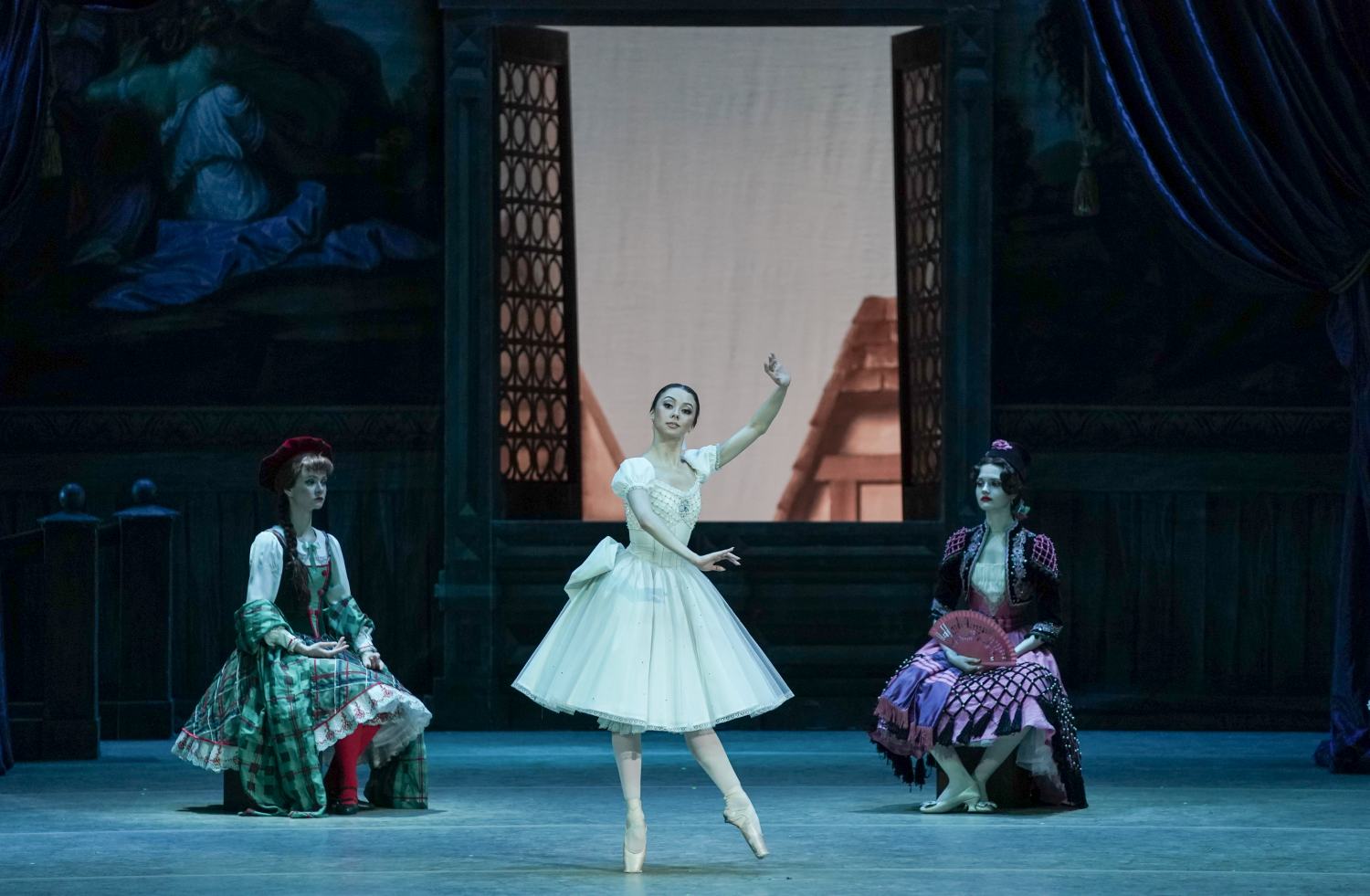
The leading couple, Swanilda (Elizaveta Kokoreva) and Frantz (Denis Zakharov), had nothing to perfect. Each step, each port de 3. E.Kokoreva (Swanilda) and D.Zakharov (Frantz), “Coppélia” by S.Vikharev after M.Petipa and E.Cecchetti, Bolshoi Ballet 2026 © Bolshoi Theatre/P.Rychkovbras, each jump, and each turn of Kokoreva represented the ideal of classical ballet and was imbued with meaning. Her acting was fresh and convincing, her pantomime unambiguous, and the show she delivered at Coppélius’s (Gennady Yanin) workshop terrific. Her fiancé, Frantz, was an unreliable lover, though. Once unobserved, he eagerly climbed through another sweetheart’s (i.e., Coppélia’s (Maria Rasskazova)) balcony door. Worse, even as he was caught red-handed by Coppélius, he affirmed his intention to marry her. What a wretch of a swain!
 

4. E.Kokoreva (Swanilda) and ensemble, “Coppélia” by S.Vikharev after M.Petipa and E.Cecchetti, Bolshoi Ballet 2026 © Bolshoi Theatre/P.RychkovOnly after Swanilda got him off the hook from Coppélius’s alchemic experiments did Frantz man up. His time had come for their wedding pas de deux, with both dressed in majestic red and the cleanest of white and with jewels sparkling at Swanilda’s décolleté and in her tiara (costumes by Tatiana Noginova). A brilliant solo, including spick and span legwork and pinpoint landings, testified to Frantz’s qualities. A gem of a woman, Swanilda sped through pirouettes, landed from split jumps in stupendous balances, and masterfully played with the tempo, smiling all the while, as if excelling on stage was exactly what she relished most. The beauty that Kokoreva and Zakharov brought to life was the performance’s most precious takeaway.
5. E.Kokoreva (Swanilda), D.Zakharov (Frantz), and ensemble; “Coppélia” by S.Vikharev after M.Petipa and E.Cecchetti, Bolshoi Ballet 2026 © Bolshoi Theatre/P.Rychkov In Act III, Elizaveta Kruteleva’s L’Aurore solo became more fluid over time as if warmed by the rising sun. Antonina Chapkina delivered a solemn, graceful La Prière solo, and Ekaterina Varlamova a zippy one as Folie. Maria Mishina led the pas de cinq Le Travail. The corps’ czardas and mazurka had verve, and Swanilda’s friends seemed ready to follow in her footsteps.

The orchestra of the Bolshoi Theatre played under the baton of Pavel Klinichev. Their rendition of Leo Delibes’s score was vibrant, creamy, and perfectly in tune with the dancers.

Link: Website of the Bolshoi Theatre
Photos: 1. Elizaveta Kokoreva (Swanilda) and Denis Zakharov (Frantz), “Coppélia” by Sergei Vikharev after Marius Petipa and Enrico Cecchetti, Bolshoi Ballet 2026
2. Denis Zakharov (Frantz), Elizaveta Kokoreva (Swanilda), and ensemble; Coppélia” by Sergei Vikharev after Marius Petipa and Enrico Cecchetti, Bolshoi Ballet 2026
3. Elizaveta Kokoreva (Swanilda) and Denis Zakharov (Frantz), “Coppélia” by Sergei Vikharev after Marius Petipa and Enrico Cecchetti, Bolshoi Ballet 2026
4. Elizaveta Kokoreva (Swanilda) and ensemble, “Coppélia” by Sergei Vikharev after Marius Petipa and Enrico Cecchetti, Bolshoi Ballet 2026
5. Elizaveta Kokoreva (Swanilda), Denis Zakharov (Frantz), and ensemble;Coppélia” by Sergei Vikharev after Marius Petipa and Enrico Cecchetti, Bolshoi Ballet 2026
all photos © Bolshoi Theatre/Pavel Rychkov
Editing: Kayla Kauffman


Someone is in Control

“Master and Margarita”
Bolshoi Ballet
Bolshoi Theatre (New Stage)
Moscow, Russia
February 18/19, 2026

by Ilona Landgraf
Copyright © 2026 by Ilona Landgraf

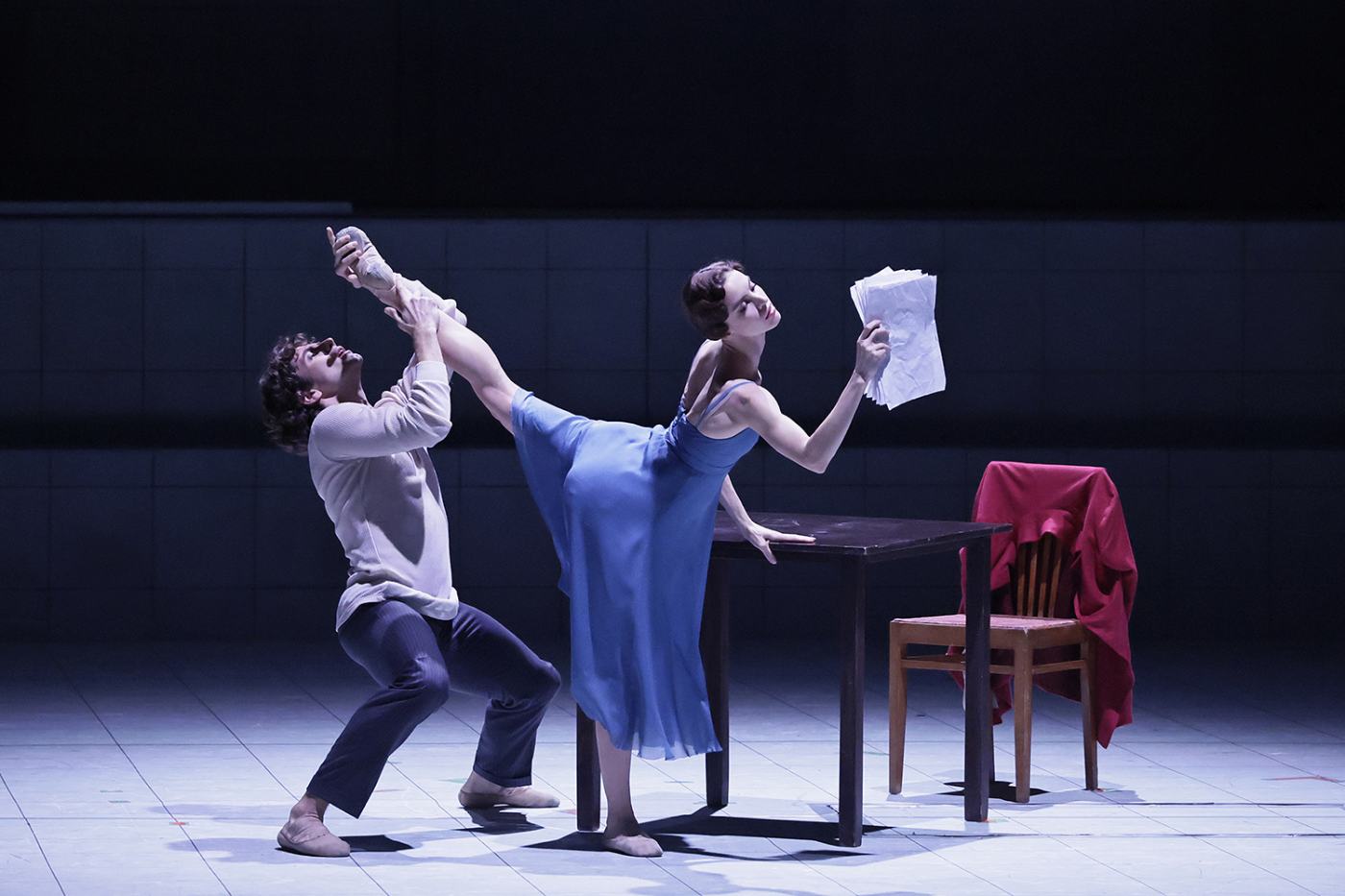
1. I.Tsvirko (Master) and M.Vinogradova (Margarita), “Master and Margarita” by E.Clug, Bolshoi Ballet 2026 © Bolshoi Theatre/D.YusupovAround two years ago, I saw Edward Clug’s ballet adaptation of Mikhail Bulgakov’s novel The Master and Margarita at the Bolshoi Theatre and found it fabulous. Last week’s two performances corroborated my impression. They also reminded me that, however chaotic the world might get, there’s no need to worry; someone is in control. In Clug’s version, it’s the Satan alias Woland and his accomplices. That hell and heaven commonly coordinate their actions went by the board.

Bulgakov intertwined two storylines (one deals with the absurd mayhem caused by Woland and his entourage on a 1930 visit to Moscow, the other is an eyewitness account of the trial of Jesus of Nazareth under Pontius Pilate’s governance), which are connected by the Master (an unrecognized Muskovit author, i.e., Bulgakov’s alter ego) and his muse, Margarita. Continue reading “Someone is in Control”

A Grand Spectacle

“La Fille du Pharaon”
Bolshoi Ballet
Bolshoi Theatre
Moscow, Russia
February 16, 2024

by Ilona Landgraf
Copyright © 2024 by Ilona Landgraf

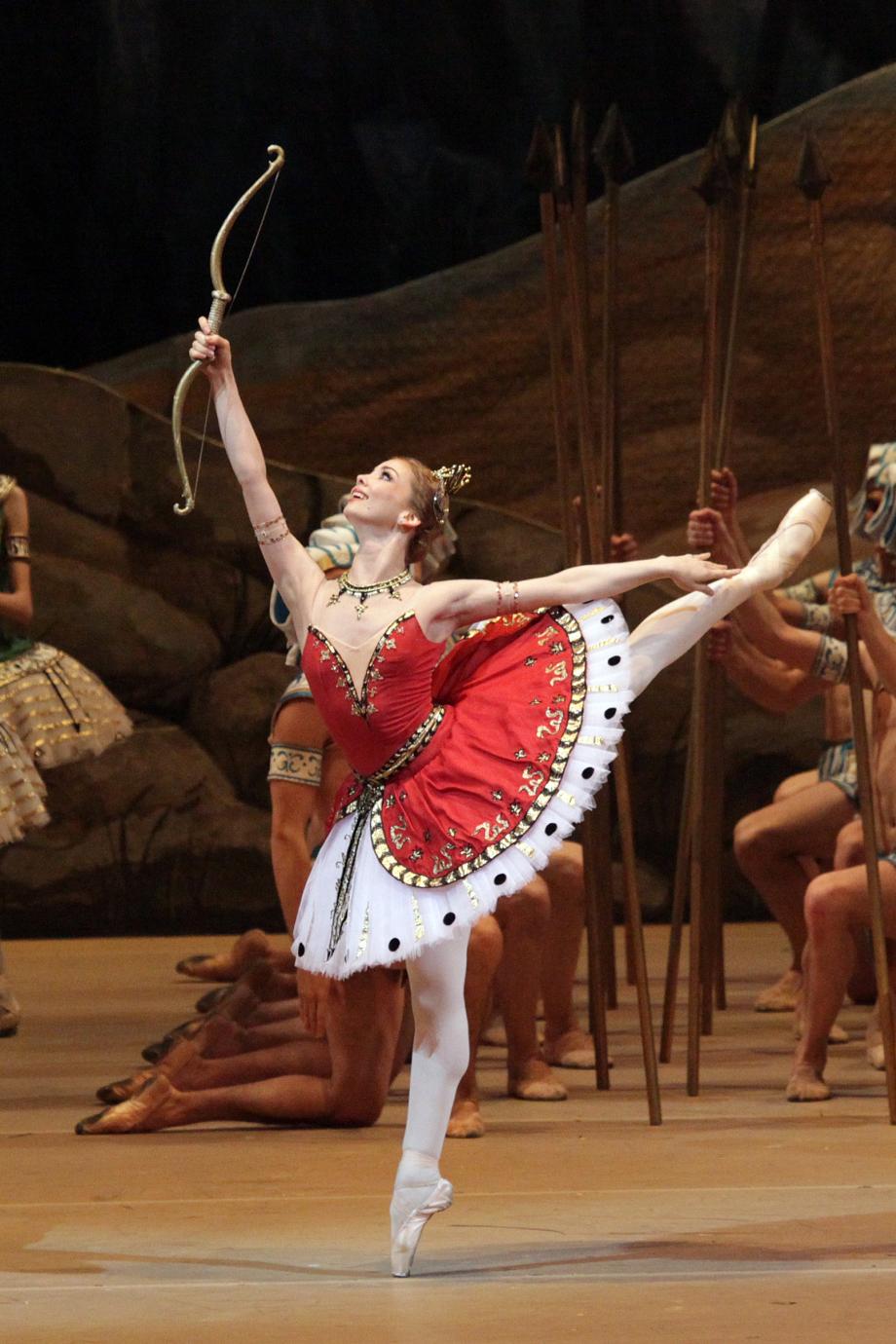
1. M.Mishina (Ramze), E.Kokoreva (Aspicia), and ensemble; “La Fille du Pharaon” by P.Lacotte, Bolshoi Ballet 2024 © Bolshoi Ballet / D.Yusupov The Bolshoi Ballet’s La Fille du Pharaon is about an Egyptian pipe dream—and it felt like a dream indeed. I was already impressed in 2019 when I watched it for the first time. Five years later, the cultural landscape has changed so much that its magnificence seems surreal. It highlights the extent to which the paths of Western and Russian cultures have diverged. While European culture finds itself on shaky grounds, the Bolshoi stands firm as a rock. The critics who argue that Pierre Lacotte’s recreation of Marius Petipa’s La Fille du Pharaon (1862) is like unearthing a dusty ballet mummy are wrong. True, the piece’s libretto (which is based on Theophile Gautier’s 1857 Le Roman de la Momie and was edited by Lacotte) is flimsy. Hearty drags on an opium pipe transport a traveling Englishman and his servant to the pyramids during the reign of a mighty pharaoh. This pharaoh has a daughter who instantly falls in love with the Englishman. After some adventurous trouble (including the dispatch of a lion, a last-minute escape, a nearly murderous assault, a suicide attempt, and the hero’s near execution), the lovers are happily united. But – alas! Upon awakening, Continue reading “A Grand Spectacle”

Well kept

“Raymonda”
Bolshoi Ballet
Bolshoi Theatre
Moscow, Russia
April 6, 2023

by Ilona Landgraf
Copyright © 2023 by Ilona Landgraf

1. D.Rodkin (Jean de Brienne) and A.Kovalyova (Raymonda), “Raymonda” by Y.Grigorovich after M.Petipa and A.Gorsky, Bolshoi Ballet 2023 © Bolshoi Theatre / M.Logvinov “Raymonda” is a foundation of Russian ballet repertoire, but is rarely performed in Europe. After his flight to the west, Nureyev staged several versions of the work for western companies, staying faithful to Petipa’s 1898 original. The few European choreographers who’ve tackled the piece – among them Pontus Lidberg for the Royal Swedish Ballet in 2014 and Rachel Beaujean for the Dutch National Ballet in 2022 – adjusted Lydia Pashkova’s libretto to match western tastes. The only Petipa/Pashkova-based Russian production I saw was Konstantin Sergeyev’s from 1948, presented by the Maryinsky Ballet on their 2014 tour to Baden-Baden. That production felt alien in Baden-Baden’s modern Festspielhaus, reinforcing the reputation of “Raymonda” as dusty and outdated. In last year’s review of Tamara Rojo’s “Raymonda” for the English National Ballet, London critic Jenny Gilbert went so far as to call Raymonda an “ineffectual heroine” (implying that the numerous renowned ballerinas who’ve taken on that leading role in the last 125 years were foolish in doing so) and the plot “offensively silly.” She also claimed that Russian “ballet culture has a higher tolerance of such [silly] things.” After watching the Bolshoi Ballet’s “Raymonda”, I’m inclined to think that the western perspective misses what “Raymonda” is actually about. Continue reading “Well kept”

Hot!

“Don Quixote”
Bolshoi Ballet
Bolshoi Theatre
Moscow, Russia
April 5, 2023

by Ilona Landgraf
Copyright © 2023 by Ilona Landgraf

1. A.Putintsev (Basilio), E.Kokoreva (Kitri), and ensemble, “Don Quixote” by A.Fadeechev after M.Petipa, Bolshoi Ballet 2023 © Bolshoi Theatre / D.Yusupov “The Bolshoi Ballet” is synonymous with excellence – and if anyone can pull off “Don Quixote”, it’s them. This past Wednesday, though, the company left me flabbergasted. Pavel Klinichev wasted no time at the conductor’s podium, unleashing Ludwig Minkus’s score the instant he turned to face the orchestra. The effervescent pacing of the first few bars made clear that this “Don Quixote” would be a spicy one.
From the first moment that the goateed Don Quixote (Alexey Loparevich) and his loyal, oft-gluttonous squire Sancho Panza (Georgy Gusev) set off on their chivalrous journey, Valeriy Levental’s set transported us to the sizzling cauldron of the jam-packed port of Barcelona. Everything is perfect: the turquoise Mediterranean Sea glints under the bright summer sun; fresh fruit is piled sky-high; and the local youth remain in the merriest of moods. The happiest of all, Kitri (Elizaveta Kokoreva) and Basilio (Alexey Putintsev), quickly bring the scene to a boil. Kokoreva’s Kitri sweeps onstage like a torpedo, her fleet-footed legs and teasing fan leaving a trail of sparks. Klinichev’s brisk conducting seemed to spur rather than challenge her. I especially admired Kokoreva’s rock-solid balances – from which she descended only to hurl herself into a battery of snappy pirouettes. Continue reading “Hot!”

Transcendent

“The Nutcracker”
Bolshoi Ballet
Bolshoi Theatre
Moscow, Russia
December 29, 2022 (matinee and evening performance)

by Ilona Landgraf
Copyright © 2023 by Ilona Landgraf

1. V.Bessonova (Columbine), “The Nutcracker” by Y.Grigorovich, Bolshoi Ballet 2022 © Bolshoi Ballet / M.LogvinovAfter meeting him at a guest performance with Les Ballets de Monte Carlo six years ago, the Bolshoi’s Semyon Chudin suggested that I see their “Nutcracker” in Moscow. Year after year, one thing or another has prevented me from getting to the Bolshoi at Christmastime. Finally, this year, it happened: on the edge of New Year’s Eve, I watched a matinee and an evening performance.

The Bolshoi’s “Nutcracker” dates back to 1966 – qualifying it neither as trendy nor hip by today’s standards. Perhaps Makhar Vaziev, the company’s artistic director, has kept it in the repertoire for a number of reasons: out of respect for tradition; out of respect for the ballet’s choreographer – Yuri Grigorovich – one of the company’s formative figures; and out of respect for the crowd-pleasing nature of the piece that leads to sold out performances now as ever. Continue reading “Transcendent”

Pipe Dreams

“La Fille du Pharaon”
Bolshoi Ballet
Bolshoi Theatre
Moscow, Russia
March 08, 2019 (matinee and evening performance)

by Ilona Landgraf
Copyright © 2019 by Ilona Landgraf

1. E. Obraztsova, “La Fille du Pharaon” by P. Lacotte, Bolshoi Ballet 2019 © Bolshoi Ballet / D. Yusupov Aspicia, the heroine in Petipa’s “La Fille du Pharaon”, was a highly coveted role among ballerinas. Carolina Rosati, an Italian ballerina whose insistence propelled the ballet to creation, danced Aspicia at the world premiere in St. Petersburg in 1862. Mathilde Kschessinska, the unofficial queen of St. Petersburg’s Imperial Theatres, claimed the role as hers at the 1898 revival – meaning that it was like a revolution when the role was given to Anna Pavlova in 1906. “La Fille du Pharaon” was Petipa’s first significant choreographic success. Pierre Lacotte’s take on the ballet for the Bolshoi Ballet in 2000 was a tribute to Petipa and to the famous ballerinas who had shared their knowledge about Aspicia with Lacotte: Lyubov Egorova, Mathilde Kschessinska, and Olga Spesivtseva.

The ballet’s rambling narrative is loosely based on Théophile Gautier’s 1857 novel “The Romance of a Mummy”. Fueled by opium, an English explorer imagines a slew of adventures with Aspicia, the daughter of an Egyptian pharaoh. Aspicia, a mummy, resurrected from her sarcophagus, goes hunting and is saved from a lion’s wrath by the heroic Egyptian Taor (the Englishman), with whom she naturally falls in love. The duo, contending with Aspicia’s forced marriage to the King of Nubia, elopes to an idyllic fishing village. There, they are met by further hazards: suicide attempts, a detour to the underwater realm of the God of the river Nile, and more. Finally, Aspicia and Taor are reunited and happily married – until at the height of the rejoicing, the Englishman awakes from his dream. Continue reading “Pipe Dreams”