“Wonderland” (“Alice in Wonderland”/“Through the Looking-Glass”)
Hamburg Ballet
Hamburg State Opera
Hamburg, Germany
June 20, 2026
by Ilona Landgraf
Copyright © 2026 by Ilona Landgraf
 Compared to Alexei Ratmansky’s recent choreography, Callirhoe, for the Vienna State Ballet, his new creation, Wonderland, for the Hamburg Ballet feels empty. It combines two dance adaptations of Lewis Carroll’s most notable novels, Alice’s Adventures in Wonderland (1865) and its sequel Through the Looking-Glass (1871), each of which is presented in a one-hour act.
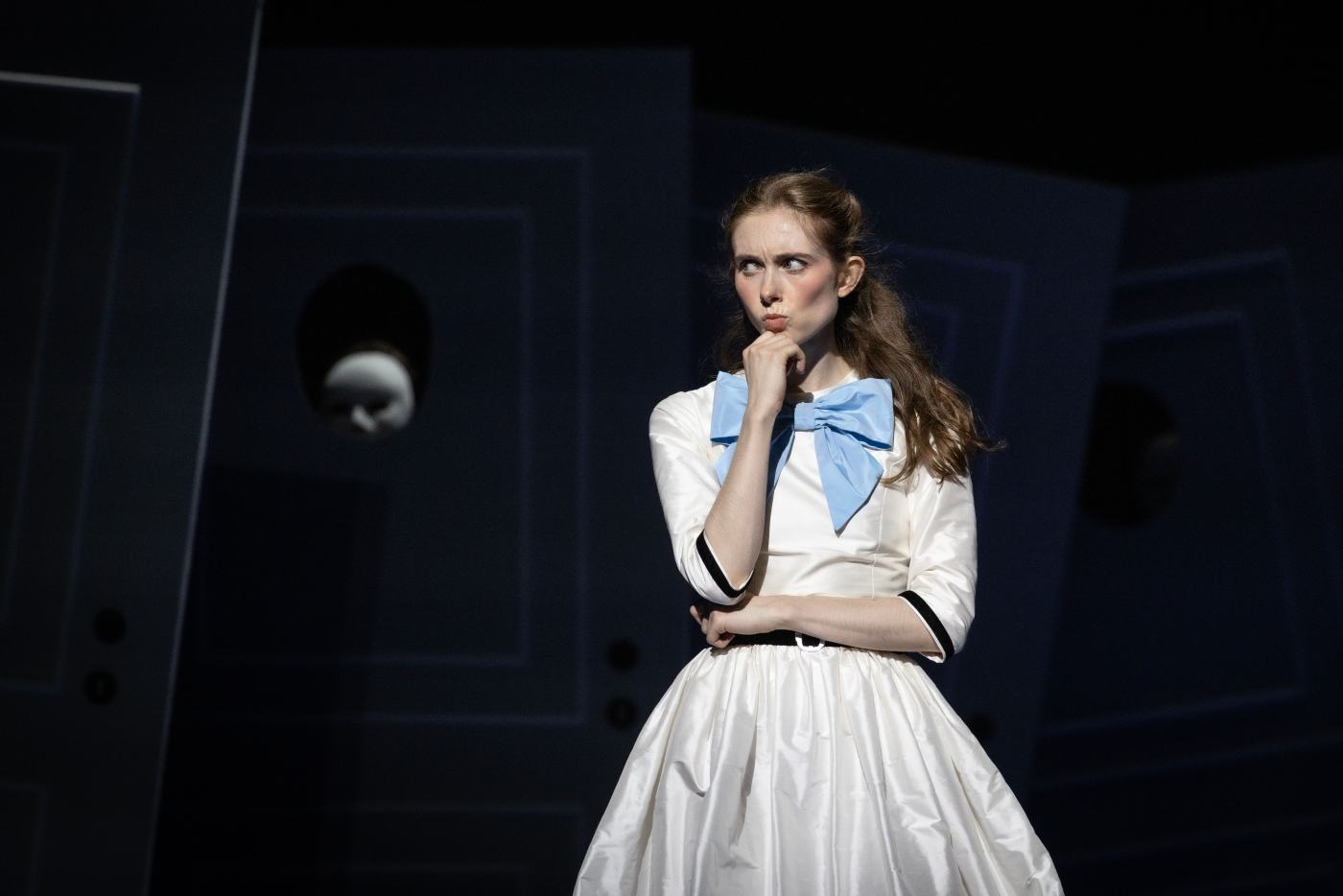
No doubt, the production is ambitious and elaborate. Ratmansky and his son, Vasyl, assembled different music for each of the no fewer than twenty-eight scenes, which Philip Feeney merged into a score. Erik Satie’s Three Gnossiennes, no.3, for example, lulls Alice (Olivia Betteridge) into her dream journey down the rabbit hole. Percy Grainger’s Molly on the Shore (amended by a cock-crow) gives the cackling animals at the Caucus race—among them a crab, mouse, dodo, and eaglet—a voice, whereas psychedelic electronics by Vasyl Ratmansky indicate the effect of the tempting mushrooms.

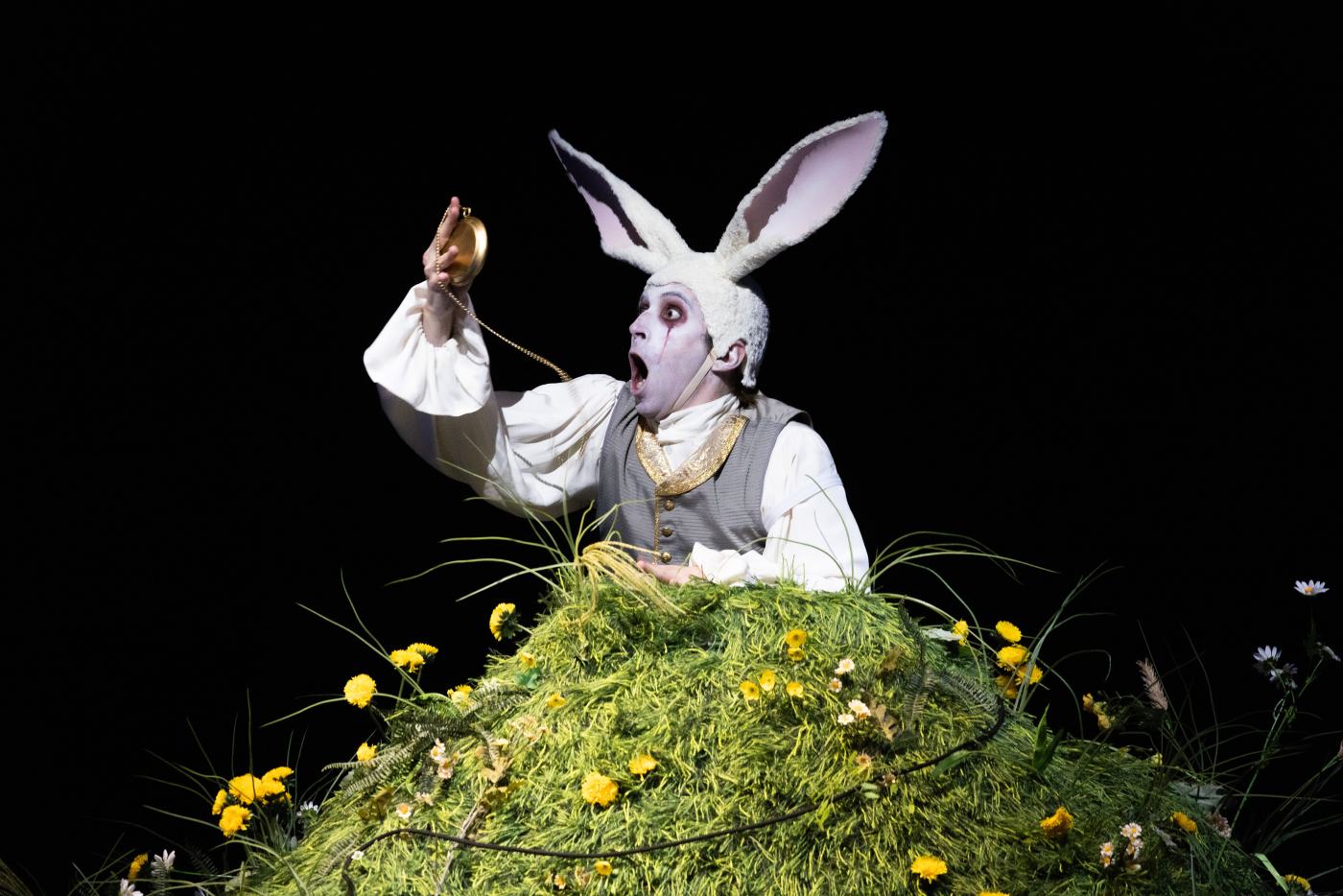
 With the car horn prelude of György Ligeti’s Le Grand Macabre, the White Rabbit (Aleix Martínez) heralds the trial to which the organ of Francis Poulenc’s Concerto for Organ, Timpani, and Strings subsequently gives weight. Maurice Ravel’s La Valse inspires Act II’s living flowers to dance. The insects bounce and buzz relentlessly to Paul Lansky’s Idle Chatter. And the jazzy rhythm of Raymond Scott’s The Penguin gives Tweedledum and Tweedledee (Francesco Cortese and Louis Musin) wings. Despite their portly stature, they are amazingly nimble, and one of the brothers flies through a series of jetés like a ball.

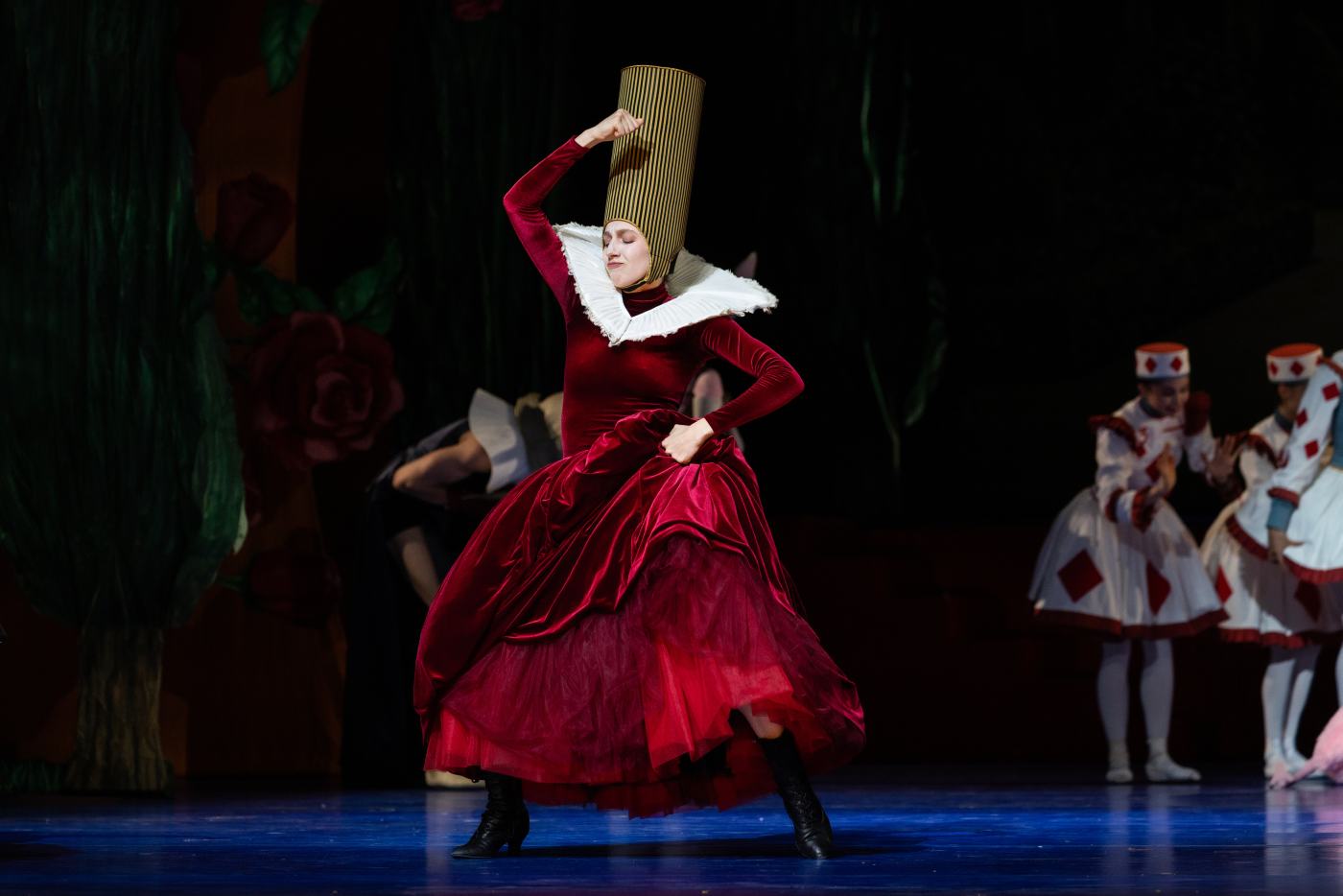
 Of the many imaginative costumes the Hungarian media artist, David Szauder, designed for his first stage commission, I especially liked the one for Bill, the iridescent, long-tailed lizard (Filipe Rettore), the gryphon’s (Francesco Cortese’s) sharp golden beak and strong but tender claws, and the patterned, floor-length dresses of the mushroom-ladies with which they wore prominent, pileus-shaped hats. The dresses’ tight cuts allowed only small gliding steps reminiscent of traditional Japanese dances.
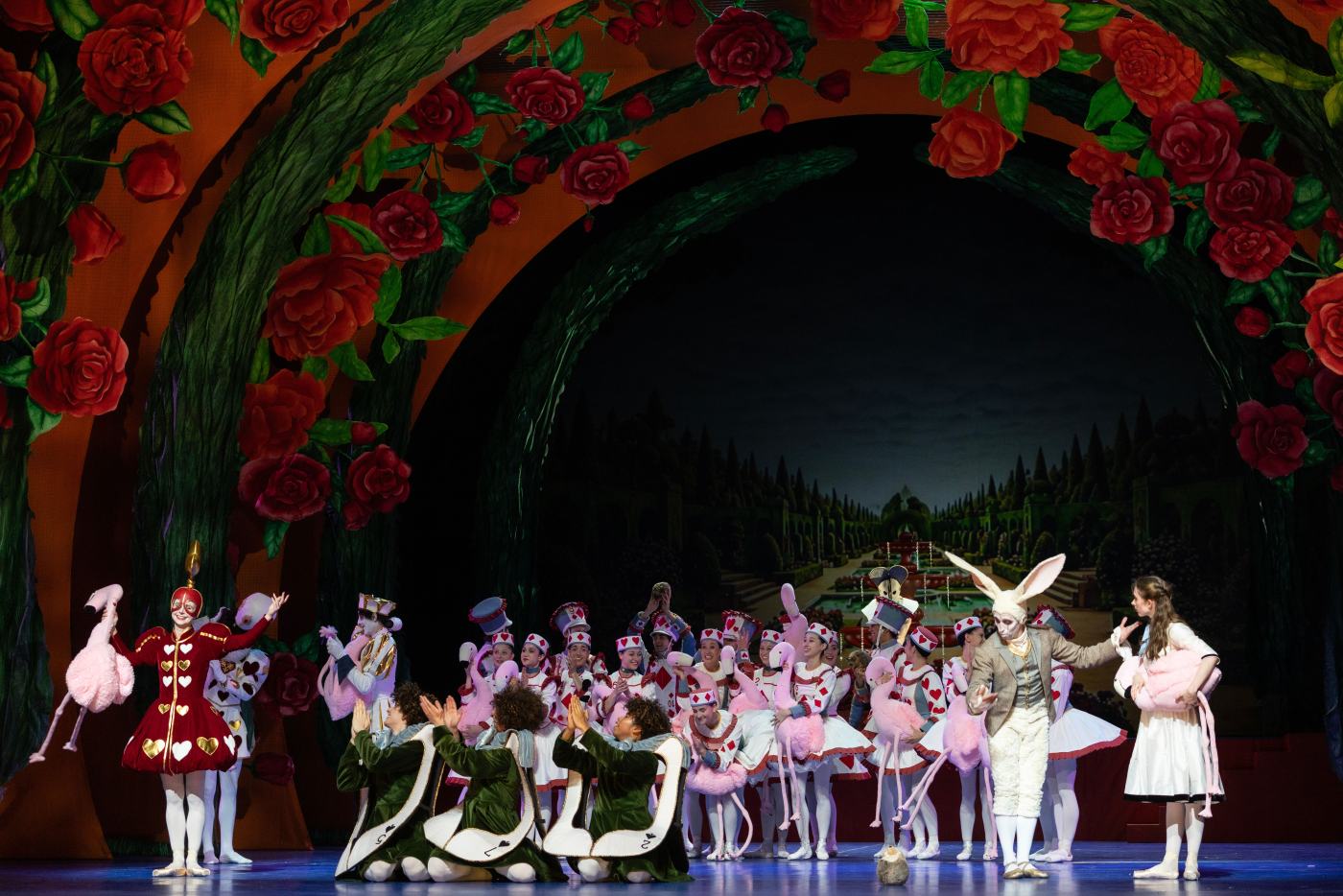 Due to many toys—among them a battery-powered piglet, plush flamingos serving as croquet clubs, stick horses for the cavalry, and a white toy horse from which the White Knight (Daniele Bonelli) fell—some scenes bordered on children’s entertainment, and Ratmansky’s heroine indeed often behaved (and in Act I dressed) like an ingénue.
For the décor, set designer Sebastian Hannak teamed up with David Szauder and Forward Productions, the latter contributing video designs. In Act I, a blooming, grassy knoll (upon which Alice clambered and her sister read a book that was presumably Carroll’s) contained a rabbit hole with a video tunnel similar to the one in Christopher Wheeldon’s Alice in Wonderland leading underground. There, moving white doors blocked Alice’s way as if to tease her. On a video screen, her big tears dropped into a sea of water with a plop.
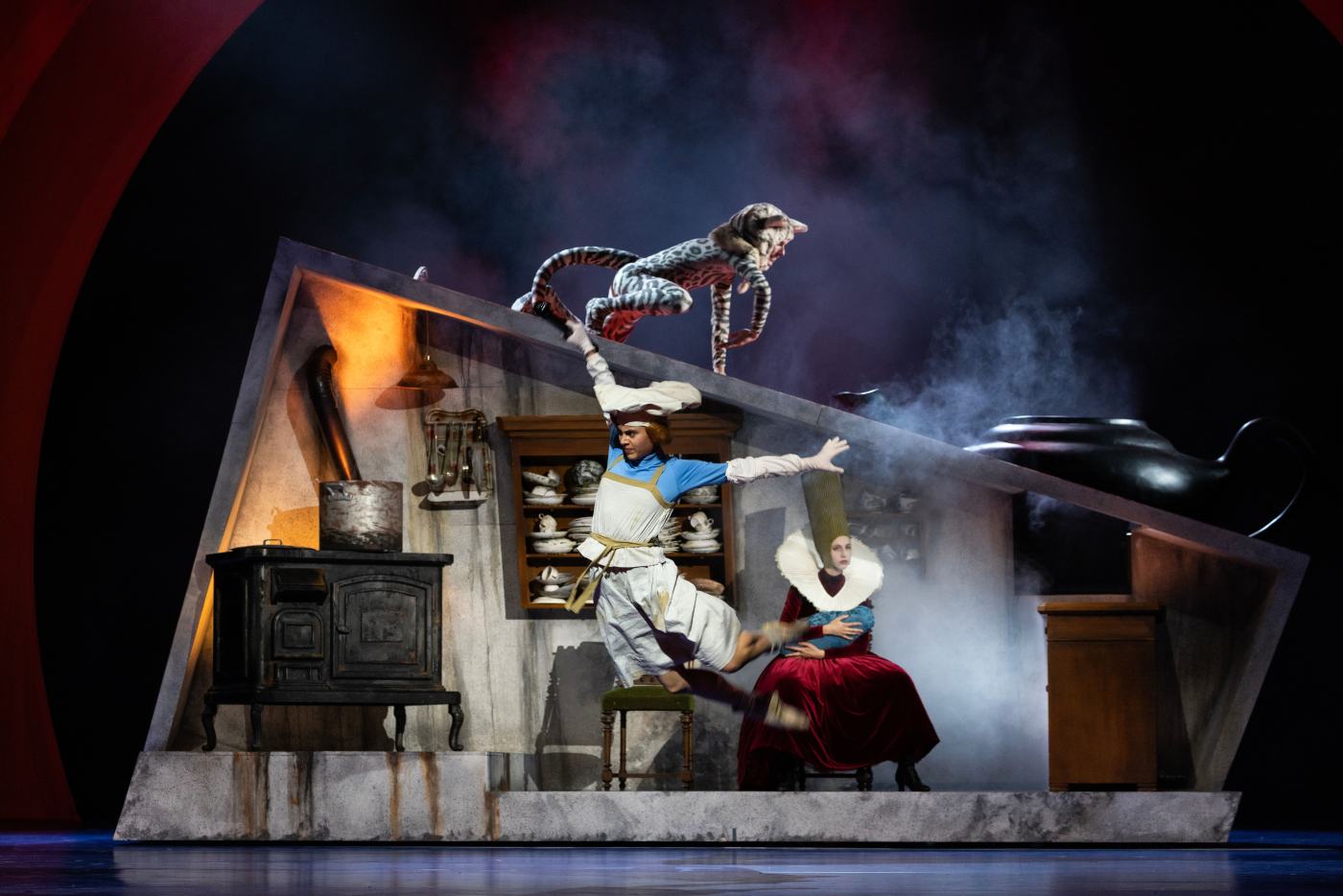
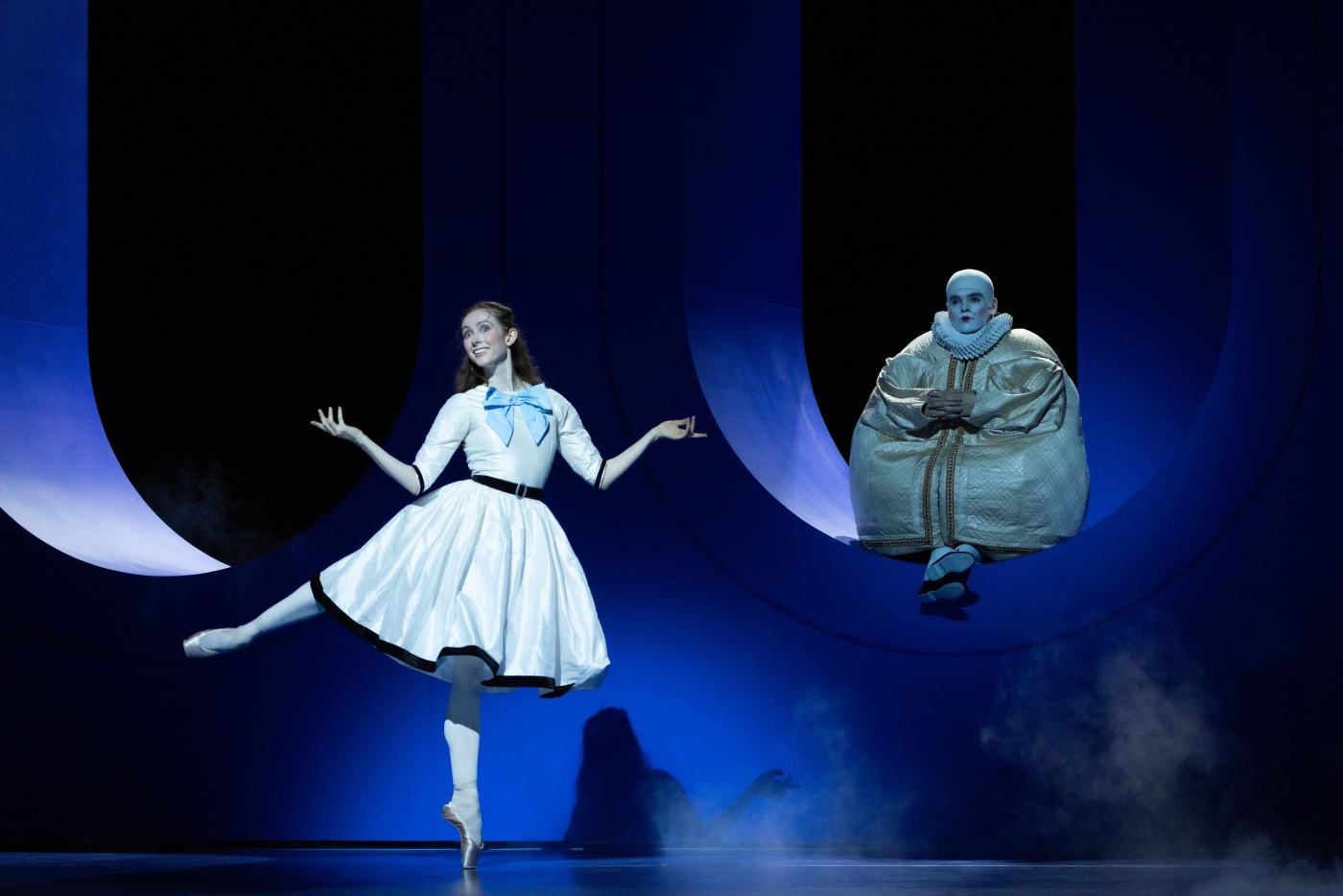
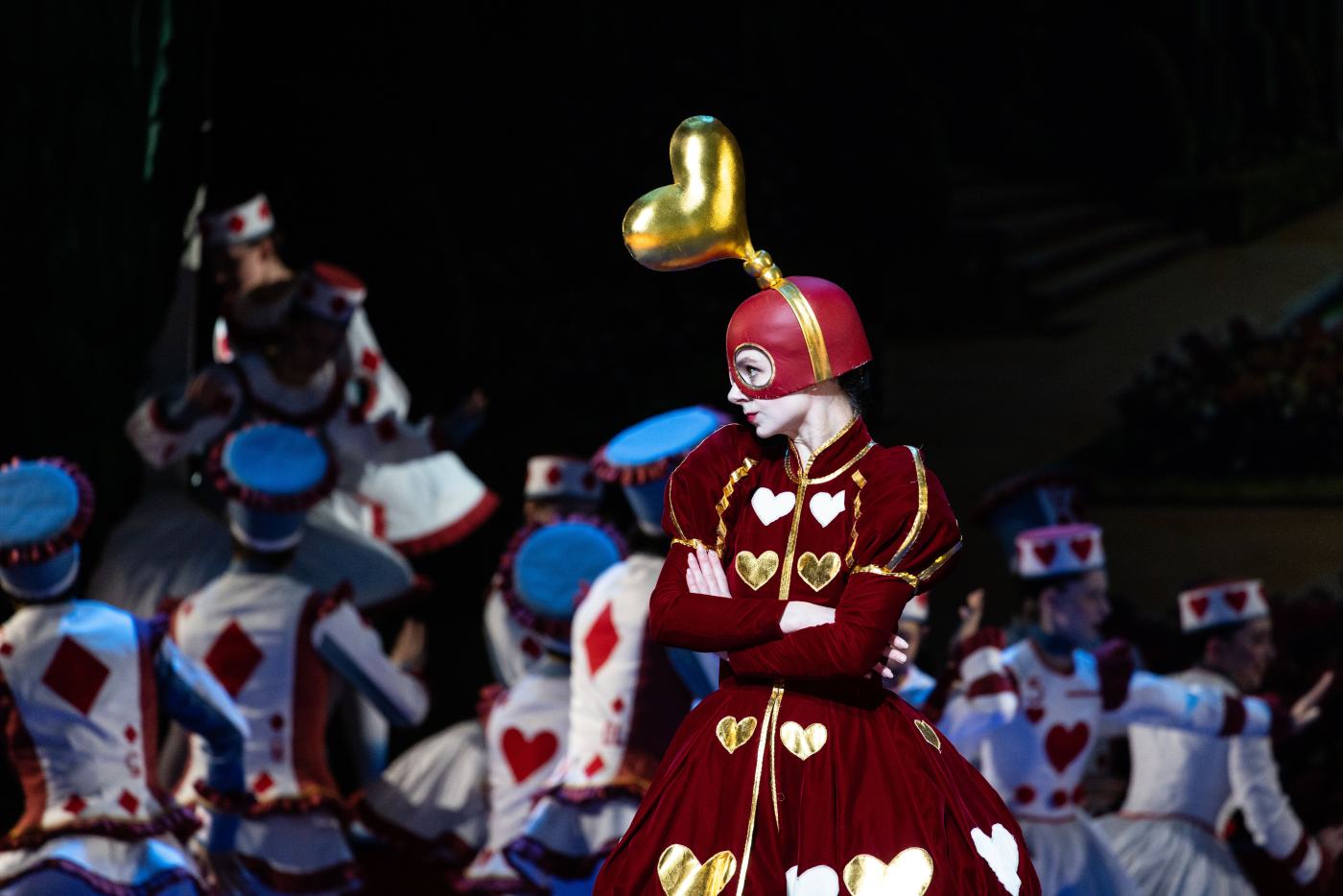 Soon afterwards, a door shrank or magnified on the screen depending on which potion she gulped. The White Rabbit’s farm, the jungle, where multiple Cheshire Cats strolled, and the front part of the Queen of Hearts’s (Ida Praetorius’s) Garden were painted. A KI picture infinitely stretched its depth. The Duchess (Alice Mazzasette) and her pepper-loving cook (Almudena Izquierdo) banged about in a peep box kitchen, and one of the Cheshire Cats tiptoed upon its pitched roof. Act II’s set was abstract and consisted mainly of movable gray-blue walls that repositioned seamlessly to define different spaces. Humpty Dumpty (Caspar Sasse) slid on one of their arcade windowsills as if it were a halfpipe before falling backwards.
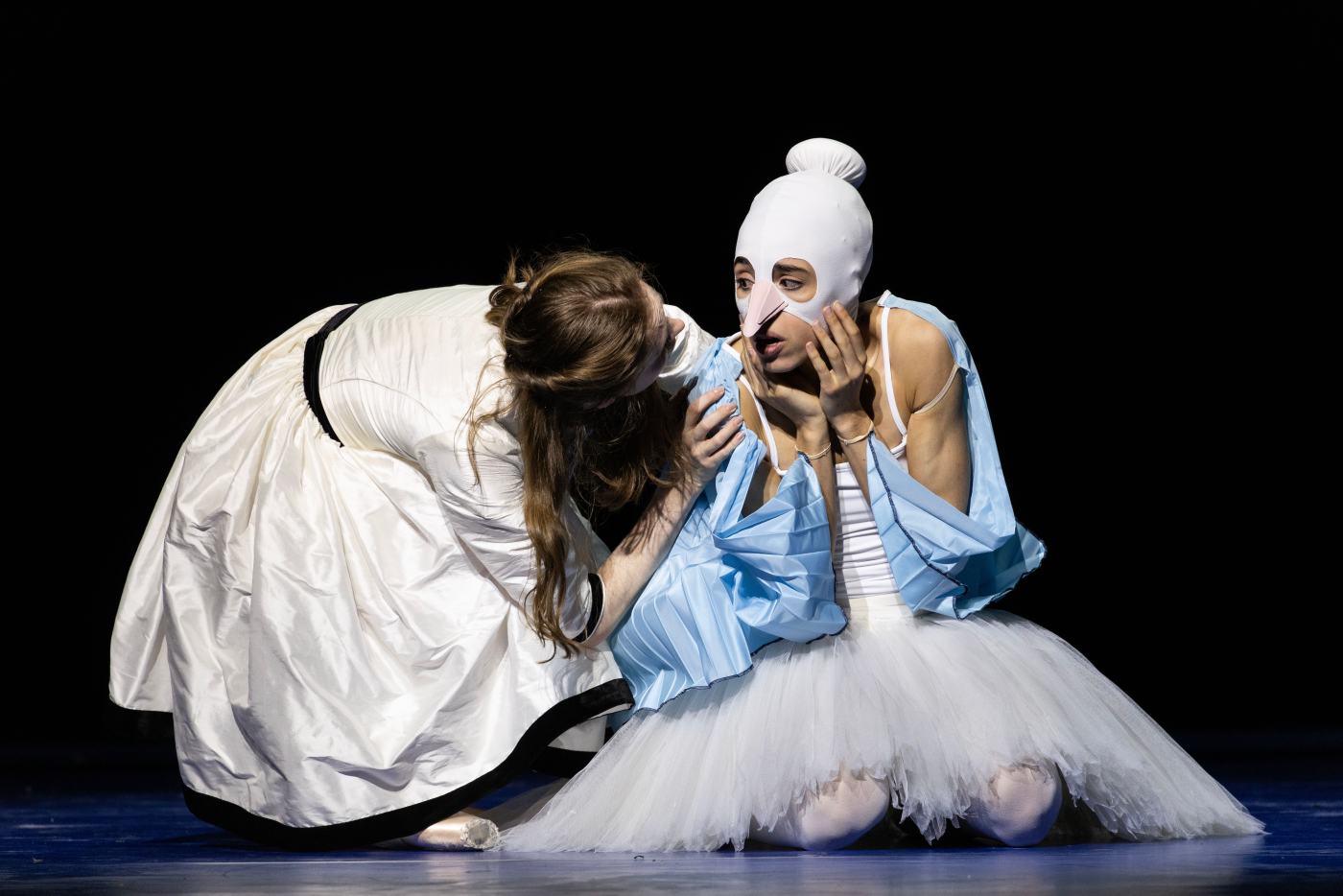 Neither the music nor the set, and certainly not the costumes, were Wonderland’s weak point. Signature movements characterized many of the animals, corps scenes were well placed, and the company danced fine. But the episodic narrative style thwarted any flow, especially as many scenes resembled reflective chamber plays with an energy too weak to reach the audience. Often, the story unfolded slowly, making the eye-catching costumes the main attraction.

 Admittedly, it’s hard to compete with Wheeldon’s version, and Ratmansky seemed careful to circumnavigate it. For example, his tea party unfolded in front of a climbing wall made of a teapot and pastries and was accompanied by Carola Bauckholt’s very sparse Geräusche (“Sounds”). How boring compared to the terrific tap dance Wheeldon choreographed for this scene! The same applies to the Duchess’s kitchen (remember Wheeldon’s robust en travestie Duchess and her rowdy cook wielding a cleaver?) and particularly to the Queen of Hearts’s solo. Wheeldon’s Queen of Hearts makes you burst into laughter time after time. Ratmansky’s choreography for the Queen was so insignificant that I immediately forgot it. Nevertheless, the local audience cheered the production. What’s considered a wonderland is subjective, after all.

| Link: | Website of the Hamburg Ballet | |
| Photos: | 1. | Aleix Martínez (The White Rabbit), “Wonderland” by Alexei Ratmansky, Hamburg Ballet 2026 |
| 2. | Olivia Betteridge (Alice), “Wonderland” by Alexei Ratmansky, Hamburg Ballet 2026 | |
| 3. | Olivia Betteridge (Alice) and Gabriel Barbosa (The Mad Hatter), “Wonderland” by Alexei Ratmansky, Hamburg Ballet 2026 | |
| 4. | Francesco Cortese (The Fish-Footman) and Louis Musin (The Frog-Footman), “Wonderland” by Alexei Ratmansky, Hamburg Ballet 2026 | |
| 5. | Almudena Izquierdo (The Cook), Alice Mazzasette (The Duchess), and Daniele Bonelli (Cheshire Cat); “Wonderland” by Alexei Ratmansky, Hamburg Ballet 2026 | |
| 6. | Ensemble, “Wonderland” by Alexei Ratmansky, Hamburg Ballet 2026 | |
| 7. | Alice Mazzasette (The Duchess) and ensemble, “Wonderland” by Alexei Ratmansky, Hamburg Ballet 2026 | |
| 8. | Ida Praetorius (The Queen of Hearts) and ensemble, “Wonderland” by Alexei Ratmansky, Hamburg Ballet 2026 | |
| 9. | Olivia Betteridge (Alice) and Ana Torrequebrada (The Dove), “Wonderland” by Alexei Ratmansky, Hamburg Ballet 2026 | |
| 10. | Olivia Betteridge (Alice) and Caspar Sasse (Humpty Dumpty), “Wonderland” by Alexei Ratmansky, Hamburg Ballet 2026 | |
| 11. | Matias Oberlin (The Gnat) and Olivia Betteridge (Alice), “Wonderland” by Alexei Ratmansky, Hamburg Ballet 2026 | |
| 12. | Louis Musin (Tweedledee), Olivia Betteridge (Alice), and Francesco Cortese (Tweedledum), “Wonderland” by Alexei Ratmansky, Hamburg Ballet 2026 | |
| 13. | Olivia Betteridge (Alice) and ensemble, “Wonderland” by Alexei Ratmansky, Hamburg Ballet 2026 | |
| all photos © Kiran West | ||
| Editing: | Kayla Kauffman |
