Someone is in Control

“Master and Margarita”
Bolshoi Ballet
Bolshoi Theatre (New Stage)
Moscow, Russia
February 18/19, 2026

by Ilona Landgraf
Copyright © 2026 by Ilona Landgraf
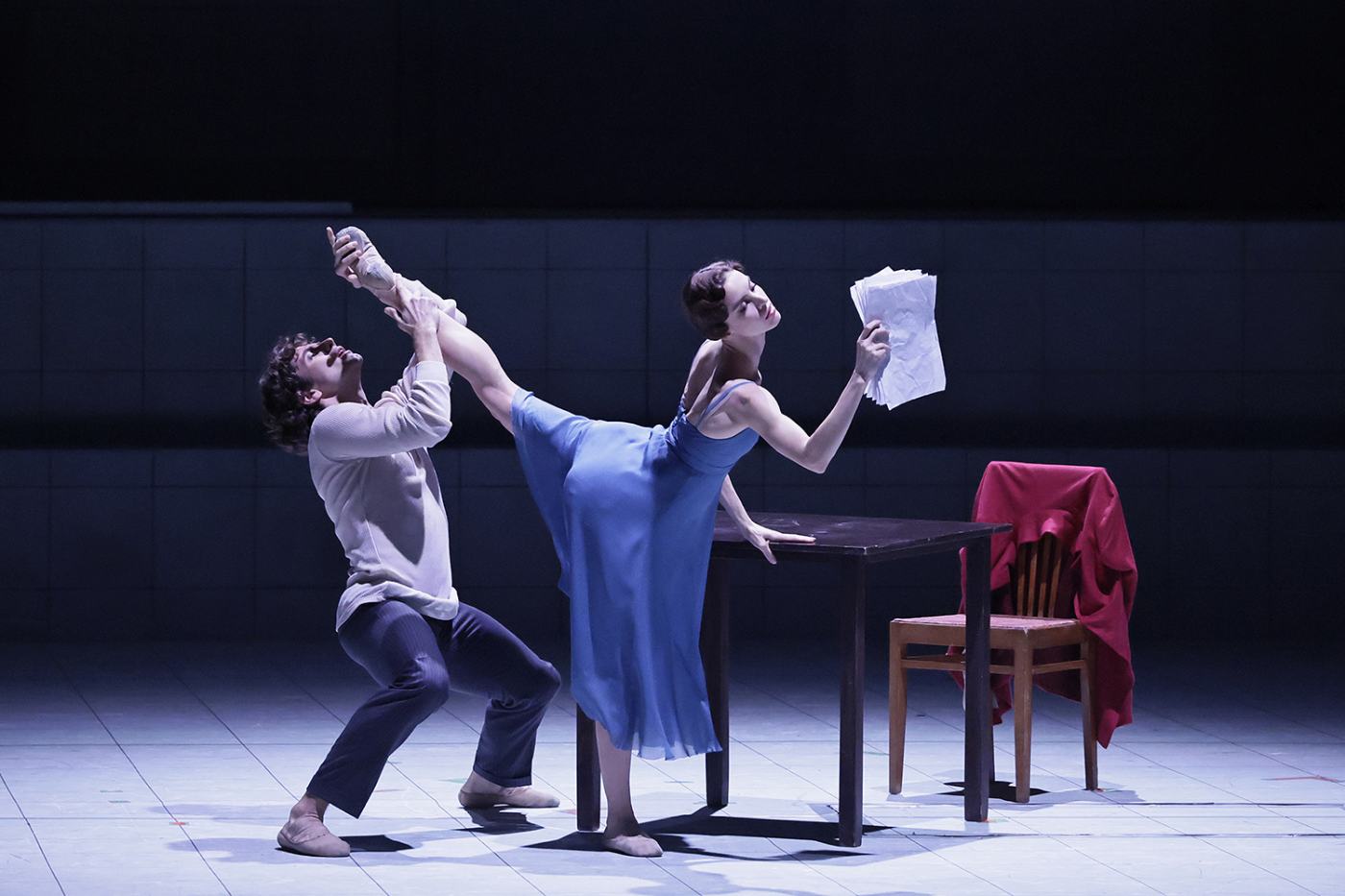
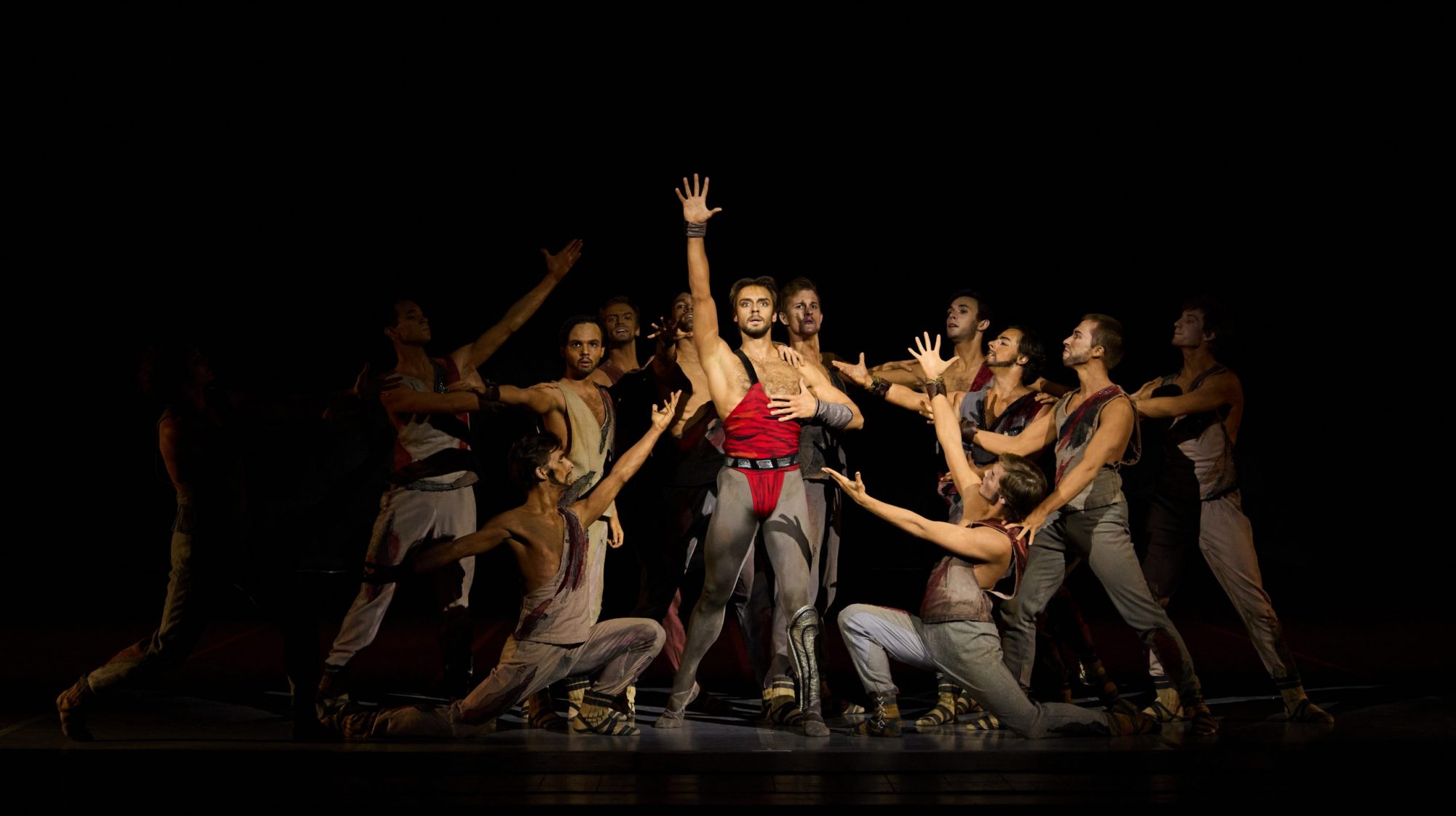
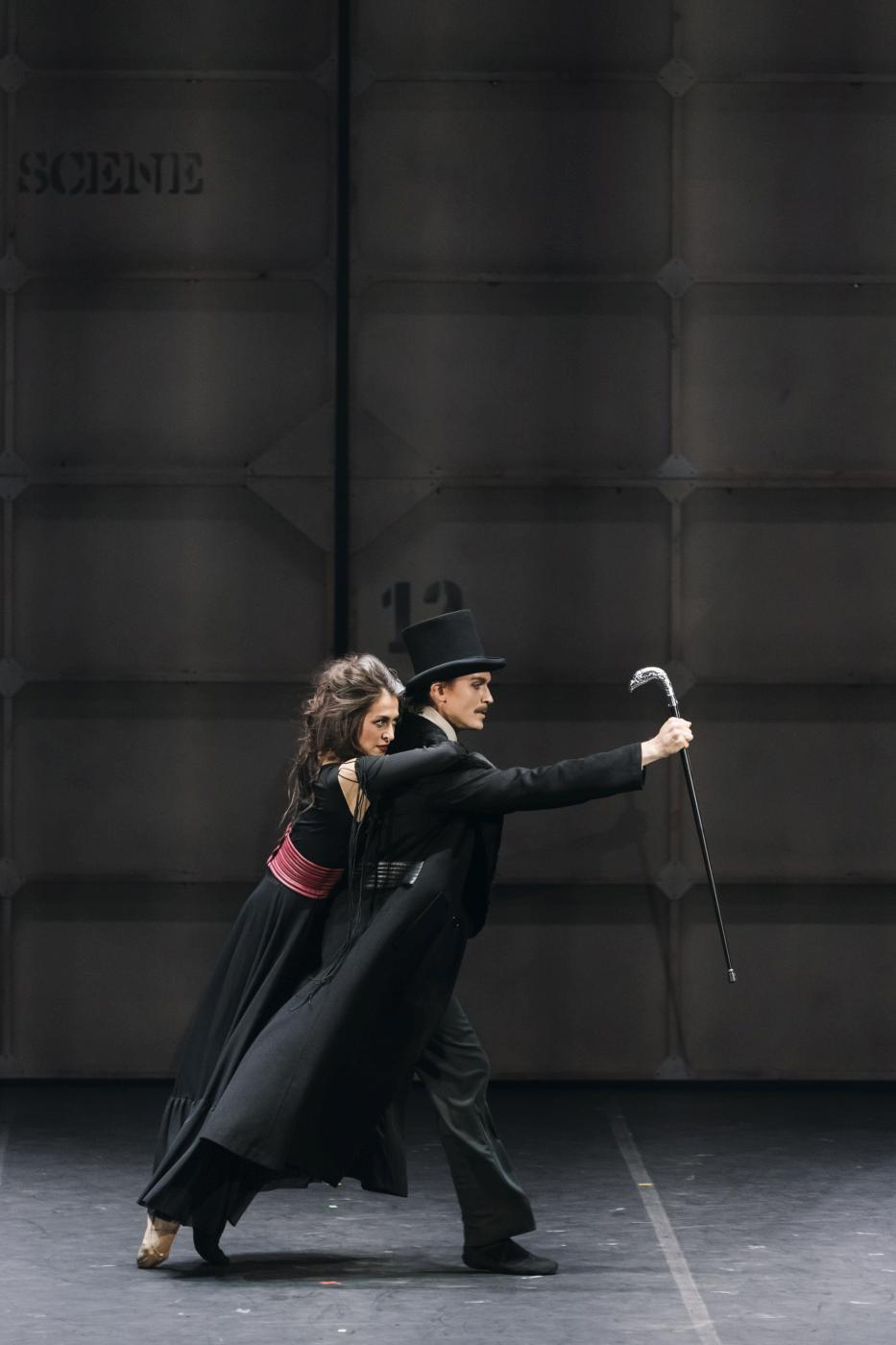
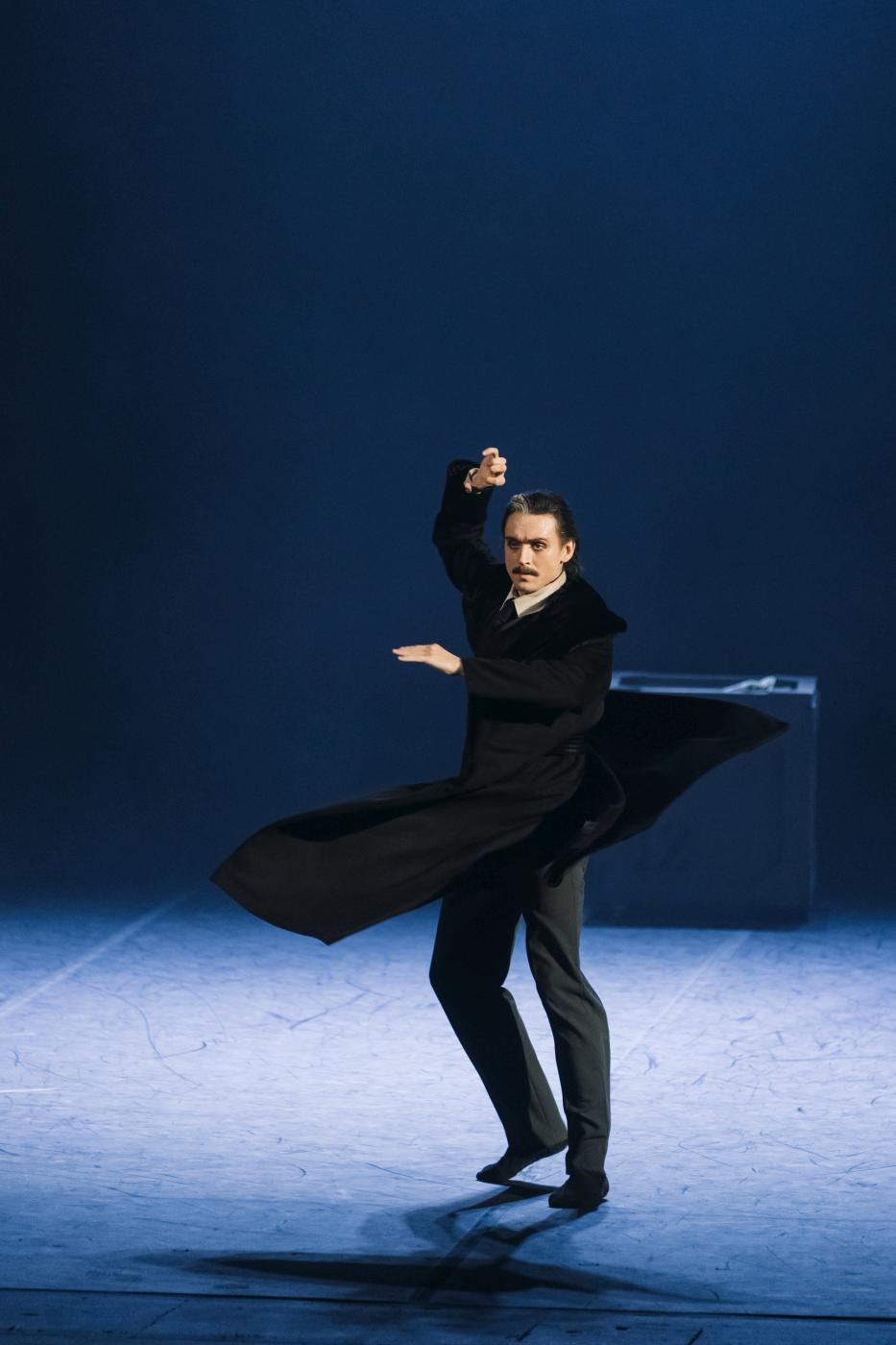
1. I.Tsvirko (Master) and M.Vinogradova (Margarita), “Master and Margarita” by E.Clug, Bolshoi Ballet 2026 © Bolshoi Theatre/D.YusupovAround two years ago, I saw Edward Clug’s ballet adaptation of Mikhail Bulgakov’s novel The Master and Margarita at the Bolshoi Theatre and found it fabulous. Last week’s two performances corroborated my impression. They also reminded me that, however chaotic the world might get, there’s no need to worry; someone is in control. In Clug’s version, it’s the Satan alias Woland and his accomplices. That hell and heaven commonly coordinate their actions went by the board.

Bulgakov intertwined two storylines (one deals with the absurd mayhem caused by Woland and his entourage on a 1930 visit to Moscow, the other is an eyewitness account of the trial of Jesus of Nazareth under Pontius Pilate’s governance), which are connected by the Master (an unrecognized Muskovit author, i.e., Bulgakov’s alter ego) and his muse, Margarita. Continue reading “Someone is in Control”
“I’m a supporter of talented people”

“Marco Spada”
Bolshoi Ballet
Bolshoi Theatre (Historic Stage)
Moscow, Russia
February 15, 2026

by Ilona Landgraf
Copyright © 2026 by Ilona Landgraf

The Bolshoi Ballet has two choreographies by Pierre Lacotte (1932-2023) in its repertory: his recreation of Petipa’s La Fille du Pharaon (which he entrusted to no other company) and Marco Spada, a 1857 ballet d’action for the Paris Opéra by Joseph Mazilier to music by Daniel Auber, which was lost except for a few sketches and reviews. In 1981, Lacotte choreographed and staged it from scratch for the Teatro Dell’Opera di Roma with Rudolf Nureyev in the title role. Despite being peripatetic, Nureyev was so eager to participate in the production that he signed a contract on the tablecloth during a restaurant outing with Lacotte. “I, Rudolf Nureyev, guarantee that for the duration of a month I will attend daily rehearsals in Rome for the ballet Marco Spada,” he wrote.

Continue reading ““I’m a supporter of talented people””

“We Need Him”

“Diaghilev”
Dancers of the Bolshoi Ballet
Bolshoi Theatre (New Stage)
Moscow, Russia
June 24, 2025 (video)

by Ilona Landgraf
Copyright © 2025 by Ilona Landgraf

1. A.Meskova (Gypsy Woman) and D.Rodkin (Sergei Diaghilev), “Diaghilev” by A.Kaggedzhi, Dancers of the Bolshoi Ballet 2025 © G.Galantnyi  2. D.Rodkin (Sergei Diaghilev), “Diaghilev” by A.Kaggedzhi, Dancers of the Bolshoi Ballet 2025 © G.Galantnyi  The man in need whom Sergei Lifar wrote about in 1939 was Sergei Diaghilev (1872-1929), impresario of the Ballets Russes and a revolutionist of ballet. Diaghilev’s burning passion to discover and promote creative beauty is unequaled. He shaped the perception of Russian culture in the West and, like a virus, changed the DNA of twentieth-century art. Without him, Vaslav Nijinsky, Tamara Karsavina, Ida Rubinstein, Feodor Chaliapin, and Igor Stravinsky wouldn’t have become known to the world, and the careers of choreographers, such as Michel Fokine, Bronislava Nijinska, Léonide Massine, and George Balanchine, might have taken another path. Ten years after Diaghilev’s death, no one had filled the void he had left behind.

Ninety-six years later, a new Diaghilev has yet to be found, but—as Russia and the West separated again—the need for a bridge-building spirit and culture that unites people across borders is more pressing than ever. That’s why Russia launched the cultural search festival We Need Diaghilev last year, which features various expositions, lectures, and performances at Russian and foreign venues. Continue reading ““We Need Him””

Brimful

“Cipollino”
Bolshoi Ballet
Bolshoi Theatre (New Stage)
Moscow, Russia
March 08, 2025 (matinee and evening performance)

by Ilona Landgraf
Copyright © 2025 by Ilona Landgraf

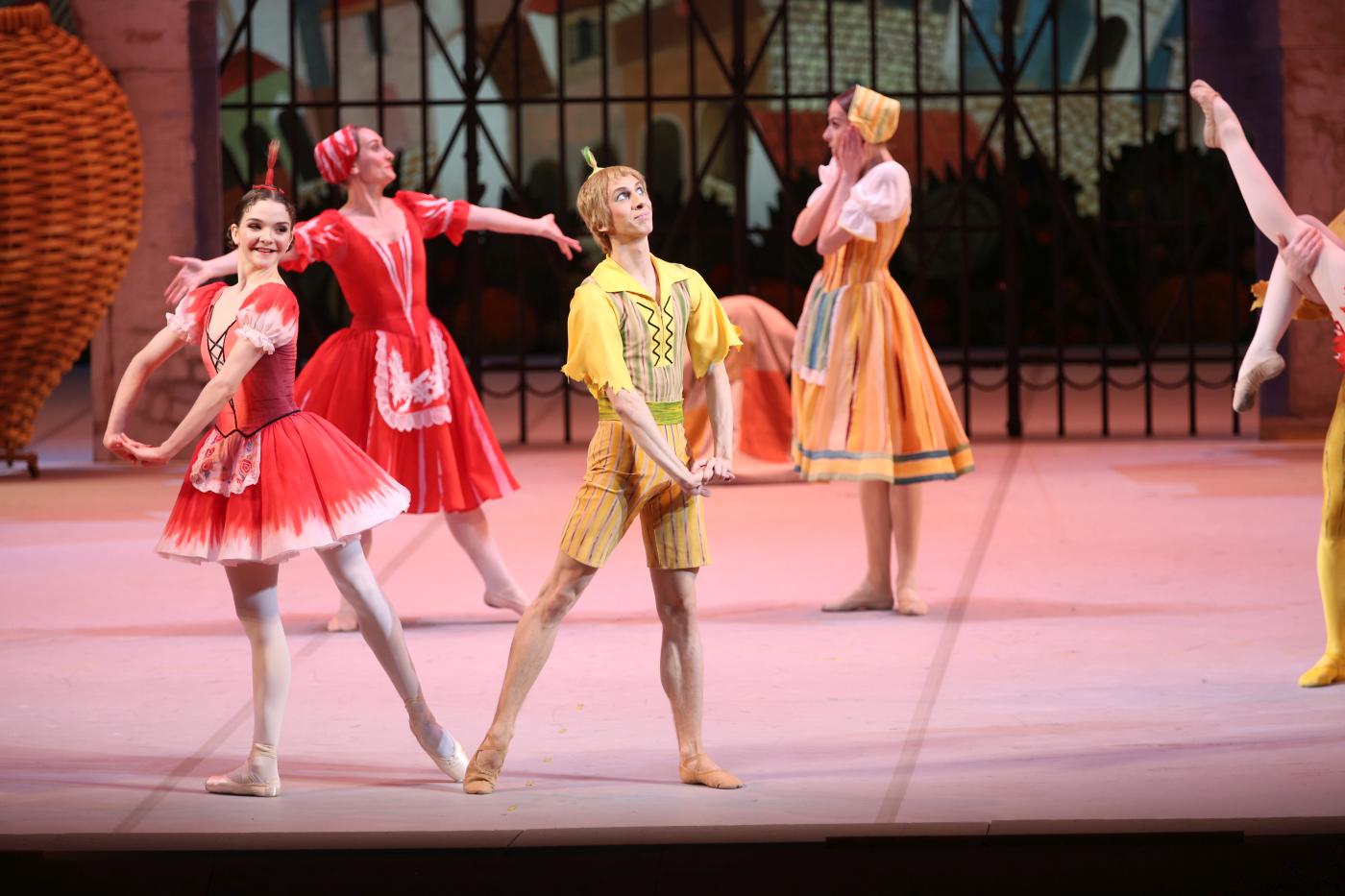
 1. S.Maymula (Little Radish), I.Sorokin (Cipollino), A.Vinokur (Mother Radish), and E.Besedina (Mother Cipolla), “Cipollino” by G.Mayorov, Bolshoi Ballet 2025 © Bolshoi Theatre/E.FetisovaThe boy Cippolino (Little Onion), the hero of Gianni Rodari’s 1957 children’s book Adventures of Cipollino, enjoyed an international career. He was especially popular in eastern countries and a famous cartoon and film figure in the Soviet Union. A ballet adaption by Genrikh Mayorov (1936-2022) entered the Bolshoi Ballet’s repertory three years after its Kiev premiere. Cipollino was revived at the Bolshoi earlier this season and still attracts crowds. Though a children’s fairy tale, adults can appreciate the production, especially when danced at top quality. I saw a matinee attended primarily by children and their parents as well as a sold-out evening performance.

The young Cipollino and his family are members of jovial townsfolk who are anthropomorphic fruits and vegetables—Cobbler Grape, Professor Pear, Godfather Pumpkin, and the Radish family, whose daughter, Little Radish, becomes Cipollino’s best buddy. They’re ruled by the high-handed, eccentric Prince Lemon whose court includes an acerbic guard, ludicrous knights, and the two overexcited Countesses Cherry. Continue reading “Brimful”

More, Please!

“Suite en blanc” / “Windgames”
Ballet Estable del Teatro Colón
Teatro Colón
Buenos Aires, Argentina
August 06, 2023 (livestream)

by Ilona Landgraf
Copyright © 2023 by Ilona Landgraf

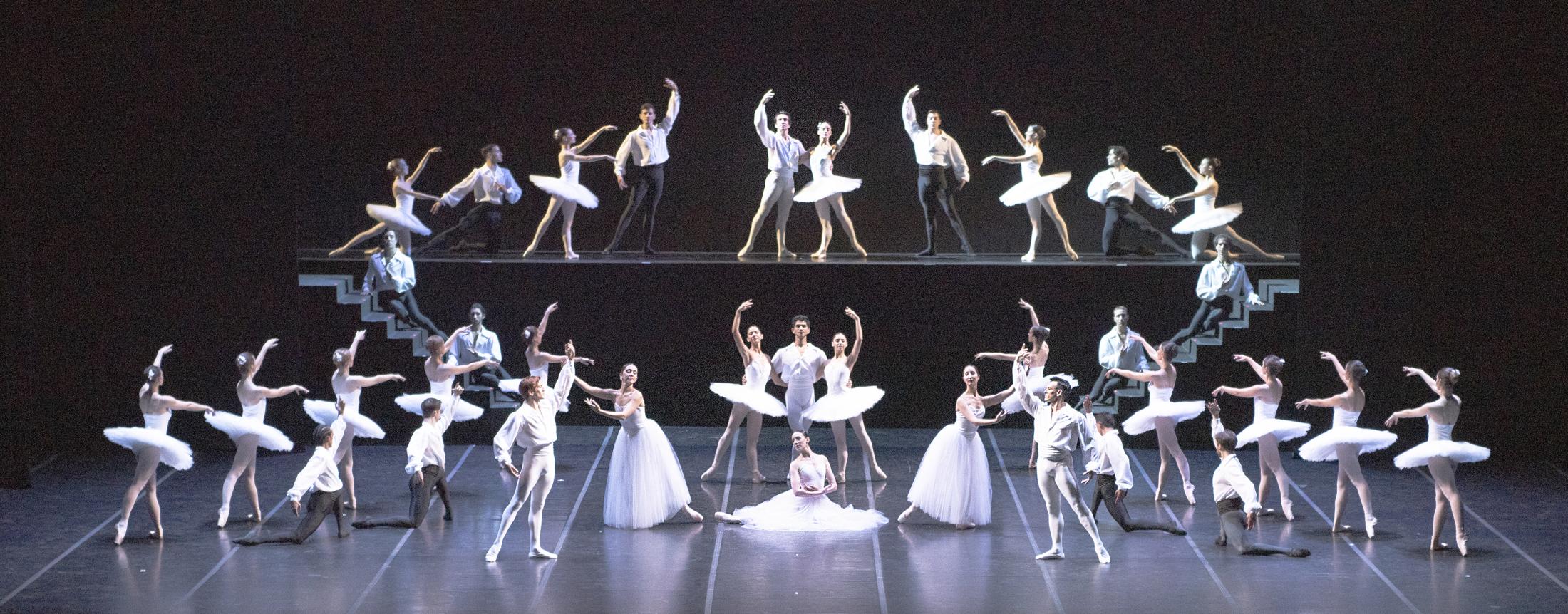
1. Ensemble, “Suite en blanc” by S.Lifar, Ballet Estable del Teatro Colón 2023 © A.Colombaroli Recently, the Teatro Colón has expanded its online program which gives me hope to watch the company more often. This Sunday, the premiere of a new double bill was streamed live. It comprised Serge Lifar’s “Suite en blanc” (1943) and Patrick de Bana’s “Windgames” (2013). Continue reading “More, Please!”

Transcendent

“The Nutcracker”
Bolshoi Ballet
Bolshoi Theatre
Moscow, Russia
December 29, 2022 (matinee and evening performance)

by Ilona Landgraf
Copyright © 2023 by Ilona Landgraf

1. V.Bessonova (Columbine), “The Nutcracker” by Y.Grigorovich, Bolshoi Ballet 2022 © Bolshoi Ballet / M.LogvinovAfter meeting him at a guest performance with Les Ballets de Monte Carlo six years ago, the Bolshoi’s Semyon Chudin suggested that I see their “Nutcracker” in Moscow. Year after year, one thing or another has prevented me from getting to the Bolshoi at Christmastime. Finally, this year, it happened: on the edge of New Year’s Eve, I watched a matinee and an evening performance.

The Bolshoi’s “Nutcracker” dates back to 1966 – qualifying it neither as trendy nor hip by today’s standards. Perhaps Makhar Vaziev, the company’s artistic director, has kept it in the repertoire for a number of reasons: out of respect for tradition; out of respect for the ballet’s choreographer – Yuri Grigorovich – one of the company’s formative figures; and out of respect for the crowd-pleasing nature of the piece that leads to sold out performances now as ever. Continue reading “Transcendent”

A Conversation With Guillaume Côté

Moscow, Russia
December 16, 2018

by Ilona Landgraf
Copyright © 2018 by Ilona Landgraf

1. G.Côté rehearsing “Frame by Frame” by R.Lepage and G.Côté, The National Ballet of Canada 2018 © The National Ballet of Canada / A.AntonijevicGuillaume Côté, principal dancer of the National Ballet of Canada, had just made his debut as a guest dancer with Moscow’s Bolshoi Ballet the previous evening, dancing Romeo in Alexei Ratmansky’s version of “Romeo and Juliet” alongside Evgenia Obraztsova. The role was originally created on Côté in 2011. We met early in the morning – a couple of hours before Côté would return to Toronto – to talk about Romeo, love, his career, and Russia. The first topic we touched upon was dance critique.
Côté’s answers are in italics. Continue reading “A Conversation With Guillaume Côté”

From “Ballet Falsity” to Long-Runner

“The Bright Stream”
Bolshoi Ballet
Bolshoi Theatre
Moscow, Russia
February 10 and 11, 2018

by Ilona Landgraf
Copyright © 2018 by Ilona Landgraf

1. Front Curtain, “The Bright Stream” by A.Ratmansky, Bolshoi Ballet © Bolshoi Theatre / D.Yusupov“The Bright Stream” was Shostakovich’s third score for ballet. After his previous ballets, “The Golden Age” (1930) and “Bolt” (1931), were banned from the stage, Shostakovich attempted to create a new composition that would please everyone. Fyodor Lopukhov (1886 – 1973) was in charge of the choreography, the libretto was by Adrian Pyotrovsky and Lopukhov, and indeed, “The Bright Stream” was enthusiastically received at its premiere in Leningrad – today’s St. Petersburg – in 1935. Continue reading “From “Ballet Falsity” to Long-Runner”

Wasted Effort?

“Gala des Étoiles”
Grand Théâtre
Luxembourg
May 20, 2017

by Ilona Landgraf
Copyright © 2017 by Ilona Landgraf

1. D.Tamazlacaru and I.Salenko / State Ballet Berlin, “Chopiniana” by M.Fokin, Gala des Étoiles 2017 © P.Abbondanza Luxembourg, one of the smallest sovereign states in Europe, has no ballet tradition. To change this is the aim of former dancer Natascha Ipatova and Georges Rischette, both founders of the Luxembourg dance school DanceXperience. This year’s two galas on May 20th and 21st mark the fifth year in succession trying to wet the Luxembourg audience’s appetite for the art form. Unlike the suggestive title of the event, no étoiles of the Paris Opera Ballet were involved. Instead, there were leading principals and their colleagues from various international companies. Continue reading “Wasted Effort?”

Real Life and Ideals – Nureyev’s “Swan Lake”

“Swan Lake”
Vienna State Ballet
Vienna State Opera
Vienna, Austria
May 14, 2017

by Ilona Landgraf
Copyright © 2017 by Ilona Landgraf

1. S.Chudin and O.Smirnova, “Swan Lake” by R.Nureyev after M.Petipa and L.Ivanov, Vienna State Ballet © Vienna State Ballet / A.Taylor “French and Russian style differ, so everything is a bit new at the moment,” Semyon Chudin told me in an interview a few weeks before his premiere in Rudolf Nureyev’s “Swan Lake” in Vienna. He and Olga Smirnova, both figureheads of the Bolshoi, guested in the leading roles with Manuel Legris’s company. I saw the first of two performances. How did they do?

Nureyev’s version differs in style, choreography and the weight given to several characters in comparison to other traditional interpretations of “Swan Lake”. The role of Benno, Prince Siegfried’s friend, is gone and, unlike in Russian productions, there is no fool either. Instead the focus shifts towards Siegfried, whom Nureyev danced more than fifty times himself; his last performance was in 1988 a few days after his 50th birthday. Nureyev’s Siegfried has more to dance – a formal Pas de cinq at his birthday party followed by a melancholy solo, for example – and allows deeper insight into his psyche. At the end he falls victim to Von Rothbart’s revenge and drowns in the floods of the lake, whereas Odette, still alive, stands at the lakeside like the idealized female. However desperately Siegfried stretches his arms towards her she is unattainable. He is doomed to die. Continue reading “Real Life and Ideals – Nureyev’s “Swan Lake””

Olga Smirnova and Semyon Chudin on “Swan Lake”

“Swan Lake”
Vienna State Ballet
Moscow / Vienna
April 28, 2017

by Ilona Landgraf
Copyright © 2017 by Ilona Landgraf

1. S.Chudin and O.Smirnova, “Swan Lake” by Y.Grigorovich after M.Petipa, L.Ivanov and A.Gorsky, Bolshoi Ballet © Bolshoi Theatre / D.YusupovIn mid-May Vienna State Ballet revives Rudolf Nureyev’s “Swan Lake,” the version he choreographed for the company in 1964. The new set and costumes are by Luisa Spinatelli. Four guest dancers will take the leading roles in the course of the run. The Bolshoi’s Olga Smirnova and Semyon Chudin dance twice, on May 14th and 17th; on June 4th Marianela Nuñez and Vadim Muntagirov of The Royal Ballet guest in Vienna. The last performance on Monday, June 12th, will be streamed live on the internet.

While “Swan Lake” is Smirnova’s debut in Vienna, Chudin returns for the third time to the Austrian capital. Two weeks before opening night I asked both about their roles and about Nureyev’s production in particular. Smirnova, who at that time was in Moscow, answered in written form. Katerina Novikova, head of the Bolshoi’s press office, kindly translated Smirnova’s answers into English. Chudin, already rehearsing with the company in Vienna, talked with me via Skype. Continue reading “Olga Smirnova and Semyon Chudin on “Swan Lake””

Bringing “Onegin” Home

“Onegin”
Bolshoi Ballet
Bolshoi Theatre
Moscow, Russia
March 10, 2017

by Ilona Landgraf
Copyright © 2017 by Ilona Landgraf

1. A.Tikhomirova, S.Chudin and ensemble, “Onegin” by J.Cranko, Bolshoi Ballet © Bolshoi Theatre / D.Yusupov“John is here” is a well-known saying within the walls of Stuttgart Ballet. People know what they are talking about. Ever since his untimely death more than forty years ago John Cranko’s spirit has energized his Stuttgart company.
Yet last weekend his presence was strongly palpable elsewhere. The Bolshoi performed his “Onegin” on three consecutive evenings at home in Moscow. On first night not only Cranko seemed close but also Reid Anderson, who had supervised the production at the Bolshoi in 2013, and Jürgen Rose, whose costumes and set design are unvaryingly matchless. The Bolshoi Theatre and Stuttgart State Opera merged into one house on this Friday evening uniting their powers in a performance of overwhelming intensity. Continue reading “Bringing “Onegin” Home”

A Dutch Program at the Bolshoi

“Frank Bridge Variations / Short Time Together / Symphony of Psalms”
Bolshoi Ballet
Bolshoi Theatre
Moscow, Russia
March 02, 2017

by Ilona Landgraf
Copyright © 2017 by Ilona Landgraf

1. D.Rodkin and E.Shipulina, “Frank Bridge Variations” by H.van Manen, Bolshoi Ballet 2017 © M.Logvinov / Bolshoi TheatreReading the names of choreographers Hans van Manen, Paul Lightfoot and Jiří Kylián as part of the same program one immediately thinks of a performance in Amsterdam or Den Haag, or maybe also in Germany. Yet this triple bill was the Bolshoi’s. It’s a menu that’s not quite so familiar for the Moscow audience. Applause was respectable, though not overwhelming. The dancers, however, were in great shape! Continue reading “A Dutch Program at the Bolshoi”

Grigorovich’s “Giselle”

“Giselle”
Bolshoi Ballet
Bolshoi Theatre
Moscow, Russia
February 18 / 19, 2017

by Ilona Landgraf
Copyright © 2017 by Ilona Landgraf

1. O.Smirnova and S.Chudin, “Giselle” by Y.Grigorovich after J.Coralli, J.Perrot and M.Petipa, Bolshoi Ballet 2017 © Bolshoi Theatre / E.Fetisova“Giselle” is in the core repertory of almost every ballet company, whether in a modern interpretation or a traditional one. The Bolshoi even holds two traditional versions, one by Yuri Grigorovich, the other by Vladimir Vasiliev. Vasiliev’s 1997 “Giselle” follows the earlier versions of Leonid Lavrovsky and Alexander Gorsky. Earlier in 1987 Grigorovich had instead traced the choreographic lineage directly via Marius Petipa to Jules Perrot and Jean Coralli’s 1841 original. In honor of the 90th anniversary of Grigorovich’s birth, the Bolshoi presented three performances of his “Giselle” as part of the Grigorovich ballet festival, of which I saw two matinées with different casts. Continue reading “Grigorovich’s “Giselle””

Olga Smirnova on “The Sleeping Beauty”

“The Sleeping Beauty”
Bolshoi Ballet
Bolshoi Theatre
Moscow, Russia
January 17, 2017

by Ilona Landgraf
Copyright © 2017 by Ilona Landgraf

1. I.Alexeyev, O.Smirnova, A.Belyakov and ensemble, “The Sleeping Beauty” by Y.Grigorovich after M.Petipa, Bolshoi Ballet © D.Yusupov 2017This Sunday, on January 22nd, the Bolshoi Ballet will stream “The Sleeping Beauty” live to cinemas all over the world. It is the Petipa-based version that Yuri Grigorovich created in 2011 for the re-opening of the Bolshoi’s historic stage which has lavish set designs by Ezio Frigerio and equally sumptuous costumes by Franca Squarciapino. Sunday’s cast includes Olga Smirnova as Princess Aurora alongside Semyon Chudin as her Prince. As the Lilac Fairy, Yulia Stepanova will counter Alexei Loparevich’s Carabosse.
I skyped with Olga Smirnova a few days prior to the cinema broadcast to talk about the piece and her role. Katerina Novikova, head of the Bolshoi’s press office, kindly interpreted from the Russian. Smirnova’s responses are in italics. Continue reading “Olga Smirnova on “The Sleeping Beauty””