Harmony Born From Love

“The Sleeping Beauty”
Bolshoi Ballet
Bolshoi Theatre
Moscow, Russia
November 3, 2026 (Historic Stage)

by Ilona Landgraf
Copyright © 2026 by Ilona Landgraf
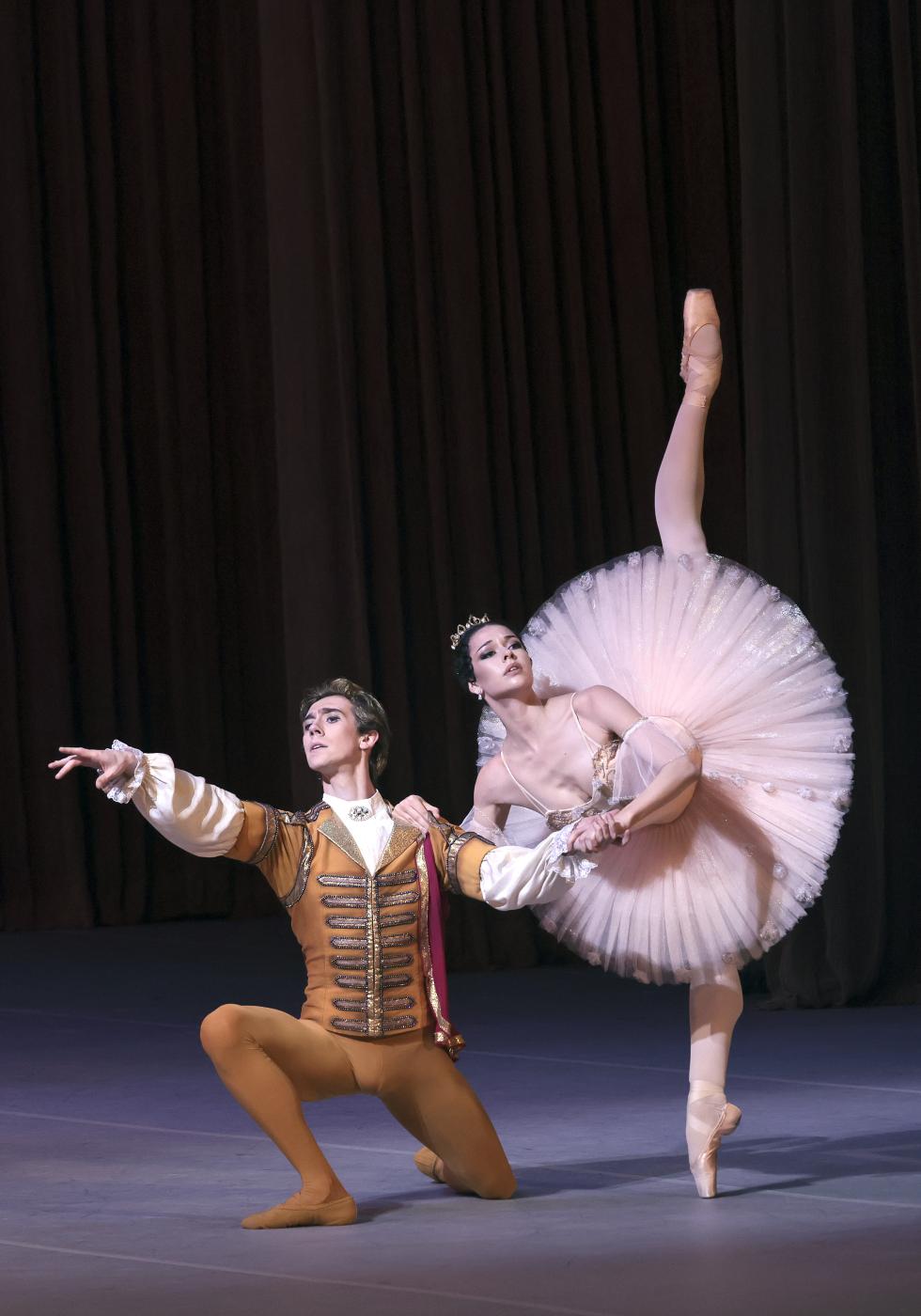
1. D.Vyskubenko (Prince Désiré) and M.Koshkaryova (Princess Aurora), “The Sleeping Beauty” by Y.Grigorovich, Bolshoi Ballet 2026 © Bolshoi Theatre/D.YusupovOnly as I sat in the Bolshoi Theatre’s auditorium did I realize that this was my first time seeing Yuri Grigorovich’s The Sleeping Beauty live. A 2017 live stream was impressive, but Ezio Frigerio’s and Franca Squarciapino’s opulent set and costumes distracted from the piece’s essence: the awakening of an inner beauty. Of all the choreographies of The Sleeping Beauty I know, Grigorovich’s most successfully projects spirituality.
In 2024, the Bolshoi revived the far more restrained décor of Simon Virsaladze created for Grigorovich’s revised 1973 version of The Sleeping Beauty. It was streamed live at the season’s opening. But on screen, a ballet looks different.
For example, during the live stream, I didn’t notice the frame of green-gray legs turning the stage into a peep-box to a fairy realm. I also missed the effect of the backdrops’ loose brushstroke technique. The palace garden’s hazy vegetation offers nothing that sticks in the mind. One doesn’t think much about the staircase beyond that it leads somewhere pleasant. The mysterious lake in the forest hints at depths our consciousness does not plumb.

Taken together, the set, the Historic Stage’s enormous breadth, and the decorum and grace at court induce an inner calm that allows true beauty to reach the soul. It happens subtly with Princess Aurora’s awakening. Tchaikovsky’s brisk prologue heightens anticipations for a fabulous dance piece.
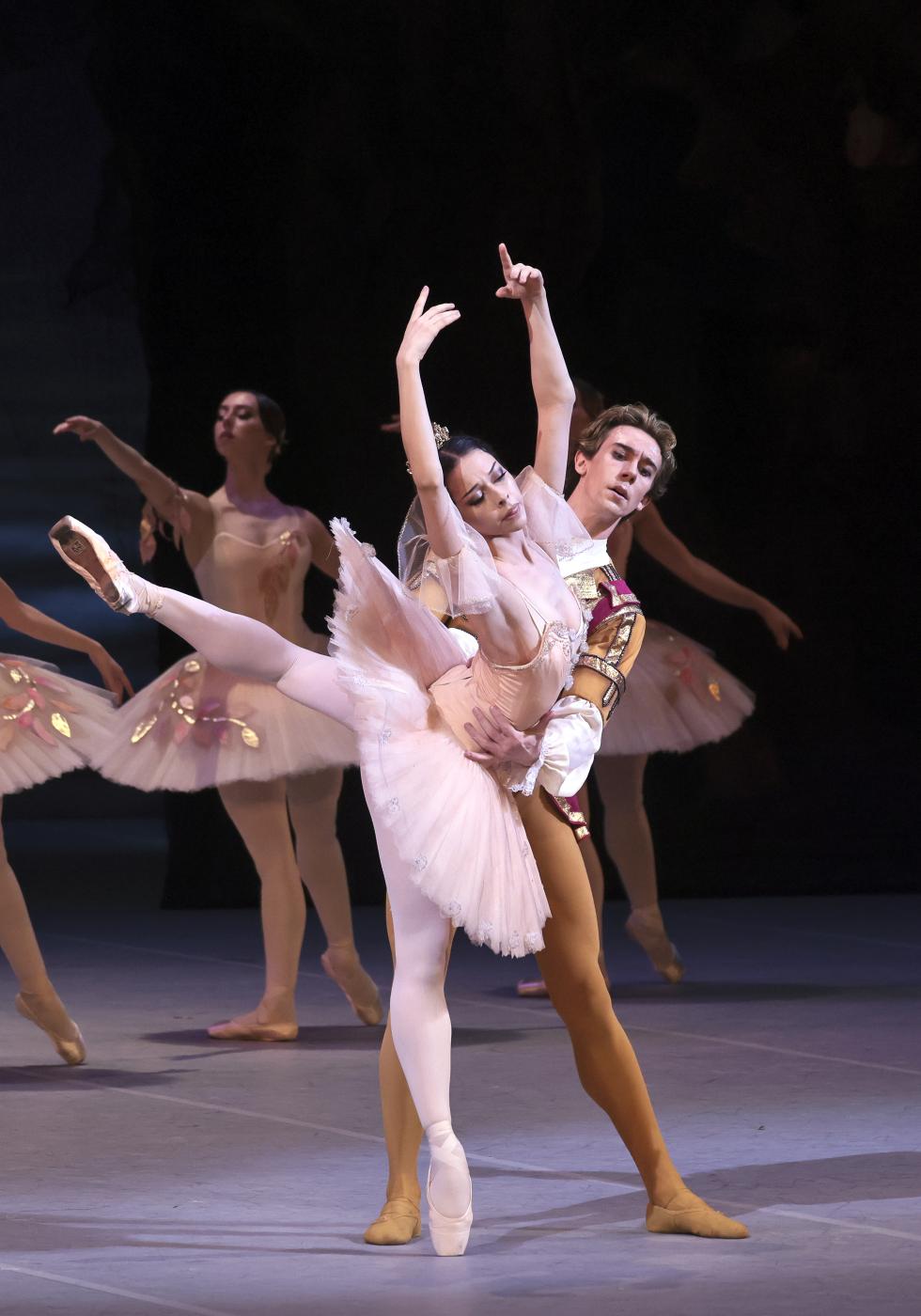
2. D.Vyskubenko (Prince Désiré) and M.Koshkaryova (Princess Aurora), “The Sleeping Beauty” by Y.Grigorovich, Bolshoi Ballet 2026 © Bolshoi Theatre/D.Yusupov Maria Koshkaryova’s Princess Aurora was a graceful, delicate young woman with innate modesty. Glamour wasn’t part of her character. As she played with the spindle presented to her by the wicked Carabosse (Gennady Yanin), the entire court watched her as though she carried a defused bomb. High flying grand jetés carried Prince Désiré (Dmitry Vyskubenko) on stage (Prince Siegfried in Grigorovich’s Swan Lake enters in the same sweeping way). Vyskubenko has elegant lines, excellent jumps, and a likable nature. His performance was polished to perfection. In the hunting scene, each step of his solo spoke to the superb coaching he went through.
Alyona Kovalyova’s mature Lilac Fairy stood above all evil. Her calm and unwavering kindness reduced Carabosse to an incorrigible (but manageable) troublemaker. Except for Angelina Vlashinet’s Fairy of Audacity, the good fairies who bestowed their well-wishes on the newborn Aurora exaggerated their characters. Yuri Ostrovsky, whom I often saw in the role of a churchman, played Catalabutte, the Master of Ceremonies who hardly ever got it right.
Of the fairy tale characters, I especially liked Makar Mikhalkin’s powerfully soaring Blue Bird. Anastasia Smirnova was his lightweight Princess Florine.
The star of the evening was the corps whose perfect lines enraptured me. Regardless of the pace, their unity in the vision scene was impeccable and surpassed everything I’ve seen elsewhere.
The Bolshoi Orchestra played under the baton of Pavel Sorokin and was, as always, outstanding.

Link: Website of the Bolshoi Theatre
Photos: 1. Dmitry Vyskubenko (Prince Désiré) and Maria Koshkaryova (Princess Aurora), “The Sleeping Beauty” by Yuri Grigorovich, Bolshoi Ballet 2026
2. Dmitry Vyskubenko (Prince Désiré) and Maria Koshkaryova (Princess Aurora), “The Sleeping Beauty” by Yuri Grigorovich, Bolshoi Ballet 2026
all photos © Bolshoi Theatre/Damir Yusupov
Editing: Kayla Kauffman


Selective

“More Than Theater: Celebrating the 250th Anniversary of the Bolshoi Theatre”
Museum of Contemporary Russian History
Moscow, Russia
November 1, 2026

by Ilona Landgraf
Copyright © 2026 by Ilona Landgraf

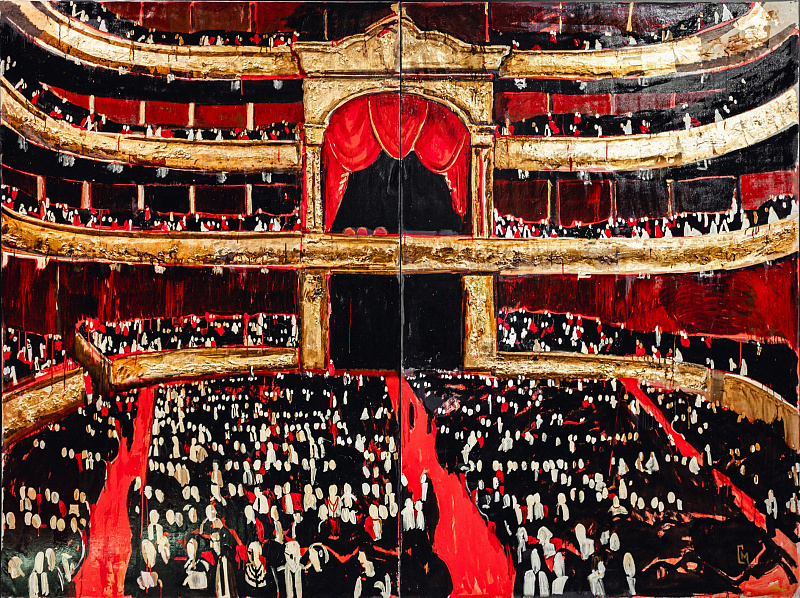
1. Maria Suvorova, “The Greatest Theater” © MustART GalleryThe announcement of a large-scale exhibition to celebrate the Bolshoi Theatre’s 250th birthday made me reflect on the period from 1776 (when Empress Catherine the Great granted Prince Pyotr Urusov permission to establish a theater company in Moscow, the Bolshoi Theatre’s predecessor) to today, admittedly, a gigantic undertaking. But, after all, the Bolshoi is Russia’s most prestigious theater.

But the Museum of Contemporary Russian History’s exhibition More Than Theater takes a different approach. In collaboration with Moscow’s private MustART Gallery, the museum assigned sixteen contemporary Russian artists to “unravel the Bolshoi’s stage’s captivating and infinite mystery.” It is questionable whether the paintings, drawings, sculptures, and installations to which the theater added archived video performances achieved this goal. Many of the works show past and present artists, but the selection criteria remained unclear. I didn’t count the objects but had the impression that the ballet company was better represented than the opera company. Continue reading “Selective”

First Time

“Cinderella”
Bolshoi Ballet
Bolshoi Theatre
Moscow, Russia
September 05, 2026 (Historic Stage)

by Ilona Landgraf
Copyright © 2026 by Ilona Landgraf

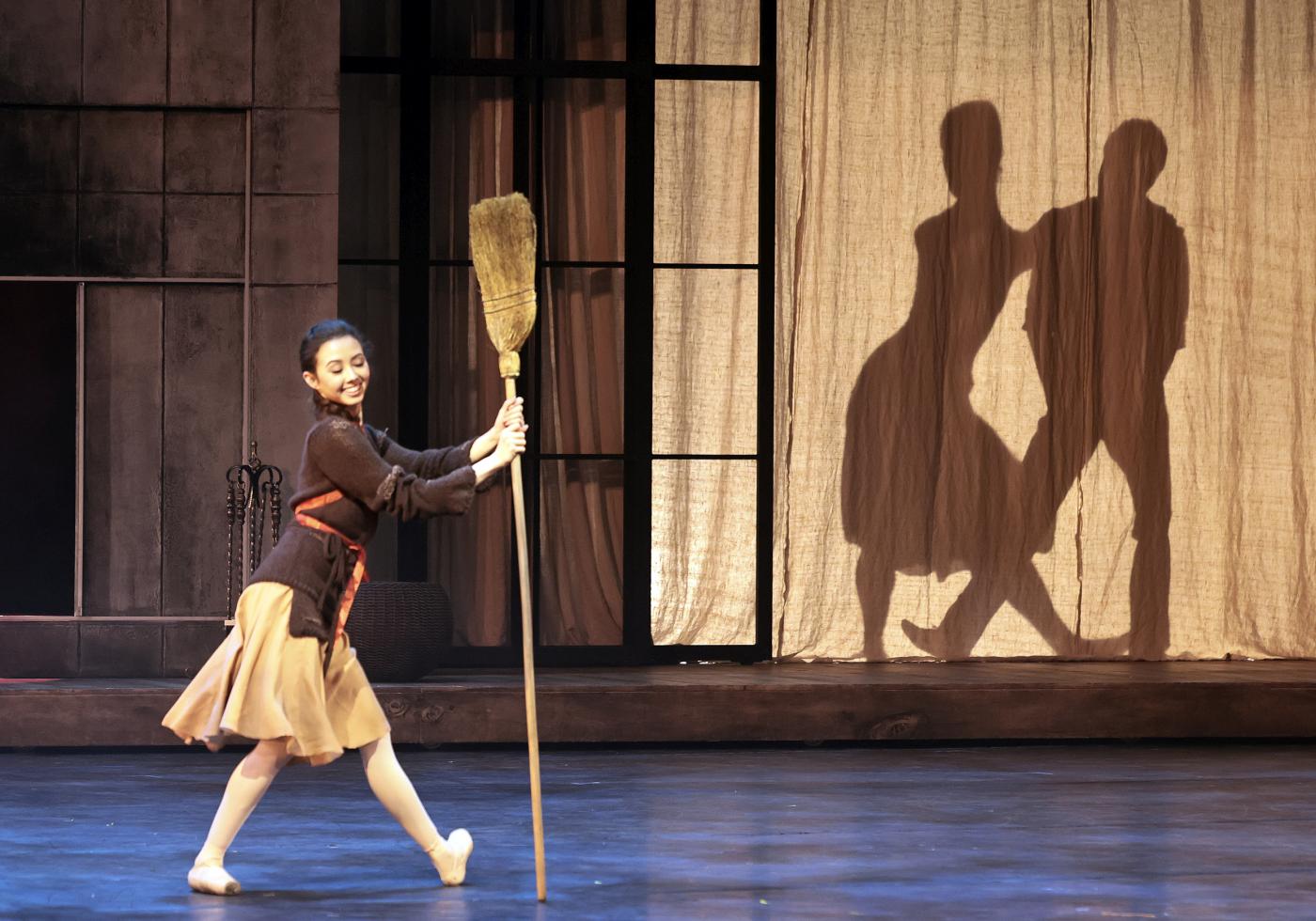
1. E.Kokoreva (Cinderella), “Cinderella” by V.Lopatin, Bolshoi Ballet 2026 © Bolshoi Theatre/D.YusupovOf the two Cinderellas that premiered last May on major Russian stages in celebration of Sergei Prokofiev’s 135th birthday anniversary, I saw Nadezha Kalinina’s version for the Kazan Ballet a few weeks later on video. With some delay, I got to know Vyacheslav Lopatin’s Cinderella for the Bolshoi Ballet last Saturday during the new season’s opening matinee. Lopatin, principal of the company and fledgling ballet master, had never choreographed before. Giving his debut with no less than a full-blown production was due to the artistic director’s, Makhar Vaziev’s, encouragement and support. The outcome isn’t (and realistically couldn’t be) mind-boggling, but it is respectable.

Continue reading “First Time”

An Opening Salute

“The Sleeping Beauty”
Bolshoi Ballet
Bolshoi Theatre
Moscow, Russia
September 07, 2024 (live stream)

by Ilona Landgraf
Copyright © 2024 by Ilona Landgraf

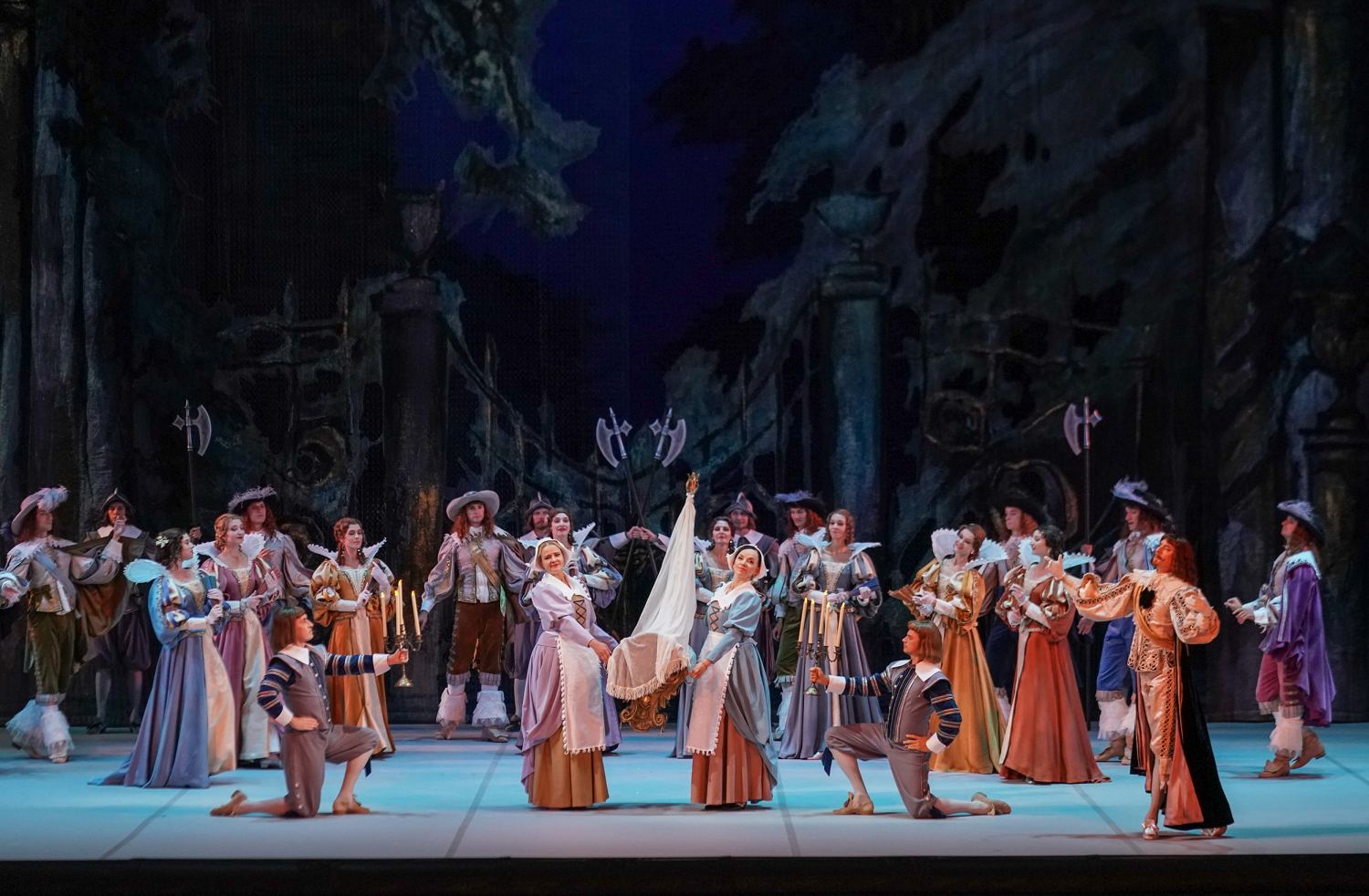
 1. Y.Ostrovsky (Catalabutte) and ensemble, “The Sleeping Beauty” by Y.Grigorovich after M.Petipa, Bolshoi Ballet 2024 © Bolshoi Theatre/P.Rychkov The Bolshoi Ballet opened its 249th season with a revival of Yuri Grigorovich’s The Sleeping Beauty, which has been absent from the stage for four years. Because of the thorough change of décor, the production was announced as a premiere. It swapped the opulent (and often criticized) sets and costumes that Ezio Frigerio and Franca Squarciapino designed for the 2011 revival (celebrating the reopening of the theater’s Historic Stage after six years of refurbishment) for the restrained décor that Simon Virsaladze (1909–1989) created for Grigorovich’s second version of the ballet in 1973. The subdued hues and aquarelle-ish style of its courtly surroundings direct the gaze toward the colorful costumes (recalling French court fashion from King Louis XIII’s to the Sun King, Louis XIV’s, reign), beautiful flower garlands and bouquets at Aurora’s birthday party, and, most importantly, the dancers and their performances. Raising the curtain didn’t elicit oohs and aahs from the audience as, for example, Jürgen Rose’s décor for Marcia Haydée’s Sleeping Beauty regularly has done on Western stages. Continue reading “An Opening Salute”

Reassuring

“Chopiniana”/“Grand Pas from the Ballet Paquita”
Bolshoi Ballet
Bolshoi Theatre (Historic Stage)
Moscow, Russia
February 14, 2024

by Ilona Landgraf
Copyright © 2024 by Ilona Landgraf

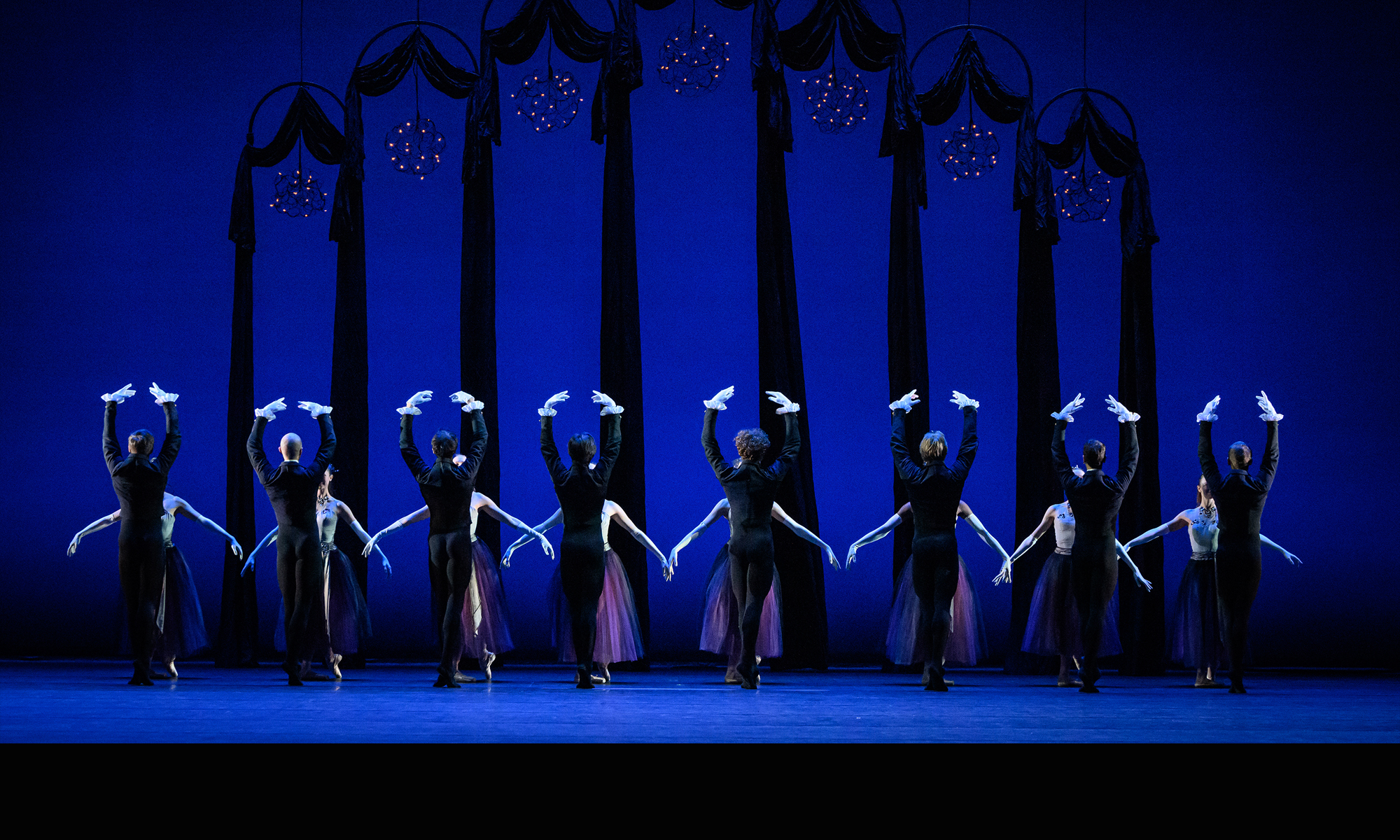
 1. A.Denisova, “Chopiniana” by M.Fokine, Bolshoi Ballet 2024 © Bolshoi Ballet / D.Yusupov The musicians of the Bolshoi Orchestra are on their toes. After acknowledging the welcoming applause, conductor, Pavel Klinichev, raised his baton in the same instant that he turned around to face them. The vigorous bars that he prompted belonged to a Polonaise by Chopin. It opened Mikhail Fokine’s romantic Chopiniana (1908), which the Bolshoi Ballet revived in November 2022. It’s the first part of a double bill the second piece of which – the Grand Pas from Petipa’s Paquita – has been a landmark of classical dance since its creation in 1881.

There’s no need to discuss how Fokine’s choreography was performed. The Bolshoi is a guarantor of sublime performances. Indeed, the unity of the corps was nothing less than staggering; every step was measured yet effortless like an outpouring of natural decency. Perfect proportions soothed the eye. As the leading sylphs, Anastasia Stashkevich, Elizaveta Kruteleva, and Anastasia Denisova paid great attention to detail, adding the right tinge of buoyancy, melancholy, or playfulness to their solos. Vyacheslav Lopatin’s poet combined sensitivity and decisiveness. His clean and – at times mighty – jumps earned applause. Alyona Pikalova’s set design – an arch of gnarled treetops opening onto a sunny water meadow – invited the mind to dream.
I’ve watched several companies dance Chopiniana, but no performance was as complete as the Bolshoi’s. Perhaps due to experiencing messy times in my home country of Germany (and in the West in general), the refined order and serenity of Chopiniana felt especially comforting. It seemed like the epitome of civilization. Continue reading “Reassuring”