A Ballet Onion

“Ma Bayadère”
Les Ballets de Monte-Carlo
Forum Ludwigsburg
Ludwigsburg, Germany
July 24, 2026

by Ilona Landgraf
Copyright © 2026 by Ilona Landgraf
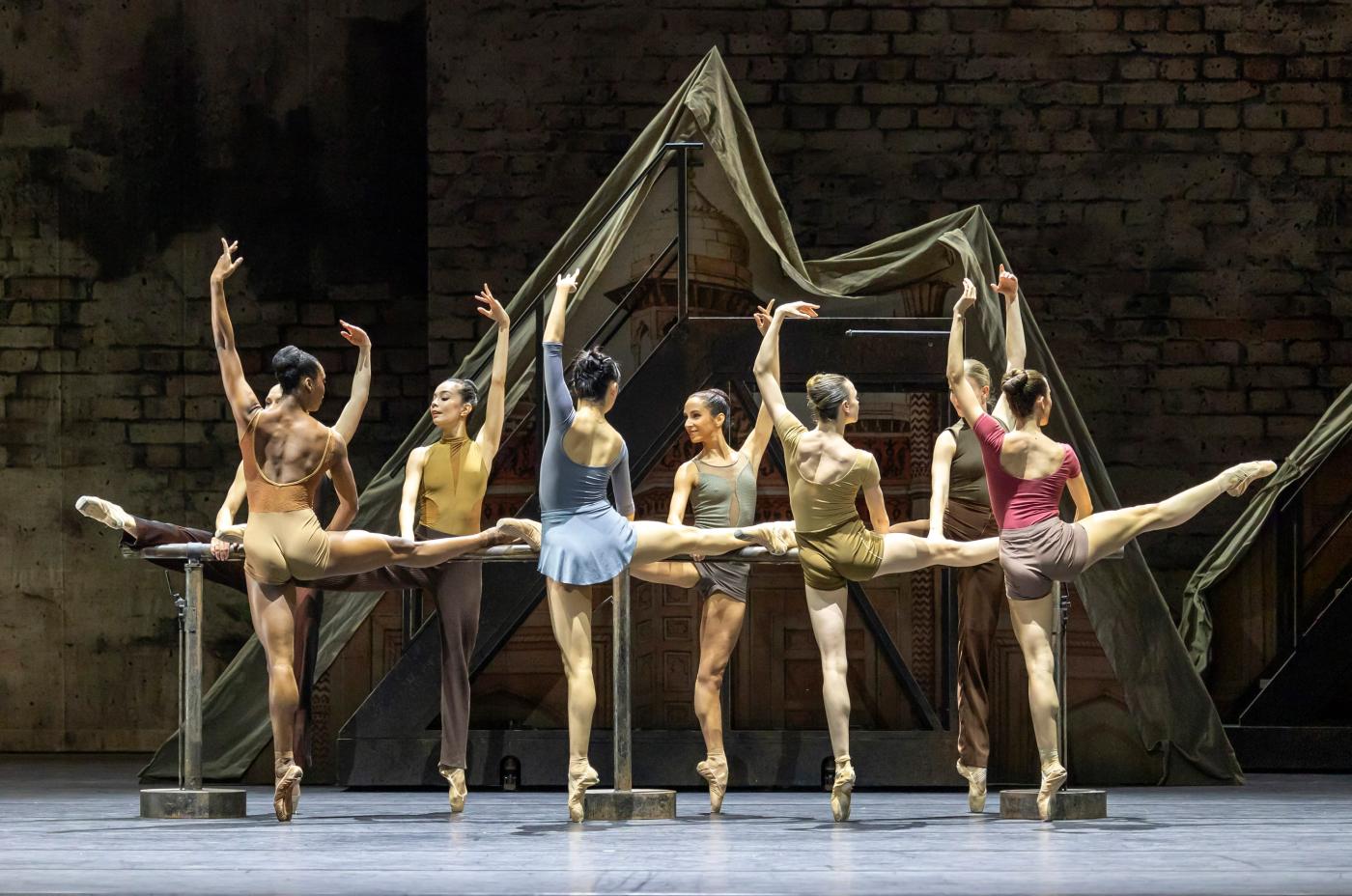
1. Ensemble, “Ma Bayadère” by J.-C.Maillot, Les Ballets de Monte-Carlo 2026 © H.GerritsenThe pronoun Ma in Les Ballets de Monte-Carlo’s 2025 Ma Bayadère is a clever modification. It allows the ballet’s creator, artistic director Jean-Christophe Maillot, to twist and mock Petipa’s La Bayadère with impunity while also advertising his brand. Ma Bayadère is like an onion of correlating layers. Like previous productions by Maillot, it reinterprets ballet history. Last weekend, the audience of the annual Ludwigsburg Festival had the opportunity to watch the German premiere of Ma Bayadère at the Ludwigsburg Forum.

Maillot transforms Petipa’s Indian Rajah from a palace ruler to a company’s choreographer who dances the role of the Rajah in his own La Bayadère. Niki, Gamza, and Solo are dancers of his company and prepare for the roles of the temple dancer, Nikiya, the Rajah’s daughter, Gamzatti, and the warrior, Solor, respectively. Instead of the temple’s High Brahmin, Maillot employed Brahma, Rajah’s ballet master. Still, the main plot revolves around the heroes’ melodramatic love story. Many references to ballet classics and a great dose of satire add complexity.
3. J.Benoot (Rajah), R.Contreras (Gamza), I.Cornelis (Solo), and ensemble; “Ma Bayadère” by J.-C.Maillot, Les Ballets de Monte-Carlo 2026 © A.Blangero2. R.Contreras (Gamza), “Ma Bayadère” by J.-C.Maillot, Les Ballets de Monte-Carlo 2026 © A.BlangeroThe score combines 1994 and 2018 versions of Léon Minkus’s composition (played by the English Chamber Orchestra and the Evergreen Symphony Orchestra) and additional music by Maillot’s brother Bertrand. By highlighting iconic passages and rearranging others, it refreshes any well-conditioned ear.

Ma Bayadère tricks the mind right away. One might think that the dancers take a warm-up barre class on stage while the audience takes their seats due to improvisation on tour. But no, the show has already begun and will soon transition from reality into a play within a play. But first, chief ballet mistress, Bernice Coppieters, must leave the stage and take a seat next to Maillot in the audience. Then the lights were dimmed.

4. R.Contreras (Gamza) and I.Cornelis (Solo), “Ma Bayadère” by J.-C.Maillot, Les Ballets de Monte-Carlo 2026 © A.Blangero 5. J.Klein (Niki), “Ma Bayadère” by J.-C.Maillot, Les Ballets de Monte-Carlo 2026 © H.GerritsenChatting, the dancers returned on stage in beige training gear while stagehands reassembled Jérôme and Paul Kaplan’s set elements at the gloomy backstage. The planked rears did not reveal their La Bayadère origin. After assembling for a group photo, the dancers took the costumes Jaat Benoot’s imposing Rajah had allocated to them from two racks on either side. A tall figure, he dominated the scene like a monolith. As if measuring his terrain, his palms sensed the floor’s vibes, his arms dissected the space, and his firm steps segmented the area. His movements switched from angular to supple at the flick of a switch. When his creative mind got stuck, his company doubled down on their efforts. Their group dances swept through the backstage like a fresh breeze. Rehearsals in costume (among others from the Danse infernale, Maillot borrowed from Alexei Ratmansky’s reconstruction of La Bayadère) blurred the line between performance and rehearsal.

6. J.Benoot (Rajah), R.Contreras (Gamza), and ensemble; “Ma Bayadère” by J.-C.Maillot, Les Ballets de Monte-Carlo 2026 © A.BlangeroUsually a second-row bystander, Brahma (Michele Esposito) assisted Rajah with choreographic trifles (such as turning a supporting hand from its back to the palm). Like his counterpart in La Bayadère, his unrequited love for Niki (Juliette Klein) corrupted him. However, despite his snake-green outfit (costumes also by Jérôme and Paul Kaplan), he was not thoroughly bad. Instead, suppressed emotions made him weird at times.

Niki had just joined the company and attracted several men, though she looked and behaved like a shrinking violet. Her favorite place was the barre to which she clung in any way possible. Eager to observe and imitate Gamza (Romina Contreras), an étoile with a diva’s airs and graces and Rajah’s favorite, she craned her neck so as not to miss a step. When tentatively touching her tutu, Niki reminded me of Giselle, who subserviently admired Bathilde’s dress.

7. I.Cornelis (Solo), and ensemble, “Ma Bayadère” by J.-C.Maillot, Les Ballets de Monte-Carlo 2026 © A.BlangeroWhether dancing alone or partnered with the male star, Solo (Ige Cornelis), the seasoned Gamza, pulled off a perfect show at the push of a button (surprisingly, she also shuffled and kicked like a washerwoman when mad as hell). Her arms briefly resembled Odile’s; her body clung to Solo’s as if she were Juliet in the balcony scene; her red tutu looked like Kitri’s, while she was actually preparing for Gamzatti. That Solo’s hands electrified her body wasn’t due only to stage chemistry but also to an intimacy that extended beyond the stage. However, an Albrecht by character, Solo fell in love with Niki at first sight (and vice versa). His friend, Magda’s (Francesco Resch) fondness for her also caused tension. Because of his female name and the white shawl he later delivered to Solo, Magda made me think of La Sylphide’s Madge.

8. J.Klein (Niki), I.Cornelis (Solo), J.Benoot (Rajah), and ensemble; “Ma Bayadère” by J.-C.Maillot, Les Ballets de Monte-Carlo 2026 © H.GerritsenDid Brahma hope to undermine Solo’s and Niki’s romance when encouraging her to apply for the role of Gamzatti in the upcoming La Bayadère or did he want to promote her career? In any case, he caused a nasty catfight. Unlike Gamza, who performed all the more brilliantly under pressure, Niki could not rein in her inner life while dancing before Rajah. Being desperately jealous could have deepened her variation with the flower basket, but she wallowed in her emotions and stopped dancing. Funnily enough, Solor’s turban substituted for the flower basket with the serpent. Meanwhile, the tragedy neared its climax. Niki lost control of her rage, her pointe shoes pummeled the floor, thunder rolled, and she hastened up a backstage staircase and fell.
Aghast glances spread, awkward uncertainty arose, and the curtain closed.

9. I.Cornelis (Solo), J.Klein (Niki), R.Contreras (Gamza), and ensemble; “Ma Bayadère” by J.-C.Maillot, Les Ballets de Monte-Carlo 2026 © H.Gerritsen Although this was a standard theater exit, the downfall was an effective cliffhanger. When the curtain rose again, Niki’s corpse was carried on stage. Nevertheless, the show had to go on. The sets for a small-stage La Bayadère were lowered, the Golden Idol performed his solo, and the confused Solo was ushered into his costume. But when he balked at the sight of Gamza(tti) and the second cast of Nikiya (Ashley Krauhaus), the performance went awry. Gamza ripped the white shawl that had covered the corpse from Solo’s hand, put it around her shoulders, and strutted off. Alone with the dead, Solo knelt under a spotlight as glaring as the insight that seemed to strike him.

11. I.Cornelis (Solo) and J.Klein (Niki), “Ma Bayadère” by J.-C.Mailot, Les Ballets de Monte-Carlo 2026 © H.Gerritsen10. I.Cornelis (Solo), J.Klein (Niki), R.Contreras (Gamza), and ensemble; “Ma Bayadère” by J.-C.Maillot, Les Ballets de Monte-Carlo 2026 © A.BlangeroWithin his psychedelic dream, Niki came alive in Act II’s cloudy, snow-covered Olympian heights. She appeared from behind the central mountain, pointing toward Solo with one hand and covering an eye with the other as if to symbolize the Holy Trinity’s all-seeing eye. His fellow dancers, visible only up to their shoulders, descended smoothly from mountains on either side as if delivered by invisible escalators (the repeated arabesque phrase of the Entrance of the Shades therefore became obsolete). First crouching in a semi-circle with their backs toward the audience, then turning onto their bellies with their hands supporting the heads like putti, they framed the love, peace, and harmony-reunion of Solo, Niki, and Gamza. It culminated in a kiss between the two women, snubbing the men. The atmosphere turned festival-esque when the Kingdom of the Shades’ waltzes adopted a rollercoaster-like momentum. From there, the piece gradually zapped back to reality. Solo found himself alone with Niki’s corpse. One curtain later, the company posed, mimicking the opening scene. Then the final curtain fell.

Links: Website of the Forum Ludwigsburg
Website of Les Ballets de Monte-Carlo
Creation of Ma Bayadère (video)
Photos: 1. Ensemble, “Ma Bayadère” by Jean-Christophe Maillot, Les Ballets de Monte-Carlo 2026 © Hans Gerritsen
2. Romina Contreras (Gamza), “Ma Bayadère” by Jean-Christophe Maillot, Les Ballets de Monte-Carlo 2026 © Alice Blangero
3. Jaat Benoot (Rajah), Romina Contreras (Gamza), Ige Cornelis (Solo), and ensemble; “Ma Bayadère” by Jean-Christophe Maillot, Les Ballets de Monte-Carlo 2026 © Alice Blangero
4. Romina Contreras (Gamza) and Ige Cornelis (Solo), “Ma Bayadère” by Jean-Christophe Maillot, Les Ballets de Monte-Carlo 2026 © Alice Blangero
5. Juliette Klein (Niki), “Ma Bayadère” by Jean-Christophe Maillot, Les Ballets de Monte-Carlo 2026 © Hans Gerritsen
6. Jaat Benoot (Rajah), Romina Contreras (Gamza), and ensemble; “Ma Bayadère” by Jean-Christophe Maillot, Les Ballets de Monte-Carlo 2026 © Alice Blangero
7. Ige Cornelis (Solo), and ensemble, “Ma Bayadère” by Jean-Christophe Maillot, Les Ballets de Monte-Carlo 2026 © Alice Blangero
8. Juliette Klein (Niki), Ige Cornelis (Solo), Jaat Benoot (Rajah), and ensemble; “Ma Bayadère” by Jean-Christophe Maillot, Les Ballets de Monte-Carlo 2026 © Hans Gerritsen
9. Ige Cornelis (Solo), Juliette Klein (Niki), Romina Contreras (Gamza), and ensemble; “Ma Bayadère” by Jean-Christophe Maillot, Les Ballets de Monte-Carlo 2026 © Hans Gerritsen
10. Ige Cornelis (Solo), Juliette Klein (Niki), Romina Contreras (Gamza), and ensemble; “Ma Bayadère” by Jean-Christophe Maillot, Les Ballets de Monte-Carlo 2026 © Alice Blangero
11. Ige Cornelis (Solo) and Juliette Klein (Niki), “Ma Bayadère” by Jean-Christophe Maillot, Les Ballets de Monte-Carlo 2026 © Hans Gerritsen
Editing: Kayla Kauffman


Growing From Solid Roots

“Miniatures”
Les Ballets de Monte Carlo
Salle Garnier Opéra de Monte-Carlo
Monte-Carlo, Monaco
April 18, 2026

by Ilona Landgraf
Copyright © 2026 by Ilona Landgraf

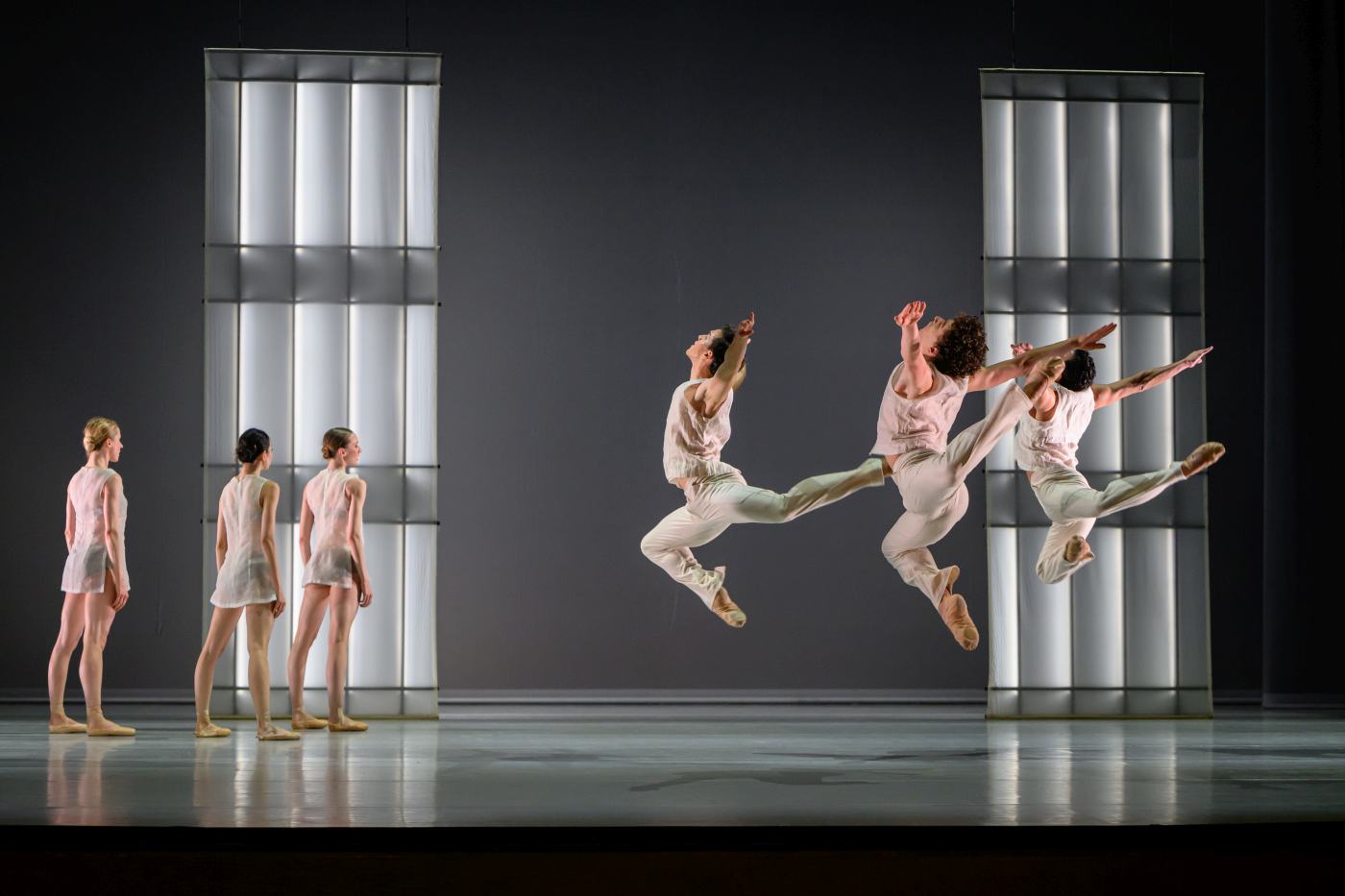
1. Ensemble, “Résonances” by J.-C.Maillot, Les Ballets de Monte-Carlo 2026 © A.BlangeroLes Ballets de Monte-Carlo’s recent premiere, Miniatures, takes up the 2004 project of the same title. Back then, Bruno Mantovani, artistic director of the festival Printemps des Arts de Monte-Carlo and director of the Ensemble Orchestral Contemporain, challenged Le Ballets de Monte-Carlo’s artistic director, Jean-Christophe Maillot, with seven contemporary compositions. Each of them represented another mindscape; none was written for dance, and Maillot was tasked with choreographies. He was successful. Mantovani threw four new compositions commissioned for this year’s festival into the ring (and also played them with the Ensemble Orchestral Contemporain during the run of the program), which former and current dancers of the company put into dance. Two of Maillot’s 2004 works complemented the ninety-minute program. Continue reading “Growing From Solid Roots”

Soft Wrapping – Crisp Core

“Soirée 3 Choréographes” (“Claude Pascal” / “Casi Casa” / “Back on Track 61”)
Les Ballets de Monte Carlo
Salle des Princes, Grimaldi Forum
Monte Carlo, Monaco
July 16, 2022

by Ilona Landgraf
Copyright © 2022 by Ilona Landgraf

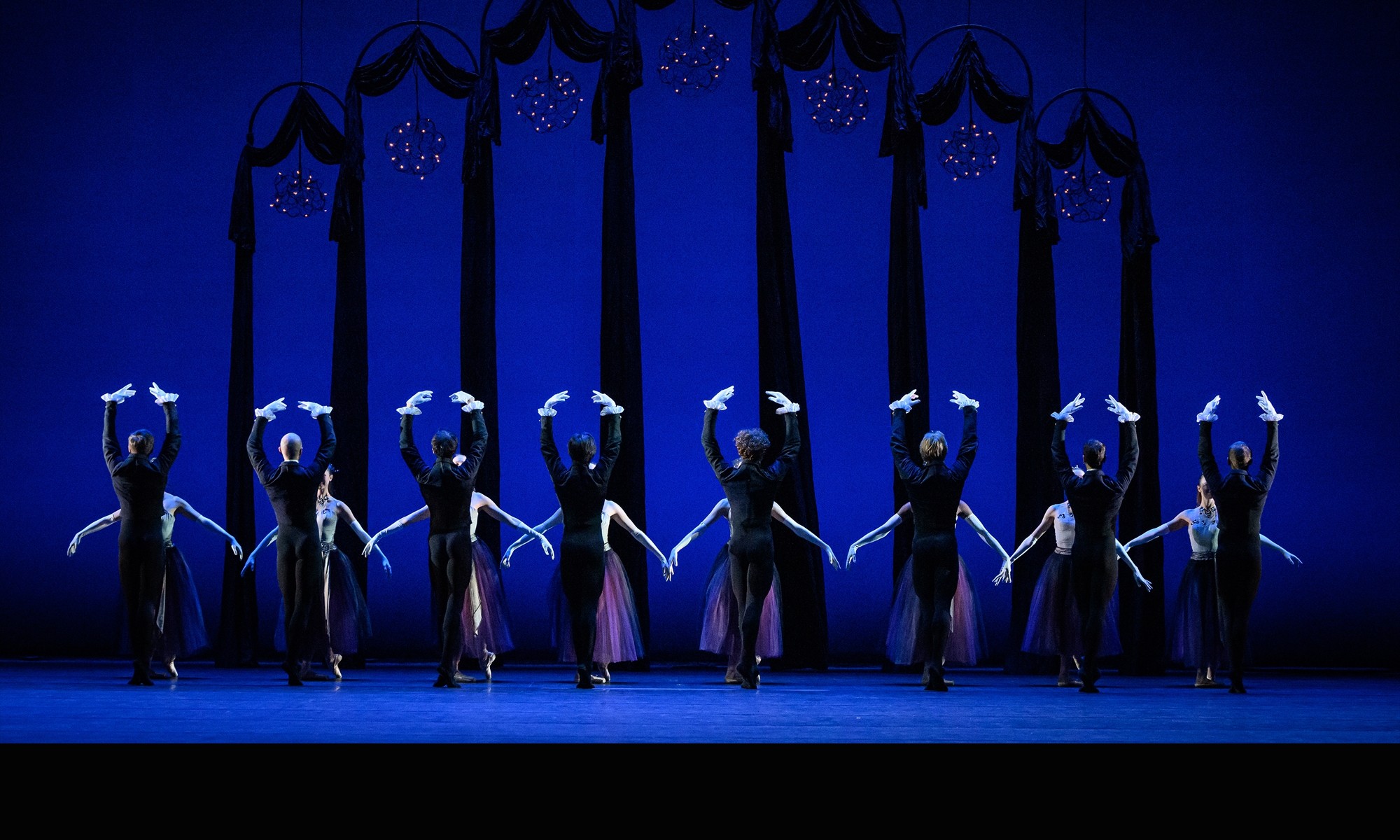
1. L.Beyne (Marie-Claire), A.Reist (Pierre-Marie), A.Maksakov (Jean-Pascale), and G.Riou (Marie-Claude), “Claude Pascal” by J.Kylián, Les Ballets de Monte Carlo 2022 © A.BlangeroLes Ballet de Monte Carlo’s recent triple bill combines a new piece by the company’s artistic director Jean-Christophe Maillot (“Back on Track 61”) with Jiří Kylián’s “Claude Pascal” (2002) and Mats Ek’s “Casi Casa” (2009).

“Claude Pascal” is a misleading title, as no one in Kylián’s black-and-white-hued piece is so named. There’s Marie-Claire (Lou Beyne), a grand dame with a Russian accent and a fan collection; the childish Marie-Claude (Gaëlle Riou), who plays rock n’ roll on her tennis racket; Jean-Pascale (Artjom Maksakov), wielding a walking cane and talking about hair loss and grief-stuffed pants (…); and the athletically-inclined Pierre-Marie (Adam Reist), who recites an excerpt from Bram Stoker’s “Dracula” on the life expectancies of turtles, elephants, parrots, frogs, and fakirs. All four are time travelers from 1890(ish) – Continue reading “Soft Wrapping – Crisp Core”