Believe in Miracles

“The Nutcracker. Waiting for a Miracle”
Bolshoi Ballet
Bolshoi Theatre
Moscow, Russia
December 29, 2025 (documentary)

by Ilona Landgraf
Copyright © 2026 by Ilona Landgraf
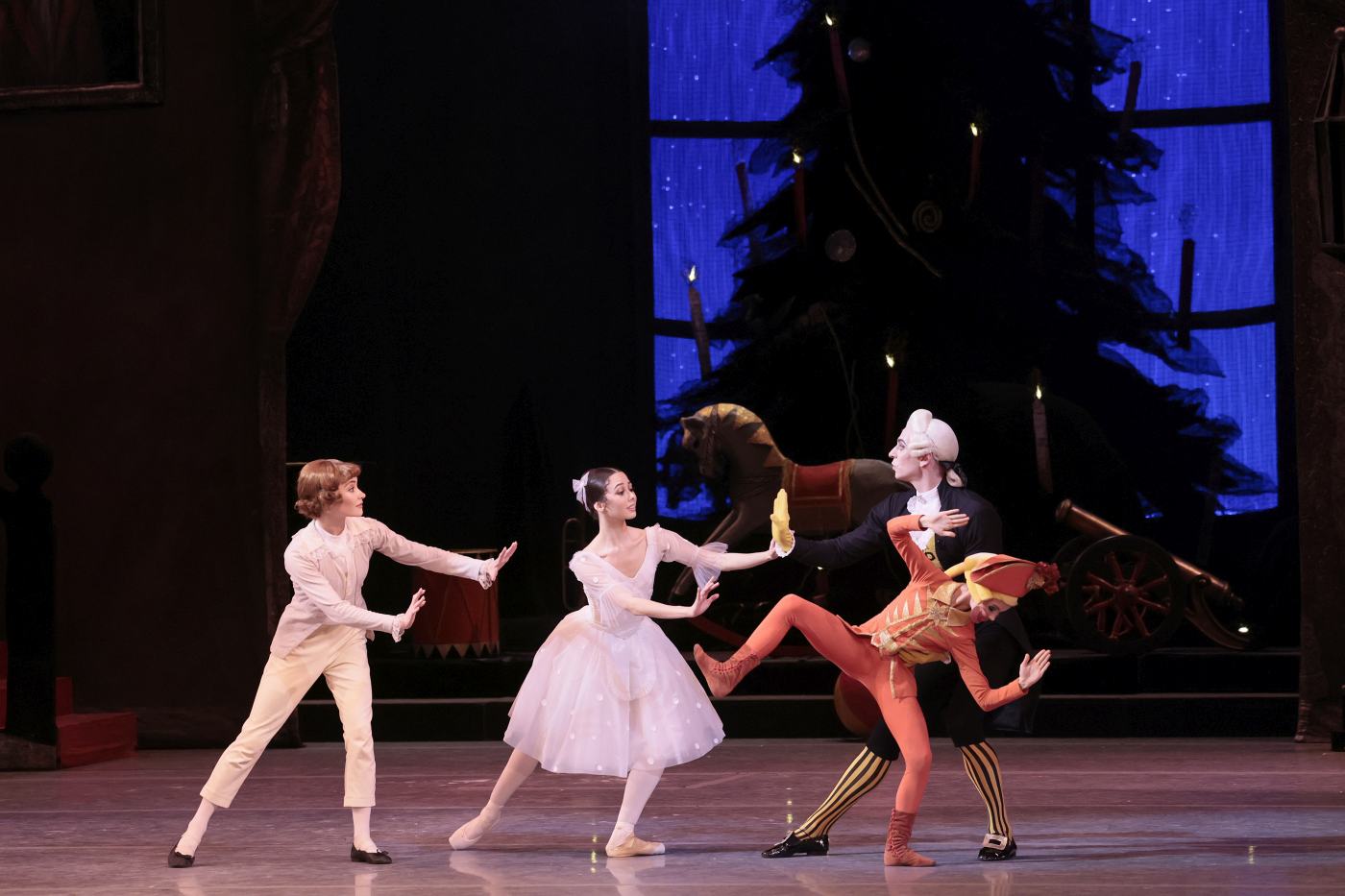
1. E.Kokoreva (Marie), D.Savin (Drosselmeier), and ensemble, “The Nutcracker” by Y.Grigorovich, Bolshoi Ballet 2025 © Bolshoi Theatre/D.YusupovOf the many special moments in Yuri Grigorovich’s The Nutcracker, there’s one you shouldn’t miss: when the Christmas tree is growing, and Marie’s transformation takes place. Then you need to make a wish. At least, that’s the insiders’ tip from the Bolshoi Ballet’s artists involved in the production.

Grigorovich’s The Nutcracker premiered at the Bolshoi Theatre in 1966 and was performed for the eight hundredth time earlier in December. Perhaps that’s why the Russian Channel One broadcast a one-hour documentary about The Nutcracker at the end of December. The film outlines the plot, provides insight into the music, set, and costumes, and looks at sixty years of performance history, during which nothing changed. Numerous coaches and ballet masters guarantee that Grigorovich’s legacy is preserved and kept alive. “Our profession is passed on from hand to hand, from foot to foot,” Maria Allash told. Regina Nikiforova, who has served the Bolshoi Ballet for sixty-five years, added: “Of course, we look at the records and ask the performers of past years what Yuri Nikolaevich told them. Though taking any liberties isn’t allowed, the individuality of each artist still shines through. Their charisma is what catches the audience.”

2. A.Ovcharenko (Nutcracker Prince), M.Kryuchkov (Mouse King), and ensemble, “The Nutcracker” by Y.Grigorovich, Bolshoi Ballet 2025 © Bolshoi Theatre/D.YusupovThe Bolshoi’s doyen, Boris Akimov, narrated the film, his voice wavering between excitement and appreciation. Aged seventy-nine, Akimov’s élan and warmth were as intense as always. Among others, he and the company’s artistic director, Makhar Vaziev, touched on one invariable ingredient in all The Nutcrackers: Tchaikovsky’s music. “There are no other composers whose works are performed thousands of times throughout the world per season,” Vaziev said. However, the Bolshoi’s (and presumably the Mariinsky’s) The Nutcracker is played quicker than elsewhere, as general director Valery Gergiev insists on conducting at exactly the pace Tchaikovsky determined.

Even its aerial shots of Moscow’s Christmas-lit Theatre Square and the fabulous camera work inside the theater make the film a must-watch. It also pays a visit to Moscow’s Choreographic Academy, where the Bolshoi’s principal, Mikhail Lobukhin, substituting 3. K.Efimov (Nutcracker Prince) and ensemble, “The Nutcracker” by Y.Grigorovich, Bolshoi Ballet 2025 © Bolshoi Theatre/M.Logvinovfor Drosselmeier, assisted in the selection of the youngest performer of the production, the student for the role of the Nutcracker doll. “Usually, the doll is just an ordinary toy in the hands of a dancer, and I’m surprised about the solution Yuri Nikolaevich found, a living doll with a unique dancing technique as the leitmotif of the entire production,” Vaziev explained. When Marie’s naughty brother, Fritz, accidentally breaks the doll, it is the springboard for Marie’s magical dream journey. She dreams the sort of dreams that are so strong that they might become true. Something similar happened to Lyudmila Semenyaka as a young girl in Leningrad when she first saw a photo of a ballerina in a tutu: Alla Sizova as Masha in Vasily Vainonen’s version of The Nutcracker. Semenyaka cut out the photo and pinned it to the piano, where it stayed. Twelve years later, in 1972, the twenty-year-old Semenyaka gave her debut as Marie in Grigorovich’s The Nutcracker on the Bolshoi’s stage.

4. Ensemble, “The Nutcracker” by Y.Grigorovich, Bolshoi Ballet 2025 © Bolshoi Theatre/M.LogvinovOf the many other dancers who shared their thoughts about The Nutcracker, Denis Rodkin revealed that “When watching the performance, you always expect some kind of miracle in your soul,” and Kristina Kretova admitted to getting goosebumps the moment the Nutcracker toy awakens as a real prince. About the same scene, Vladislav Lantratov said, “You know, love is born, and you just want it. Take Marie very carefully and lean her head onto your shoulder—this is the feeling.”

Love is at the core of Grigorovich’s The Nutcracker, and now and then, the dancers in the main roles fell in love with one another. Such was the case for Artem Ovcharenko and Anna Tikhomirova, for example, who got married in 2016. “At some point during the performance, you touch something sacred that you cannot put into words,” Ovcharenko explained. Sometimes, swearing love to each other on stage spurs real-life romances.

5. Ensemble, “The Nutcracker” by Y.Grigorovich, Bolshoi Ballet 2025 © Bolshoi Theatre/D.YusupovEkaterina Maximova and Vladimir Vasiliev were already a married couple when they danced the lead roles at The Nutcracker’s premiere in 1966. Their performance is the threshold for today’s generation of dancers. Shortly before stepping on stage, Elizaveta Kokoreva and Daniil Potaptsev were lucky enough to be coached by Vasiliev in a masterclass that ran like a golden thread through the documentary. Kokoreva gave her debut as Marie in 2019, and Potaptsev was about to dance the Nutcracker Prince for the first time. It was a pity that I couldn’t see their performances and missed the live stream on December 31 featuring Kokoreva alongside Dmitry Vyskubenko as the prince.

The live stream of December 2024 can be watched on the Bolshoi Theatre’s vimeo site until January 11.

Links: Website of the Bolshoi Theatre
The Nutcracker—live stream December 2024 (online until January 11, 2026)
The Nutcracker. Waiting for a Miracle—Channel One
Photos: 1. Elizaveta Kokoreva (Marie), Denis Savin (Drosselmeier), and ensemble, “The Nutcracker” by Yuri Grigorovich, Bolshoi Ballet 2025 © Bolshoi Theatre/Damir Yusupov
2. Artem Ovcharenko (Nutcracker Prince), Mikhail Kryuchkov (Mouse King), and ensemble, “The Nutcracker” by Yuri Grigorovich, Bolshoi Ballet 2025 © Bolshoi Theatre/Damir Yusupov
3. Klim Efimov (Nutcracker Prince) and ensemble, “The Nutcracker” by Yuri Grigorovich, Bolshoi Ballet 2025 © Bolshoi Theatre/Mikhail Logvinov
4. Ensemble, “The Nutcracker” by Yuri Grigorovich, Bolshoi Ballet 2025 © Bolshoi Theatre/Mikhail Logvinov
5. Ensemble, “The Nutcracker” by Yuri Grigorovich, Bolshoi Ballet 2025 © Bolshoi Theatre/Damir Yusupov
Editing: Kayla Kauffman

“We Need Him”

“Diaghilev”
Dancers of the Bolshoi Ballet
Bolshoi Theatre (New Stage)
Moscow, Russia
June 24, 2025 (video)

by Ilona Landgraf
Copyright © 2025 by Ilona Landgraf

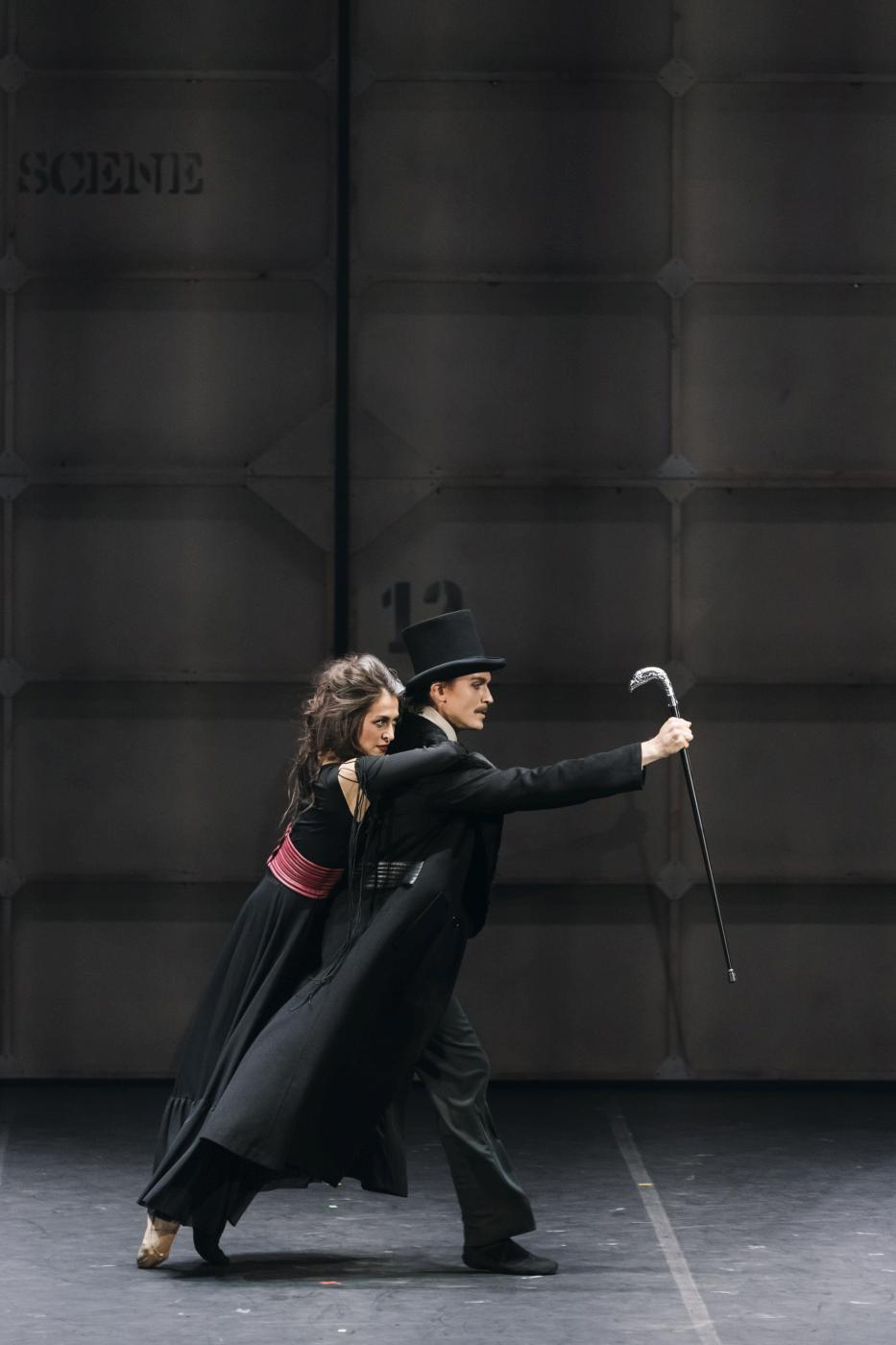
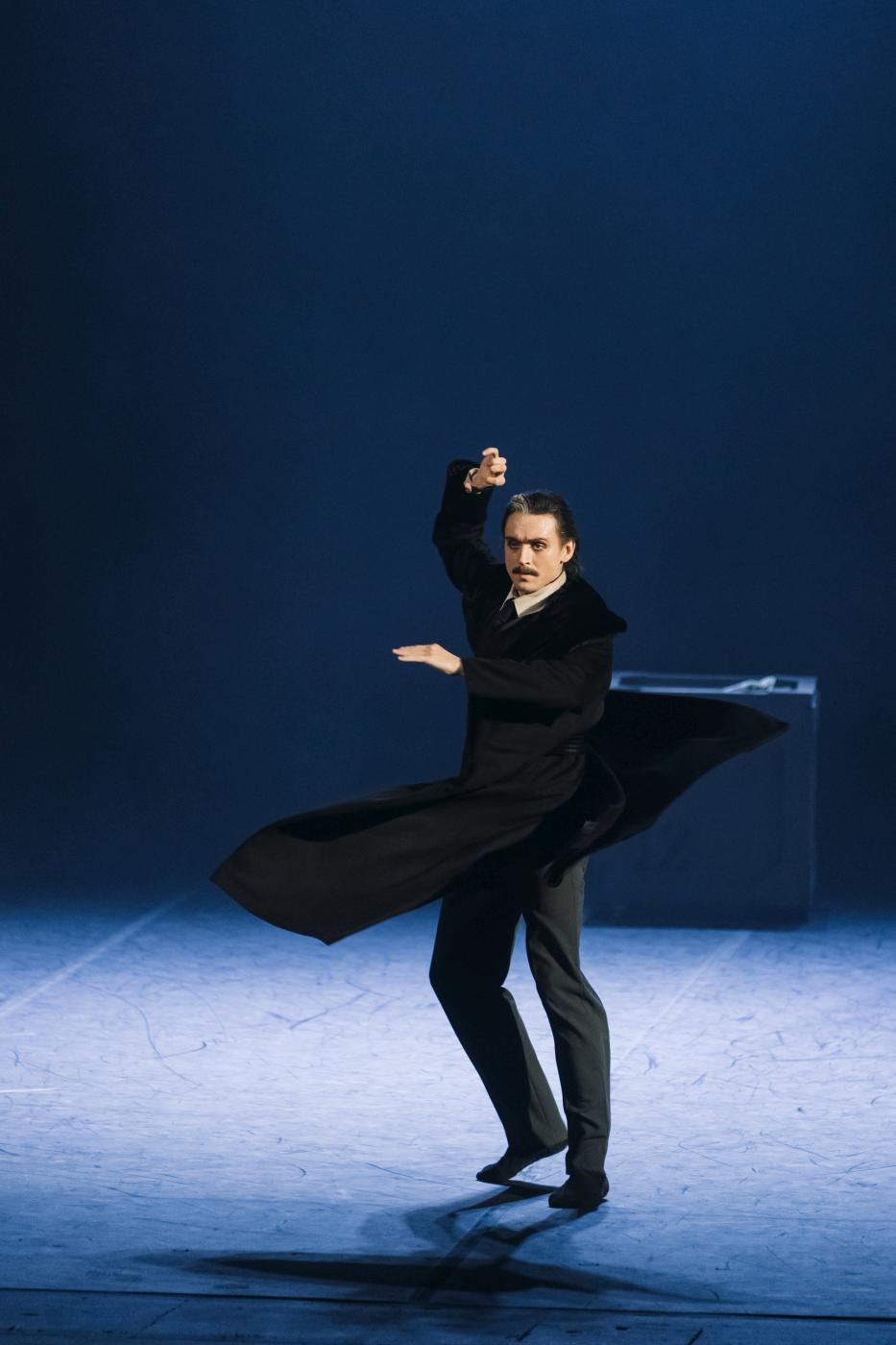
1. A.Meskova (Gypsy Woman) and D.Rodkin (Sergei Diaghilev), “Diaghilev” by A.Kaggedzhi, Dancers of the Bolshoi Ballet 2025 © G.Galantnyi  2. D.Rodkin (Sergei Diaghilev), “Diaghilev” by A.Kaggedzhi, Dancers of the Bolshoi Ballet 2025 © G.Galantnyi  The man in need whom Sergei Lifar wrote about in 1939 was Sergei Diaghilev (1872-1929), impresario of the Ballets Russes and a revolutionist of ballet. Diaghilev’s burning passion to discover and promote creative beauty is unequaled. He shaped the perception of Russian culture in the West and, like a virus, changed the DNA of twentieth-century art. Without him, Vaslav Nijinsky, Tamara Karsavina, Ida Rubinstein, Feodor Chaliapin, and Igor Stravinsky wouldn’t have become known to the world, and the careers of choreographers, such as Michel Fokine, Bronislava Nijinska, Léonide Massine, and George Balanchine, might have taken another path. Ten years after Diaghilev’s death, no one had filled the void he had left behind.

Ninety-six years later, a new Diaghilev has yet to be found, but—as Russia and the West separated again—the need for a bridge-building spirit and culture that unites people across borders is more pressing than ever. That’s why Russia launched the cultural search festival We Need Diaghilev last year, which features various expositions, lectures, and performances at Russian and foreign venues. Continue reading ““We Need Him””

Well kept

“Raymonda”
Bolshoi Ballet
Bolshoi Theatre
Moscow, Russia
April 6, 2023

by Ilona Landgraf
Copyright © 2023 by Ilona Landgraf

1. D.Rodkin (Jean de Brienne) and A.Kovalyova (Raymonda), “Raymonda” by Y.Grigorovich after M.Petipa and A.Gorsky, Bolshoi Ballet 2023 © Bolshoi Theatre / M.Logvinov “Raymonda” is a foundation of Russian ballet repertoire, but is rarely performed in Europe. After his flight to the west, Nureyev staged several versions of the work for western companies, staying faithful to Petipa’s 1898 original. The few European choreographers who’ve tackled the piece – among them Pontus Lidberg for the Royal Swedish Ballet in 2014 and Rachel Beaujean for the Dutch National Ballet in 2022 – adjusted Lydia Pashkova’s libretto to match western tastes. The only Petipa/Pashkova-based Russian production I saw was Konstantin Sergeyev’s from 1948, presented by the Maryinsky Ballet on their 2014 tour to Baden-Baden. That production felt alien in Baden-Baden’s modern Festspielhaus, reinforcing the reputation of “Raymonda” as dusty and outdated. In last year’s review of Tamara Rojo’s “Raymonda” for the English National Ballet, London critic Jenny Gilbert went so far as to call Raymonda an “ineffectual heroine” (implying that the numerous renowned ballerinas who’ve taken on that leading role in the last 125 years were foolish in doing so) and the plot “offensively silly.” She also claimed that Russian “ballet culture has a higher tolerance of such [silly] things.” After watching the Bolshoi Ballet’s “Raymonda”, I’m inclined to think that the western perspective misses what “Raymonda” is actually about. Continue reading “Well kept”

Four Dancer Nominees for the Prix Benois 2017

Prix Benois de la Danse
Bolshoi Ballet / Korean National Ballet / National Ballet of Uruguay
Moscow / Seoul / Montevideo
April 28, 2017

by Ilona Landgraf
Copyright © 2017 by Ilona Landgraf

1. Statuette of the Prix Benois de la Danse, design by I.Ustinov © Y.PokrovskyOn May 30th and 31st the Bolshoi again hosts the ceremonies of the annual Prix Benois de la Danse Galas. Prizes will be given on the first evening, while the gala on the following day will look back on highlights from the twenty-five-year history of the Prix Benois. It is already known that Marcia Haydée will be awarded the Benois Prize for Lifetime Achievement and Aurelie Dupont the Russian-Italian Prize Miroir de la Danse.

This year’s nominees include seven choreographers, six ballerinas and seven male dancers. I asked four dancers – two female, two male – about the roles which earned them the nomination: they are, alphabetically, Nina Kaptsova (Bolshoi Ballet), Jae-Woo Lee (Korean National Ballet), Maria Riccetto (National Ballet of Uruguay), and Denis Rodkin (Bolshoi Ballet).
All four were asked the same questions:
“Why was performing this role special compared to other roles you danced? What challenged you? In what perspective did the role make you grow as an artist?”

Here is what they answered: Continue reading “Four Dancer Nominees for the Prix Benois 2017”

Room for Improvement

“Onegin”
Bolshoi Ballet
Bolshoi Theatre
Moscow, Russia
March 11, 2017

by Ilona Landgraf
Copyright © 2017 by Ilona Landgraf

1. E.Obraztsova and N.Semizorova, “Onegin” by J.Cranko, Bolshoi Ballet © Bolshoi Theatre / D.YusupovConditions were the same overall on the second of the three evening performances of “Onegin” at the Bolshoi. The sky above the garden of the Larina family’s country house was bright blue, domestic bliss was as yet unclouded, the village folk were in an expansively jolly mood. The Bolshoi Orchestra under Pavel Sorokin, reliable as always, ensured a fine rendition of Tchaikovsky’s music. Yet unlike the evening before the story didn’t gain momentum.

“Onegin” needs four dancers of equal or complementary strength in the leading roles. The role of Olga is smaller than the other three, but her part is pivotal for the dramatic turn the story takes. Saturday’s cast had only one consistently strong dancer, Evgenia Obraztsova as Tatiana. Continue reading “Room for Improvement”

A Dutch Program at the Bolshoi

“Frank Bridge Variations / Short Time Together / Symphony of Psalms”
Bolshoi Ballet
Bolshoi Theatre
Moscow, Russia
March 02, 2017

by Ilona Landgraf
Copyright © 2017 by Ilona Landgraf

1. D.Rodkin and E.Shipulina, “Frank Bridge Variations” by H.van Manen, Bolshoi Ballet 2017 © M.Logvinov / Bolshoi TheatreReading the names of choreographers Hans van Manen, Paul Lightfoot and Jiří Kylián as part of the same program one immediately thinks of a performance in Amsterdam or Den Haag, or maybe also in Germany. Yet this triple bill was the Bolshoi’s. It’s a menu that’s not quite so familiar for the Moscow audience. Applause was respectable, though not overwhelming. The dancers, however, were in great shape! Continue reading “A Dutch Program at the Bolshoi”