“I’m a supporter of talented people”

“Marco Spada”
Bolshoi Ballet
Bolshoi Theatre (Historic Stage)
Moscow, Russia
February 15, 2026

by Ilona Landgraf
Copyright © 2026 by Ilona Landgraf

The Bolshoi Ballet has two choreographies by Pierre Lacotte (1932-2023) in its repertory: his recreation of Petipa’s La Fille du Pharaon (which he entrusted to no other company) and Marco Spada, a 1857 ballet d’action for the Paris Opéra by Joseph Mazilier to music by Daniel Auber, which was lost except for a few sketches and reviews. In 1981, Lacotte choreographed and staged it from scratch for the Teatro Dell’Opera di Roma with Rudolf Nureyev in the title role. Despite being peripatetic, Nureyev was so eager to participate in the production that he signed a contract on the tablecloth during a restaurant outing with Lacotte. “I, Rudolf Nureyev, guarantee that for the duration of a month I will attend daily rehearsals in Rome for the ballet Marco Spada,” he wrote.

At Nureyev’s request, Lacotte staged Marco Spada at the Paris Opéra in 1985. In 1988, Nureyev came to Les Ballets de Monte-Carlo, then directed by Lacotte and his wife, Ghislaine Thesmar, to dance the title role again. In 2013, Marco Spada premiered at the Bolshoi Theatre, starring David Hallberg, Evgenia Obraztsova, Olga Smirnova, Semyon Chudin, and Igor Tsvirko (a recording of the performance is available on DVD). The then eighty-one-year-old Lacotte personally supervised rehearsals. His fast, intricate choreographies with their clean, French-style legwork require talented dancers with a refined technique. I saw two such casts, one at a matinee, the other in the evening.

Marco Spada is a love and crime tragicomedy. Its title hero is a thief who loots Roman villages with his gang but remains incognito as he poses as an aristocrat. Not even his daughter, Angela, knows about her father’s clandestine activities. Only by accident, when a friar robbed of the collection identifies him as the culprit, does she learn the truth. Being a gangster’s daughter compromises her marriage plans with Prince Federici, whose proposal she consequently and sadly denies. Unaware of Angela’s true motive, the piqued prince instantly advances his marriage to Marquise Sampietri, daughter of the Governor of Rome, to whom he was already betrothed. But the Marquise has another fervent admirer, Count Pepinelli, the captain of the dragoon regiment. He doesn’t give up and ultimately benefits from Marco Spada’s resolve to restore his daughter’s happiness. In a bold coup, Spada’s men kidnap Count Pepinelli and the Marquise and compel the said friar to marry them. Likewise, kidnapped and without his bride, Prince Federici realizes that he actually loves Angela. Spada, meanwhile, mortally shot by the dragoons, uses a bit of cunning for the last time when he pretends that Angela isn’t his daughter, thus clearing the way for her wedding to Federici.

The complex story unfolded at five venues: a bustling Italian village square (where the peasants complained about Marco Spada’s thievery as he brazenly did exactly that right under their noses), Spada’s spacious palazzo (where all other protagonists sought shelter from the rain unaware of being in the home of a wanted bandit), the Governor of Rome’s palace (in whose grand hall at the sidelines of a splendid ball the friar exposed Spada, whereupon Angela refused Federici, and the latter asked for the Marquise’s hand), the Marquise’s boudoir (where Count Pepinelli tried in vain to prevent the Marquise from marrying Federici until both where abducted by Spada’s cronies), and the gangsters’ cavernous lair (where Spada died and each lover was united with their true match).

All sets and costumes were designed by Lacotte and represented his exquisite taste. At the Governor’s ball, for example, cream-white, champagne-colored, and soft green billowing satin evening dresses, along with dark green and black velvet cloaks and justacorpses, complemented the French chic of the columned hall with a painted, distant cupola that directed the gaze toward divine heights. Similar-looking wigs added to the confusion of who loved whom and to Spada’s perfect cover.
The multi-layered rose-colored curtain that hid the Marquise’s boudoir was of a fabric as delicate as the matters of the heart that would play out behind it. Pepinelli’s heart lost a beat at the sight of the Marquise sitting in front of her vanity table, applying powder with a huge puff, her large veil stretched across the entire floor. Seeing that she was already wearing a wedding dress, he swooned.

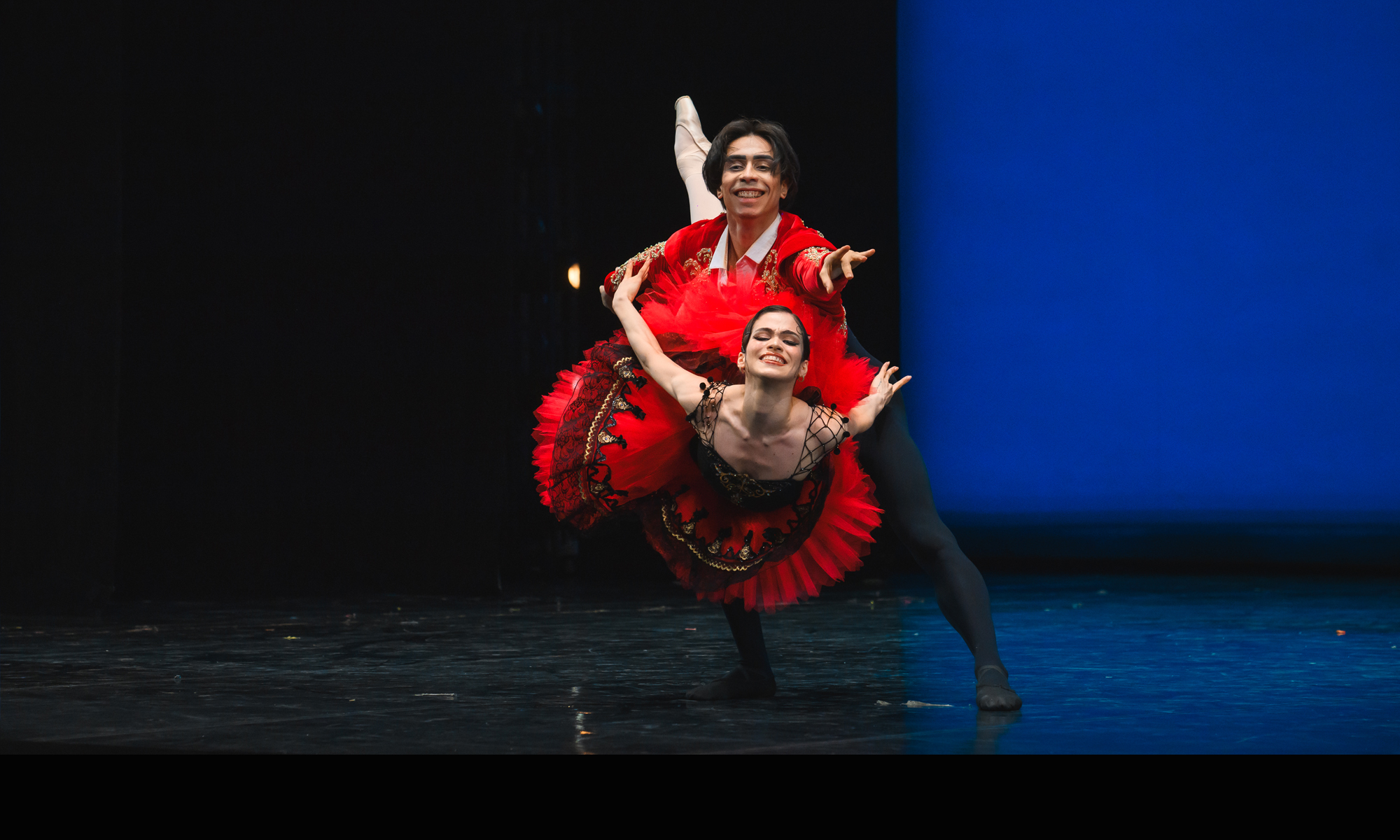
As the matinee’s Marco Spada, Denis Zakharov was a perfidious shammer. Lithe and sneaky like a cat, he struck with razor-sharp precision and mind-boggling speed. Robbing a cleric didn’t bother his conscience; it pumped his adrenaline to a level that made him whirl through the trickiest variations so lightning fast that a stolen necklace flung from his pocket. The mere abruptness of his head turns indicated his cunning and unpredictability.
His daughter, Angela (Kristina Kretova), welcomed Federici (Klim Efimov) as proper etiquette demanded. Although deeply in love with him, she reigned in her heart. Her refinement and demeanor were natural, whereas the Marquise’s (Eva Sergeyenkova) pinpoint perfection was meant to stress her status. In public, the Marquise played cat and mouse with Count Pepinelli (Alexei Putintsev, standing in for Ratmir Dzhumaliev on short notice), alluring him and parading his childish assertions of love. Ultimately, though, she seemed very glad to marry him. Despite being snappy and very correct, Putintsev’s Pepinelli was quite ineffective as a law enforcer. His dragoons marched with tiny steps like cute tin soldiers, chased the peasants instead of the bandits, and failed to detect the secret doors in Spada’s palazzo, behind which the scoundrels hid. Finally, though, when hunting down Spada, their steely determination paid off.
Efimov’s Federici’s flurry of steps as he entered the village square, quill and paper in hand, must have correlated with the abundance of his scribblings (the content of which remained unclear). His solo during the tête-à-tête with Angela was fine but not sparkling. Yet the pas de deux (one of several choreographic amendments Lacotte made for the Bolshoi) he danced with her at the ball was mesmerizing. Its elegance and esprit were food for the soul.

The evening’s Marco Spada (Artem Ovcharenko) quickly changed faces. As a thief, his life revolved around only himself. Toward whatever direction his legs darted or arms reached, their focus always came back to the same point, which in a metaphorical sense was his coffers. He seemed high on forays and, when successful, boisterously dived off the crime scene. Barely at home, a firework of steps relieved him from bursting from cockiness. Spada’s terrific turns a la seconde after taking out Count Pepinelli (Filippo Ferdinando Pagani) with some generous drinks made me think of a roulette game he feverishly controlled. At his core, however, Ovcharenko’s Spada was a loving father. His daughter (Elizaveta Kokoreva) combined everything one could wish for in a child. Charming and graceful at heart, she was playful yet also serious, bursting with energy, and an inborn leader. The entire robber gang bent their knees to her. Prince Federici (Dmitry Vyskubenko) made her fly like a feather. At the ball, Vyskubenko’s jumps briefly lacked power, but then he soared again through his next diagonal. I especially liked his sharp, angry jumps in the village square, which seemed to compensate for his displeasure at finding his fiancée (Maria Vinogradova) with Pepinelli. He had reason indeed. Pepinelli and the Marquise went together as smoothly as cream, and Pepinelli’s skyrocketing pirouettes and vigorous jumps testified to his potency. The force of his love declaration made the Marquise cover her ears. She wanted to hear nothing of the sort. It made her heart ache.

The unfortunate Friar Borromeo was played by Yuri Ostrovski and Denis Savin; Nikita Elikarov and Andrei Sitnokov portrayed the Governor of Rome. Of the couple (Uliyana Moksheva and Akib Anvar/Sofia Maymula and Ivan Sorokin) whose wedding was part of the village bustle, Anvar’s imposing jumps stuck with me. He was a groom as proud as a peacock. Many buoyant children (students of the Moscow State Academy of Choreography) participated in the festivities along with a good-tempered dog and an obedient donkey that pulled the wedding cart.
Although a known asset of the Bolshoi, the corps’ impeccable unity again impressed me. It showed the beauty of Lacotte’s movement patterns to the fullest.

Alexey Bogorad conducted the Bolshoi Orchestra on both occasions, keeping his baton finely in tune with the dancers.

Links: Website of the Bolshoi Theatre
Marco Spada—The Return
A Ticket to the Bolshoi— The Return of Marco Spada
David Hallberg about Marco Spada
Editing: Kayla Kauffman