“Master and Margarita”
Bolshoi Ballet
Bolshoi Theatre (New Stage)
Moscow, Russia
February 18/19, 2026
by Ilona Landgraf
Copyright © 2026 by Ilona Landgraf
Around two years ago, I saw Edward Clug’s ballet adaptation of Mikhail Bulgakov’s novel The Master and Margarita at the Bolshoi Theatre and found it fabulous. Last week’s two performances corroborated my impression. They also reminded me that, however chaotic the world might get, there’s no need to worry; someone is in control. In Clug’s version, it’s the Satan alias Woland and his accomplices. That hell and heaven commonly coordinate their actions went by the board.
Bulgakov intertwined two storylines (one deals with the absurd mayhem caused by Woland and his entourage on a 1930 visit to Moscow, the other is an eyewitness account of the trial of Jesus of Nazareth under Pontius Pilate’s governance), which are connected by the Master (an unrecognized Muskovit author, i.e., Bulgakov’s alter ego) and his muse, Margarita. Margarita loves the Master’s latest work, a historic novel about Pontius Pilate, but Moscow’s literary critics lambast it. Desperate and embittered, he burns the manuscript and checks in at Professor Stravinsky’s psychiatric clinic. There, he meets a fellow patient, the young author
Ivan Bezdomny, who seems over the edge after falling victim to Woland. Over time, the Master tells him his life story. Meanwhile, Margarita deals with the devil to be reunited with the Master. She turns into a witch, avenges the damning review, attends Blockula Night, and then transforms into the queen of Woland’s annual spring ball. Her ordeal frees the Master, but his melancholy doesn’t fade. To grant the lovers peace, Woland orders them killed. Before both settle in the calm limbo realm between heaven and hell, the Master finishes his novel by redeeming Pontius Pilate.
Clug drops the biblical part except for the figure of Pontius Pilate. A marble figure chiseled by the Master, he represents both his painstaking effort to write literature and the latter’s historic content. Having come to life, Pontius Pilate has a brief gig at Likhodeyev’s variety theater and returns to the Master after the critics reject his manuscript and drag him
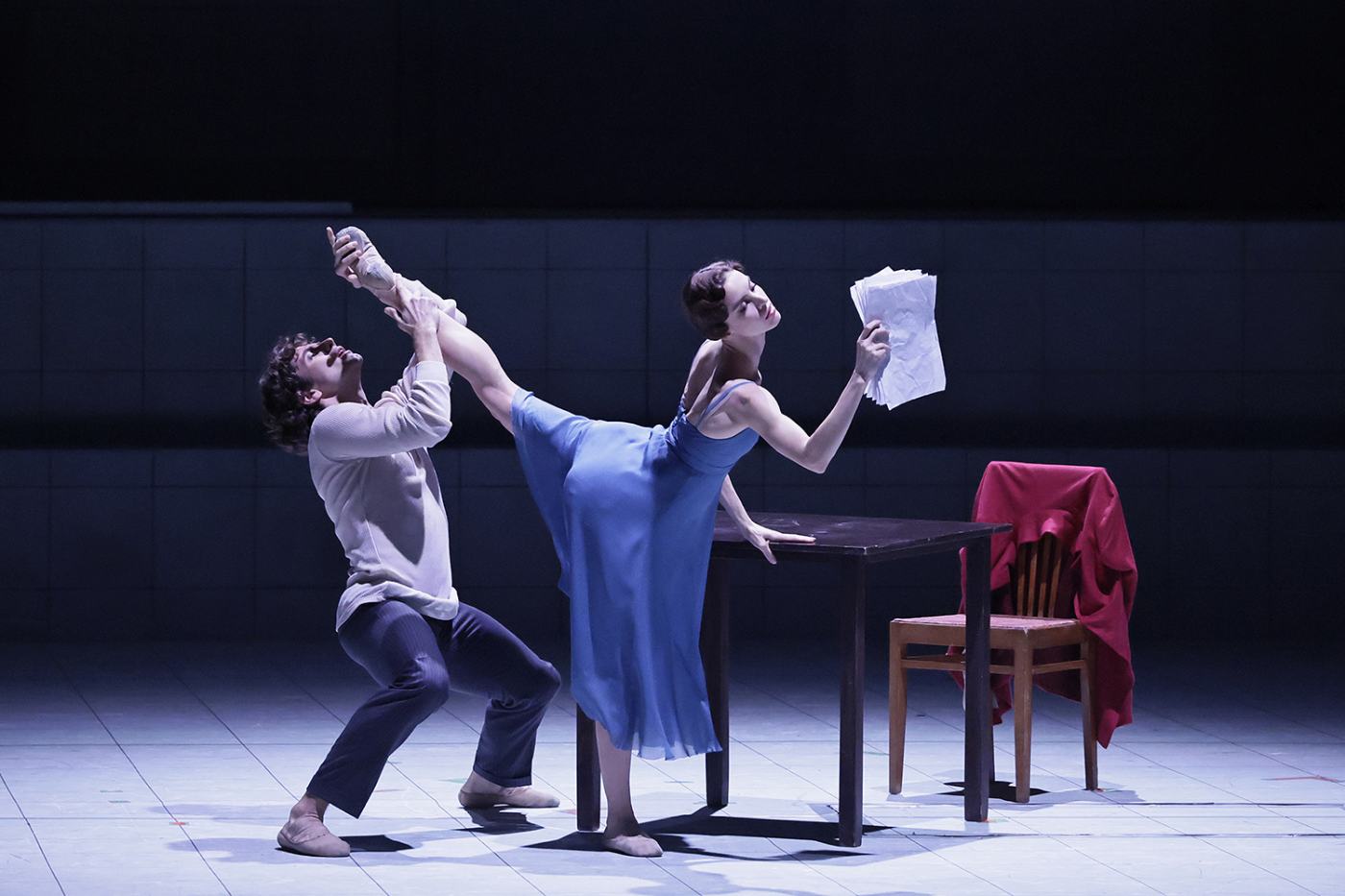
onto their critics’ bench (which serves as the bier of Berlioz’s funeral in the previous scene). Lying on the upended bench, his arms hanging sideways, the Master resembled a crucified man. Pontius Pilate found him collapsed on the ground and surrounded by his scattered manuscript. With hammer and chisel in hand, Pilate put some final touches to the writing. Then his hammer seemed to drive the nails of the Master’s cross home, but it achieved the opposite and freed him. In Pilate’s hands, the manuscript (which by then had been arduously collected by Margarita and safeguarded by Woland’s sidekicks) became history when Pontius Pilate disappeared in a tombstone slab (which until then had represented the mattress of the Master’s and Margarita’s dwelling).
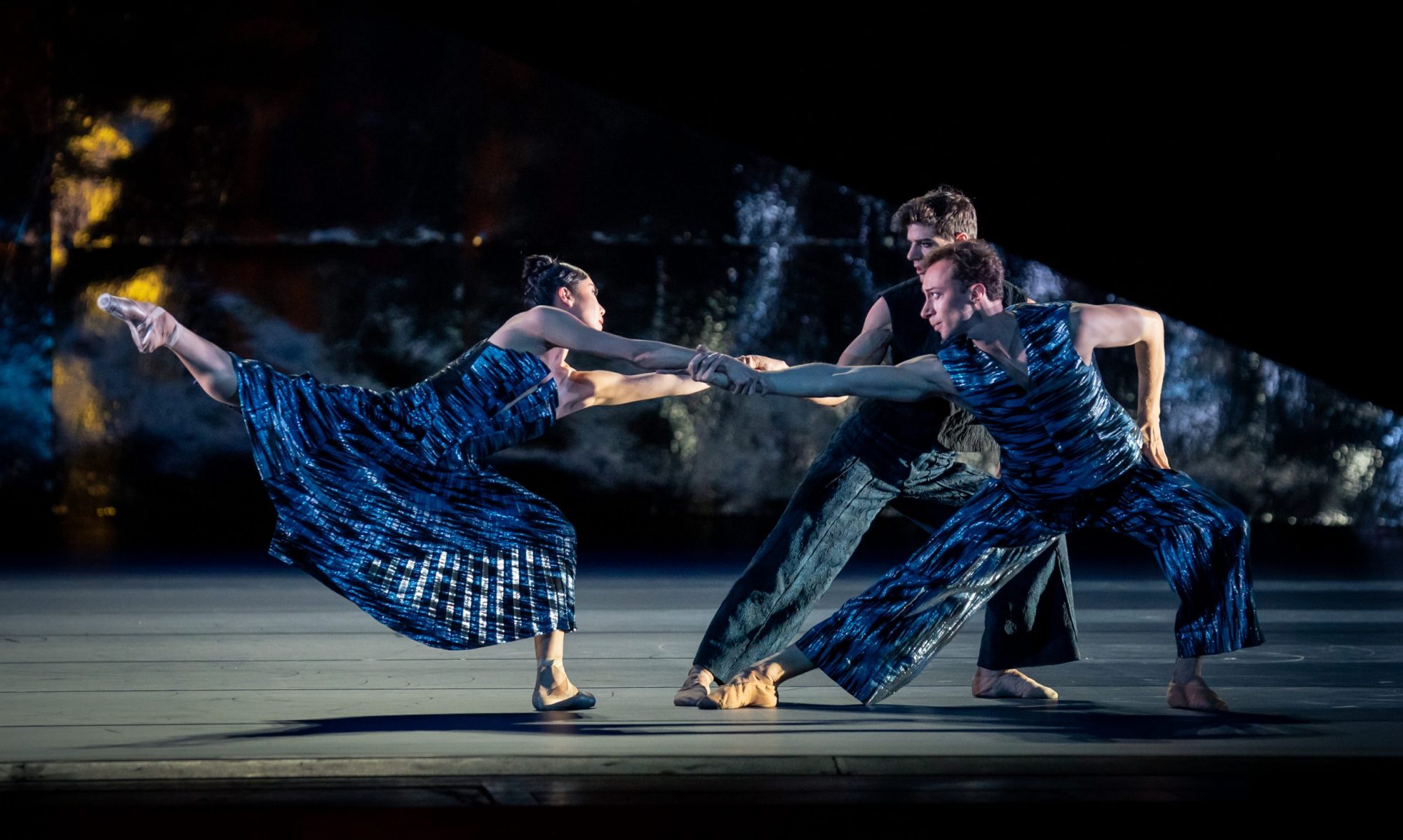
Margarita’s transformation was similarly fascinating. Azazello’s magic cream metamorphosed her in seconds into a golden blonde femme fatale, who joined numerous lookalikes in their flight across the Blockula (in fact, only the rose chiffon strap dresses, attached to hangers on thin ropes, flew up and down). Hell’s bathtub worked its alchemy, transforming Margarita into Satan’s queen. Steam clouds accompanied her as she reemerged from its depth, her voluptuous curls flowing onto a red, velvet coat dress, out of which she quickly slipped (costume design by Leo Kulaš).
Clug added more to the countless absurdities caused by Bulgakov’s Woland, most prominently a dry swimming pool spanned by a vaulted ceiling (set design by Marco Japelj) that harbored all action. A bench turned it into Patriarch’s Pond (where Woland sneaked into Berlioz’s and Bezdomny’s conversation), a hospital cod into Professor Stravinsky’s psychiatric clinic, and a mattress into the variety theater’s director Likhodeyev’s apartment, where he slept off his hangover. The presence of Woland completely derailed Likhodeyev and ensured Woland’s subsequent black magic show at said variety. In the meantime, Likodeyev was miraculously transported to far-away Yalta, where he sat on the beach (i.e., on a brown blanket) with a sand shovel and bucket. Behemoth, the black cat of Woland’s crew, left its mark in the cat litter he poured between Likodeyev’s legs.
The swimming pool marked the route of the tram that ran over and beheaded Berlioz and turned into the Moskva River (through which Bezdomny swam when chasing Behemoth), the literary elite’s headquarters at Groboyedev House (where Bezdomny was derided for his report about having met the devil), and the late Berlioz’s flat, which by then Woland and consorts occupied. When opened, the pool’s many doors revealed side plots (a screaming woman who was startled about being exposed while taking a shower, the corrupt Bosoy—Berlioz’s house manager— triumphantly waving bundles of dollar bills while sitting on the toilet, and Poplavsky calling from a telephone booth to claim the inheritance of his uncle Berlioz’s flat) or served as storage rooms for props and clothes. The doors represented the entrances of the variety theater and the gates of hell through which the corpses visiting Woland’s ball wriggled, their arms smeared with blood. At times, closed doors imprisoned the protagonists.
In preparation for the ball, the backdrop opened to reveal a diving tower with a platform from which Woland oversaw the goings-on like a mastermind.
The score, which combines music by Alfred Schnittke and Milko Lazar and is played by the Bolshoi orchestra under the batons of Ayrat Kashaev and Anton Gishanin, evoked Pilate’s time with sacral-like singing of male bass voices and accompanied Woland’s activities with Schnittke’s Concerto for Piano and Strings, among others. Its grotesque cacophony interspersed with moments of clarity, somnambulistic passages followed by violent outbursts, and feverishly high-pitched violins created an eerie suspense. At times, the sound was reminiscent of shattering glass.

Igor Tsvirko and Denis Savin portrayed the Master as a melancholic artist with a sensitive soul. The broad-shouldered Savin’s Master was especially commiserable when he stood stooped and enfeebled, his eyes fixed to his manuscript. Both Margaritas (Kristina Kretova and Maria Vinogradova) indulged in it as well as in their femininity with Satan. The most striking aspect of Vladislav Lantratov’s Woland was his sleekness. When standing motionless, his black, slim figure blended so perfectly with the environment that one forgot about his presence. Semyon Chudin’s Woland’s chilling, needle-sharp precision of his interventions was prominent.
| As the quicksilver Behemoth, Georgy Gusev and Vyacheslav Lopatin caused mischief whenever possible. Egor Gerashchenko and Dmitry Dorokhov, unmistakable in their black-and-white checkered suits, portrayed Behemoth’s buddy Fagot. Woland’s hatchet man, the top-headed Azazello, was danced by Alexander Smoliyaninov and Igor Pugachyov. Angelina Vlashinets and Antonina Chapkina wriggled their curves as hell’s red-haired Hella. The man from the past, Pontius Pilate, was portrayed by Alexander Vodopetov and Mikhail Lobukhin. Klim Efimov and Mikhail Kryuchkov played the maddened poet Bezdomny. The oil that made poor Berlioz (Evgeny Triposkiadis and Alexei Matrakhov) slip under the tram was spilled by Ksenia Averina’s and Vlada Zakharova’s Annushkas. |
| Links: | Website of the Bolshoi Theatre | |
| Ticket to the Bolshoi— Master and Margarita | ||
| Photos: | (Some photos show a different cast.) | |
| 1. | Igor Tsvirko (Master) and Maria Vinogradova (Margarita), “Master and Margarita” by Edward Clug, Bolshoi Ballet 2026 © Bolshoi Theatre/Damir Yusupov | |
| 2. | Denis Savin (Master) and Mikhail Kryuchkov (Ivan Bezdomny), “Master and Margarita” by Edward Clug, Bolshoi Ballet 2026 © Bolshoi Theatre/Damir Yusupov | |
| 3. | Ana Turazashvili (Hella), Gennady Yanin (George Bengalsky), Vyacheslav Lopatin (Behemoth), and ensemble, “Master and Margarita” by Edward Clug, Bolshoi Ballet 2026 © Bolshoi Theatre/Elena Fetisova | |
| 4. | Mikhail Kryuchkov (Ivan Bezdomny) and ensemble, “Master and Margarita” by Edward Clug, Bolshoi Ballet 2026 © Bolshoi Theatre/Damir Yusupov | |
| 5. | Denis Savin (Master) and ensemble, “Master and Margarita” by Edward Clug, Bolshoi Ballet 2026 © Bolshoi Theatre/Elena Fetisova | |
| 6. | Denis Savin (Master) and Mikhail Lobukhin (Pontius Pilate), “Master and Margarita” by Edward Clug, Bolshoi Ballet 2026 © Bolshoi Theatre/Elena Fetisova | |
| 7. | Ekaterina Krysanova (Margarita) and Vladislav Lantratov (Woland), “Master and Margarita” by Edward Clug, Bolshoi Ballet 2026 © Bolshoi Theatre/Elena Fetisova | |
| 8. | Maria Vinogradova (Margarita) and Semyon Chudin (Woland), “Master and Margarita” by Edward Clug, Bolshoi Ballet 2026 © Bolshoi Theatre/Damir Yusupov | |
| Editing: | Kayla Kauffman |

