Growing From Solid Roots

“Miniatures”
Les Ballets de Monte Carlo
Salle Garnier Opéra de Monte-Carlo
Monte-Carlo, Monaco
April 18, 2026

by Ilona Landgraf
Copyright © 2026 by Ilona Landgraf
1. Ensemble, “Résonances” by J.-C.Maillot, Les Ballets de Monte-Carlo 2026 © A.BlangeroLes Ballets de Monte-Carlo’s recent premiere, Miniatures, takes up the 2004 project of the same title. Back then, Bruno Mantovani, artistic director of the festival Printemps des Arts de Monte-Carlo and director of the Ensemble Orchestral Contemporain, challenged Le Ballets de Monte-Carlo’s artistic director, Jean-Christophe Maillot, with seven contemporary compositions. Each of them represented another mindscape; none was written for dance, and Maillot was tasked with choreographies. He was successful. Mantovani threw four new compositions commissioned for this year’s festival into the ring (and also played them with the Ensemble Orchestral Contemporain during the run of the program), which former and current dancers of the company put into dance. Two of Maillot’s 2004 works complemented the ninety-minute program.

3. Ensemble, “Résonances” by J.-C.Maillot, Les Ballets de Monte-Carlo 2026 © A.Blangero2. Ensemble, “Résonances” by J.-C.Maillot, Les Ballets de Monte-Carlo 2026 © A.BlangeroIt was dedicated to Philippe Favier (1957-2026), a French painter, printmaker, and set designer who died last month in a car accident. Favier is considered a master of the minuscule, and his work corresponds with the project as if destined. The embryo-like creature pulling eggs out of its headless neck on the program booklet’s cover illustrated an issue raised in the lead article: the mysterious relationship between music and dance. Maurice Béjart once compared it to a hen and an egg—one can’t really say which came first. Some of the white chimeras that scampered across Favier’s 1996 black stage curtain juggled eggs as well, which, given the creatures’ tails and the snakes accompanying them, must have been devils’ eggs. Other figures crawled like lizards, posed as queens, or obscenely presented their bottoms.

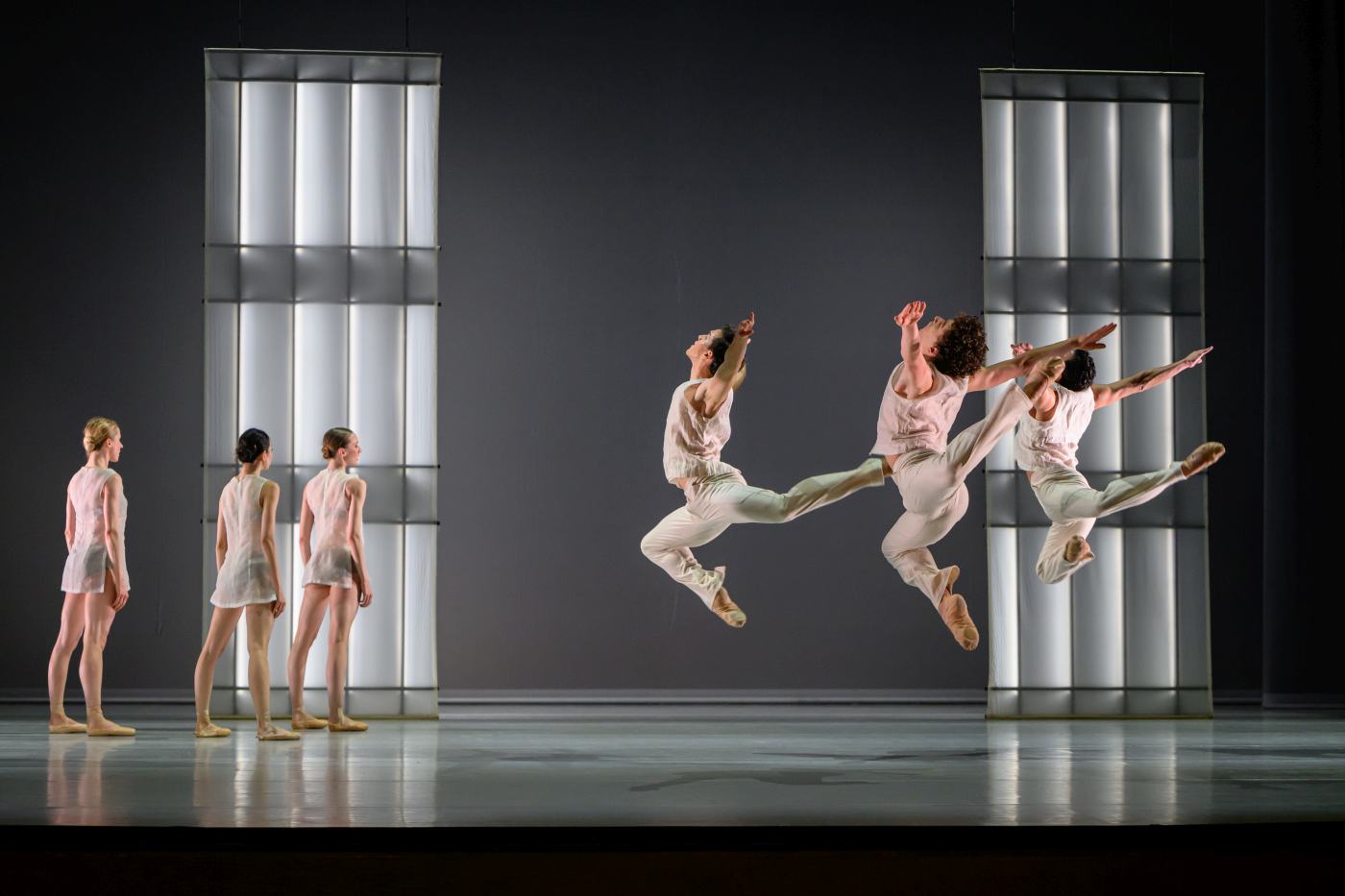
4. Ensemble, “Résonances” by J.-C.Maillot, Les Ballets de Monte-Carlo 2026 © A.BlangeroAs odd as these creatures was Ramon Lazkano’s composition, LurItzalak, to which Maillot choreographed Résonances in 2004. LurItzalak’s viola and violoncello screeched, stung, and stuttered as if screaming for oil to end their agony. At first sight, the minimalist, gray-and-white stage looked chic and smooth. But there was a pinch of scorn in three couples’ answer to the acoustic cries. Or did the music scream in their place? Regardless of how, music and dance resonated strongly. In one case, the men overpowered the women by lowering them into deep backbends while, simultaneously, a tone faded away. Shortly after, when the men clung to the women’s ankles, their feet thrusted forward in sync with single desperate notes, attempting to break free. The farce continued after the men dropped and turfed out their partners. Realizing that they were indeed alone, they huddled and whined, their hands pathetically rubbing their eyes.
6. Ensemble, “Résonances” by J.-C.Maillot, Les Ballets de Monte-Carlo 2026 © A.Blangero5. Ensemble, “Résonances” by J.-C.Maillot, Les Ballets de Monte-Carlo 2026 © A.BlangeroA whiny acoustic overtone remained, though the strings subsequently gathered volume and timbre. Some dancers ran, and others stopped, their knees shivering. Ruefully, the men scurried to heave the women to their feet. Some stylish lifts, clearly intended to amend previous rudeness, ended with the men crouching awkwardly at their partner’s feet. The only set elements, three movable white partitions, whose vertical blinds spread gentle light, shielded the women as they walked slowly off. They looked calm, but a violin’s creaks told otherwise. The men, immersed in a pas de trois, noticed nothing.

7. Ensemble, “Caravansérail” by J.Guérin, Les Ballets de Monte-Carlo 2026 © A.Blangero8. Ensemble, “Caravansérail” by J.Guérin, Les Ballets de Monte-Carlo 2026 © A.BlangeroMartin Matalon’s composition Caravansérail 2 reminded me of a crime satire. A wanton trumpet interfered with piano tinkling, the percussion dashed forward as if each second counted, and the occasional cacophony hinted at chaotic scheming. Something was going on from which Julien Guérin’s Caravansérail choreography was meant to distract us. A partitioned glass wall along the front stage (which later rose) and a low, long, white block near the grayish backdrop defined the showplace for six dancers (three men and three women).
10. Ensemble, “Caravansérail” by J.Guérin, Les Ballets de Monte-Carlo 2026 © A.Blangero9. Ensemble, “Caravansérail” by J.Guérin, Les Ballets de Monte-Carlo 2026 © A.BlangeroThey ostentatiously engaged in snappy solos, pas de deux, and pas de trois and at times sat on the block like a studio audience. Huge eyes in mysterious faces printed on their tutus and full-body leotards compelled the onlookers’ gaze to follow panther-like lunges, supple jumps, spicy legs, and buzzing port de bras. When lit, the seating block briefly highlighted the dancers’ footwork (a scene reminiscent of Lander’s Études), and then the lighting itself became the main attraction.
11. Ensemble, “Caravansérail” by J.Guérin, Les Ballets de Monte-Carlo 2026 © A.Blangero12. Ensemble, “Caravansérail” by J.Guérin, Les Ballets de Monte-Carlo 2026 © A.BlangeroShadowy blue light covered the scene, and a band of light flashed excitedly while the front glass wall was lowered. As the dancers disappeared with a sudden “Bang!” we stared at a second audience sitting backstage. It ensured double applause.

14. Ensemble, “Anémones” by F.Nappa, Les Ballets de Monte-Carlo 2026 © A.Blangero13. Ensemble, “Anémones” by F.Nappa, Les Ballets de Monte-Carlo 2026 © A.BlangeroVioleta Cruz’s composition Huit carrés rouges (meaning “Eight Red Squares”) accompanied a bunch of dancers huddled in the gloom. Huge cobwebs made from crumpled plastic foil hung behind them. Given that Francesco Nappa titled his choreography Anémones, they presumably represented a coral reef. Nothing in Anémones reflected the color red, geometrical objects, and the music’s segmented, minimalist structure.
15. Ensemble, “Anémones” by F.Nappa, Les Ballets de Monte-Carlo 2026 © A.Blangero16. Ensemble, “Anémones” by F.Nappa, Les Ballets de Monte-Carlo 2026 © A.BlangeroNappa’s choreography looked like the antithesis of the music. Its eleven dancers wore metallically iridescent tops and baggy pants and moved like a fluid mass bound to the floor. At times, individuals ascended from the group like heroes (their pride reminded me of the slaves in Spartacus) or set the direction for the others to follow. Arms floated gently like tentacles or intertwined as if building a cage.
18. Ensemble, “Anémones” by F.Nappa, Les Ballets de Monte-Carlo 2026 © A.Blangero17. Ensemble, “Anémones” by F.Nappa, Les Ballets de Monte-Carlo 2026 © A.BlangeroIn one couple that separated from the group, the woman first clung to her partner’s chest, her legs wrapped around his waist, and then she seemed eager to escape (but was held back). They finally had intercourse while rolling across the floor. The music that had almost died down during their pas de deux gained momentum when one woman voluntarily jumped into the outstretched arms of the group as if sacrificing herself as prey.

19. M.Esposito and A.Joaquim, “Time Lapse” by J.-C.Maillot, Les Ballets de Monte-Carlo 2026 © A.Blangero20. A.Krauhaus and L.Wellington, “Time Lapse” by J.-C.Maillot, Les Ballets de Monte-Carlo 2026 © A.BlangeroIn Maillot’s second 2004 piece, Time Lapse, music (Bruno Mantovani’s L’ivresse pour quatuor à cordes, meaning “Intoxication for String Quartet”) and choreography went hand in glove. The sound of Mantovani’s string instruments was as shrill, screeching, and feverish as the relationships of the two couples (Lydia Wellington & Michele Esposito and Ashley Krauhaus & Alexandre Joaquim) on stage. Incessant reproaches, taunts, feelings of guilt, manipulation, devotion, and reconciliation left their marks on bodies (and souls). Skimpy, half-undone gauze bandages and extra-large medical strips covered the wounds and held together what was left. Even the men and women could not establish a trusting alliance among themselves.

22. L.Wellington, M.Esposito, and C.Roelandt (Old Man); “Time Lapse” by J.-C.Maillot, Les Ballets de Monte-Carlo 2026 © A.Blangero21. A.Joaquim and A.Krauhaus, “Time Lapse” by J.-C.Maillot, Les Ballets de Monte-Carlo 2026 © A.BlangeroWhether the five toddler puppets that suddenly stood in the right back stage corner caused the domestic tension or were their silent witness was unclear. In any case, the adults stared at them, frozen to the spot. As the toddlers slowly glided toward the left side, a yellow rod frame attached to them with thin pull ropes came into sight. Seconds later, the rod frame turned out to be an old man’s (Chris Roelandt’s) walking aid. His baggy diaper (with which he wore a white corset and white socks) put him on the toddlers’ level, but being drawn by them also turned him into their yoke.
23. C.Roelandt (Old Man) and ensemble, “Time Lapse” by J.-C.Maillot, Les Ballets de Monte-Carlo 2026 © A.Blangero24. M.Esposito, L.Wellington, A.Joaquim, and A.Krauhaus; “Time Lapse” by J.-C.Maillot, Les Ballets de Monte-Carlo 2026 © A.BlangeroMid-back center, the baby carthorses halted so that grandpa could watch the absurd drama the couples pulled off. The women, in return, forced their men’s gazes toward grandpa, maybe to remind them of how they might end in old age. After the old man shook his head disapprovingly and shuffled off, one of the women dropped to the floor. Bustle continued, but as the others realized that she would not stand up, they retreated in horror.

26. Ensemble, “Steps for Bea(s)ts That Never Were” by J.Verbruggen, Les Ballets de Monte-Carlo 2026 © A.Blangero25. L.Simonetto and ensemble, “Steps for Bea(s)ts That Never Were” by J.Verbruggen, Les Ballets de Monte-Carlo 2026 © A.BlangeroAurélien Dumont’s composition Steps for Beasts That Never Were was inspired by Philip K. Dick’s science fiction short story The Preserving Machine (1953) about a machine that transforms (and thereby preserves) classical music in the event of an apocalypse. Johann Sebastian Bach’s compositions transformed into little beetles, Franz Schubert’s songs became lamb-like creatures, and so on. But evolution brutalized them and, once fed back into the machine, the music’s beauty and harmony were lost.
27. Ensemble, “Steps for Bea(s)ts That Never Were” by J.Verbruggen, Les Ballets de Monte-Carlo 2026 © A.Blangero28. Ensemble, “Steps for Bea(s)ts That Never Were” by J.Verbruggen, Les Ballets de Monte-Carlo 2026 © A.BlangeroChoreographer Jeroen Verbruggen took up this idea of bizarre transformations that exterminate beauty. In a sweeping blow, he also obliterated the music. At least that’s what the title of his choreography, Steps for Bea(s)ts That Never Were, suggests. And indeed, I only remember a trickling piano melody, the hiss of a valve, and hysterical laughter. Everything else paled in comparison to Verbruggen’s freak show.

Its set design consisted of a metal shelf cart with a skinned, tattered dog specimen whose dissector must have stopped working midway. A naked bulb hanging from the ceiling lit the pathetic creature. The boxing gloves dangling from a lower shelf were later put on by Luca Bergamaschi and Alejandro Moya Vaquero, who were dressed to resemble the dog but had stylishly gelled silver hair. Emma Knowlson’s and Cara Verschraegen’s tricots were similar in style and later complemented by white tutus taken from the shelf cart. Lukas Simonetto, sporting trendy black and white trunks and bad manners, most likely resembled a boxer. His bare chest glinted from fake sweat. Coiling like a faun, he oozed a degenerate lust.
30. Ensemble, “Steps for Bea(s)ts That Never Were” by J.Verbruggen, Les Ballets de Monte-Carlo 2026 © A.Blangero29. L.Simonetto, E.Knowlson, C.Verschraegen, and ensemble; “Steps for Bea(s)ts That Never Were” by J.Verbruggen, Les Ballets de Monte-Carlo 2026 © A.BlangeroAs the dancers ran and gesticulated, rolled and wriggled across the floor, and kicked their legs, the meager lighting turned bilious green. A band of white light flickered like a warning signal. The great experiment crammed the women into the shelf cart like lab animals, and applied voltage to the metal. After that, Bergamaschi and Moya Vaquero lay motionless. Maybe witnessing the convulsing bodies had floored them.

31. B.Coppieters, “Kintsugi” by M.Koike, Les Ballets de Monte-Carlo 2026 © A.Blangero32. B.Coppieters, “Kintsugi” by M.Koike, Les Ballets de Monte-Carlo 2026 © A.BlangeroThe atmosphere felt run-down after the curtain closed on Verbruggen’s piece, but spirits rose during the first scene of Mimoza Koike’s Kintsugi, proving how beneficial the mindset behind its title is (in Japanese, kintsugi roughly means “to repair with gold something that is broken”). Each of the five dancers Koike employed had laid the foundation of Les Ballets de Monte-Carlo in 1986. Since they retired from the stage, three of them—Bernice Coppieters, Gaëtan Morlotti, and Asier Uriagereka—have served as the company’s ballet masters, while two—Francesca 33. A.Salmon-Favier, “Kintsugi” by M.Koike, Les Ballets de Monte-Carlo 2026 © A.BlangeroDolci and Annabelle Salmon-Favier—joined the administration. On the company’s fortieth anniversary, Kintsugi intends to honor them by echoing the Japanese veneration of the beauty of long-used objects.
A piece of their azure blue costumes (either the pants or the shirt) showed golden lines from former fissures. They hadn’t harmed their vitality though, about which Coppieters left no doubt as she entered the stage. The densely leaved young tree she carried, its roots still wrapped in a bag, banged on the floor like a pillar placed for eternity. Subsequently, the line of trees grew, each species representing another dancer.

34. F.Dolci, A.Uriagereka, G.Morlotti, B.Coppieters, and A.Salmon-Favier; “Kintsugi” by Mimoza Koike, Les Ballets de Monte-Carlo 2026 © A.Blangero35. A.Salmon-Favier, B.Coppieters, F.Dolci, G.Morlotti, and A.Uriagereka; “Kintsugi” by M.Koike, Les Ballets de Monte-Carlo 2026 © A.BlangeroMisato Mochizuki’s calm, poised composition Sakiwai – Wabi-sabi Bloom allowed Coppieters a deep breath and space to reminisce, feel, and appreciate the here and now. Hips gyrated as if enjoying a good groove, and feet assembled with mincing steps and moved in sync. The dancers seemed to play like children as their hands mimed beaks. There was a poetry that only seasoned souls could create. As Salmon-Favier detected and carried a precious light, all stood in awe. It soon ascended to spread a greater shine. Did the upraised arms try to hold on to it, or did they wave goodbye?
The shower of dark golden pieces that rained down on the humble group like propelled maple seeds seemed a harvest of forty years of work. It also promised future growth.
36. F.Dolci, B.Coppieters, G.Morlotti, A.Salmon-Favier, and A.Uriagereka; “Kintsugi” by M.Koike, Les Ballets de Monte-Carlo 2026 © A.Blangero

Link: Website of Les Ballets de Monte-Carlo
Photos: 1. Ensemble, “Résonances” by Jean-Christophe Maillot, Les Ballets de Monte-Carlo 2026
2. Ensemble, “Résonances” by Jean-Christophe Maillot, Les Ballets de Monte-Carlo 2026
3. Ensemble, “Résonances” by Jean-Christophe Maillot, Les Ballets de Monte-Carlo 2026
4. Ensemble, “Résonances” by Jean-Christophe Maillot, Les Ballets de Monte-Carlo 2026
5. Ensemble, “Résonances” by Jean-Christophe Maillot, Les Ballets de Monte-Carlo 2026
6. Ensemble, “Résonances” by Jean-Christophe Maillot, Les Ballets de Monte-Carlo 2026
7. Ensemble, “Caravansérail” by Julien Guérin, Les Ballets de Monte-Carlo 2026
8. Ensemble, “Caravansérail” by Julien Guérin, Les Ballets de Monte-Carlo 2026
9. Ensemble, “Caravansérail” by Julien Guérin, Les Ballets de Monte-Carlo 2026
10. Ensemble, “Caravansérail” by Julien Guérin, Les Ballets de Monte-Carlo 2026
11. Ensemble, “Caravansérail” by Julien Guérin, Les Ballets de Monte-Carlo 2026
12. Ensemble, “Caravansérail” by Julien Guérin, Les Ballets de Monte-Carlo 2026
13. Ensemble, “Anémones” by Francesco Nappa, Les Ballets de Monte-Carlo 2026
14. Ensemble, “Anémones” by Francesco Nappa, Les Ballets de Monte-Carlo 2026
15. Ensemble, “Anémones” by Francesco Nappa, Les Ballets de Monte-Carlo 2026
16. Ensemble, “Anémones” by Francesco Nappa, Les Ballets de Monte-Carlo 2026
17. Ensemble, “Anémones” by Francesco Nappa, Les Ballets de Monte-Carlo 2026
18. Ensemble, “Anémones” by Francesco Nappa, Les Ballets de Monte-Carlo 2026
19. Michele Esposito and Alexandre Joaquim, “Time Lapse” by Jean-Christophe Maillot, Les Ballets de Monte-Carlo 2026
20. Ashley Krauhaus and Lydia Wellington, “Time Lapse” by Jean-Christophe Maillot, Les Ballets de Monte-Carlo 2026
21. Alexandre Joaquim and Ashley Krauhaus, “Time Lapse” by Jean-Christophe Maillot, Les Ballets de Monte-Carlo 2026
22. Lydia Wellington, Michele Esposito, and Chris Roelandt (Old Man); “Time Lapse” by Jean-Christophe Maillot, Les Ballets de Monte-Carlo 2026
23. Chris Roelandt (Old Man) and ensemble, “Time Lapse” by Jean-Christophe Maillot, Les Ballets de Monte-Carlo 2026
24. Michele Esposito, Lydia Wellington, Alexandre Joaquim, and Ashley Krauhaus; “Time Lapse” by Jean-Christophe Maillot, Les Ballets de Monte-Carlo 2026
25. Lukas Simonetto and ensemble, “Steps for Bea(s)ts That Never Were” by Jeroen Verbruggen, Les Ballets de Monte-Carlo 2026
26. Ensemble, “Steps for Bea(s)ts That Never Were” by Jeroen Verbruggen, Les Ballets de Monte-Carlo 2026
27. Ensemble, “Steps for Bea(s)ts That Never Were” by Jeroen Verbruggen, Les Ballets de Monte-Carlo 2026
28. Ensemble, “Steps for Bea(s)ts That Never Were” by Jeroen Verbruggen, Les Ballets de Monte-Carlo 2026
29. Lukas Simonetto, Emma Knowlson, Cara Verschraegen, and ensemble; “Steps for Bea(s)ts That Never Were” by Jeroen Verbruggen, Les Ballets de Monte-Carlo 2026
30. Ensemble, “Steps for Bea(s)ts That Never Were” by Jeroen Verbruggen, Les Ballets de Monte-Carlo 2026
31. Bernice Coppieters, “Kintsugi” by Mimoza Koike, Les Ballets de Monte-Carlo 2026
32. Bernice Coppieters, “Kintsugi” by Mimoza Koike, Les Ballets de Monte-Carlo 2026
33. Annabelle Salmon-Favier, “Kintsugi” by Mimoza Koike, Les Ballets de Monte-Carlo 2026
34. Francesca Dolci, Asier Uriagereka, Gaëtan Morlotti, Bernice Coppieters, and Annabelle Salmon-Favier; “Kintsugi” by Mimoza Koike, Les Ballets de Monte-Carlo 2026
35. Annabelle Salmon-Favier, Bernice Coppieters, Francesca Dolci, Gaëtan Morlotti, and Asier Uriagereka; “Kintsugi” by Mimoza Koike, Les Ballets de Monte-Carlo 2026
36. Francesca Dolci, Bernice Coppieters, Gaëtan Morlotti, Annabelle Salmon-Favier, and Asier Uriagereka; “Kintsugi” by Mimoza Koike, Les Ballets de Monte-Carlo 2026
all photos © Alice Blangero
Editing: Kayla Kauffman


The Art of Embarrassing Oneself

“Stravinsky in Paris” (“Farewell in Paris”/“Le Sacre du Printemps”)
State Ballet of the Gärtnerplatztheater, Munich
Forum Ludwigsburg
Ludwigsburg, Germany
July 30, 2025

by Ilona Landgraf
Copyright © 2025 by Ilona Landgraf

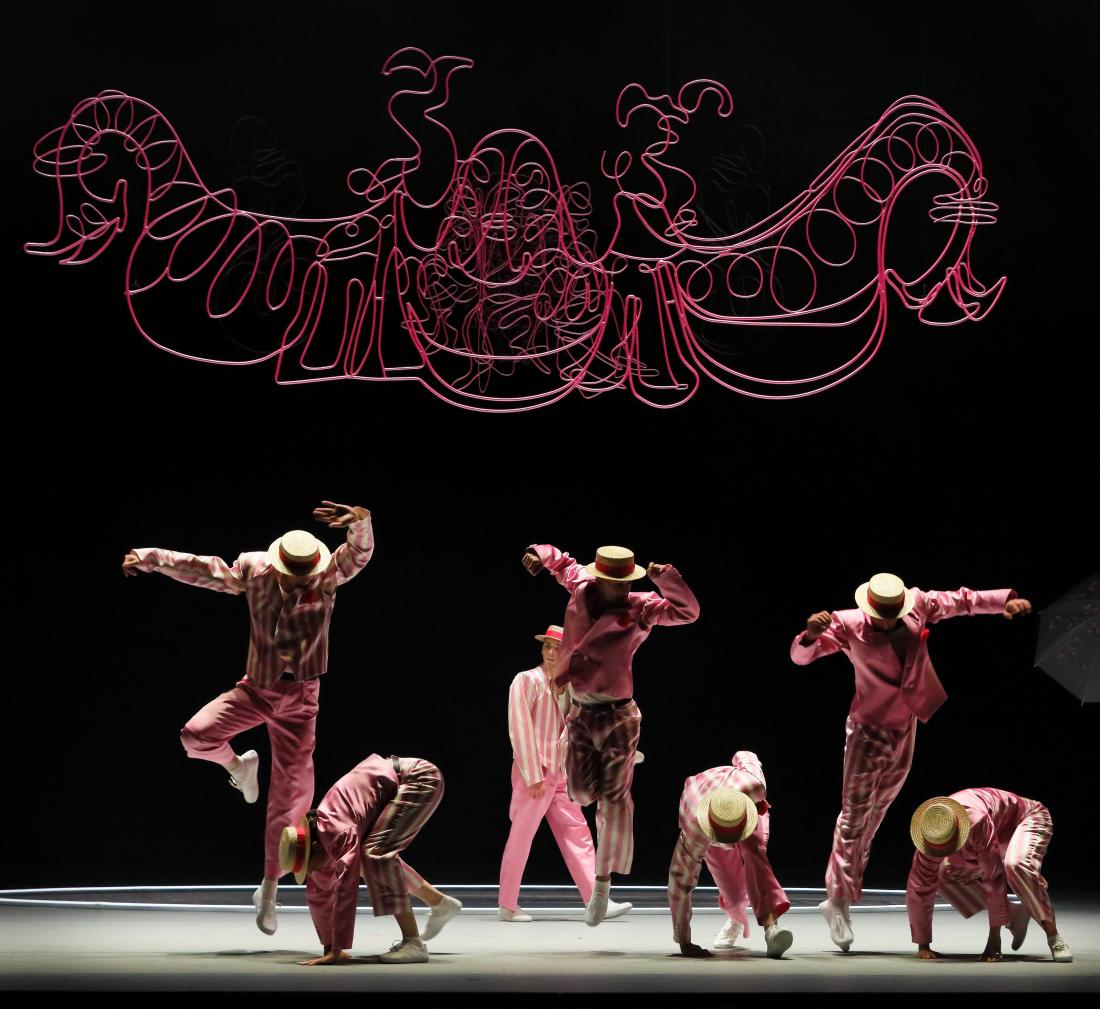
1. M.J.Perko (Jerry) and ensemble, “Farewell in Paris” by J.Verbruggen, State Ballet of the Gärtnerplatztheater 2025 © M.-L.Briane Since 1932, the city of Ludwigsburg in Baden-Württemberg has hosted an annual summer festival featuring various cultural genres. Many events are held at the Ludwigsburg Palace, a vast complex that served as the Duke of Württemberg’s residence after its completion in 1733. Munich’s State Ballet of the Gärtnerplatztheater, whose Stravinsky in Paris marked the festival’s final dance event, performed at the Ludwigsburg Forum near the palace. Last October, the Gärtnerplatztheater showed Troja (“Troy”) by the Greek-born Andonis Foniadakis on its tour to Ludwigsburg. Its display of sexist abuse was annoying. As the press praised Stravinsky in Paris as a “confetti rocket,” I was curious about its “sophisticated dance and music.”
Stravinsky in Paris, a co-production of the Gärtenerplatztheater and the Ludwigsburg Festival, recently premiered in Munich. The double bill combines Jeroen Verbruggen’s Farewell in Paris and Marco Goecke’s Le Sacre du Printemps.
The nonchalant steps of the straw-hatted men who opened Farewell to Paris seemed inspired by a blend of Broadway style and Parisian savoir vivre. In their pale pink of their blazers and pants, they seemed to belong in a little girl’s dream (costumes by Emmanuel Maria). Continue reading “The Art of Embarrassing Oneself”