“La Bayadère”
Ballet of the Stanislavsky and Nemirovich-Danchenko Moscow Music Theatre
Stanislavsky and Nemirovich-Danchenko Moscow Music Theatre
Moscow, Russia
November 2, 2026
by Ilona Landgraf
Copyright © 2026 by Ilona Landgraf
The Stanislavsky Theatre’s in-house museum is always worth a visit. Currently, the temporary photo exhibition pays tribute to three anniversaries. The first is the centenary consolidation of two art studios at the building at 17 Bolshaya Dmitrovka Street (today’s Stanislavsky Theatre): Konstantin Stanislavsky’s Opera Studio (formerly housed at the Bolshoi Theatre) and Vladimir Nemirovich-Danchenko’s Musical Studio (an offshoot of the Moscow Art Theater). Both studios received state theater status after this move. The second celebrated anniversary is the theater’s reopening in 2006 after prolonged renovations. Two fires in 2003 and 2005, the latter destroying the auditorium, considerably expanded the scope of the works. Finally, the theater also commemorates the 90th birthday of Moscow’s former mayor Yuri Luzhkov, a supporter of the house who laid the cornerstone for the new building.
On Monday evening, the company performed La Bayadère, a well-loved mainstay of the repertory. A large group of middle-grade students was in the audience, and I wondered about their takeaway from the exotic, ancient Indian romance. It seems distant from youths’ interests.
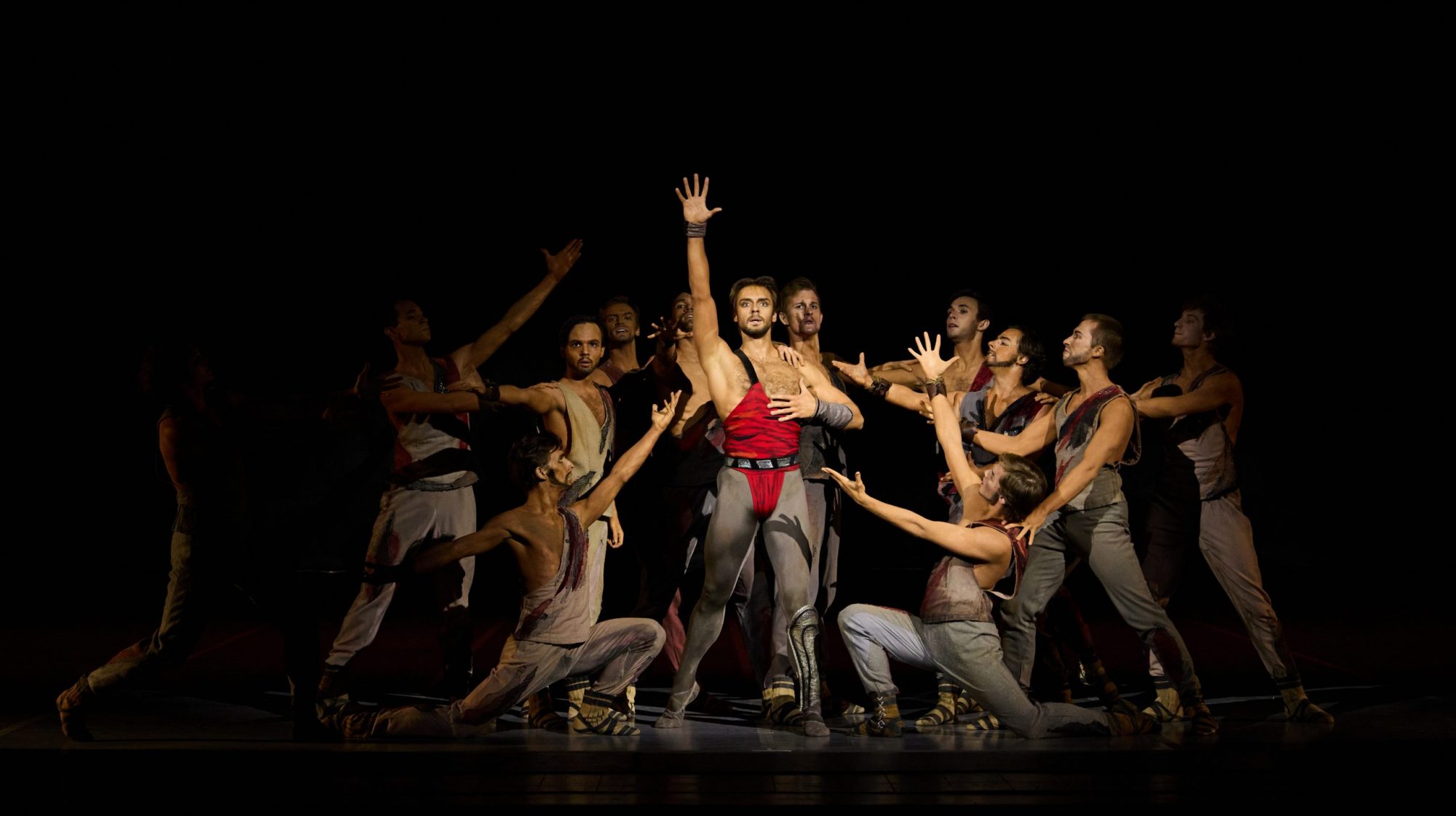
The Stanislavsky dances Natalia Makarova’s 1980 version created for the American Ballet Theatre. Its set and costumes by Pier Luigi Samaritani and Yolanda Sonnabend, respectively, merge into an oriental pastiche dominated by pastel colors. It comprises a sacred forest, a richly decorated, bronze-gold pillared hall, a garden of a rajah’s palace, and the tent of the hero, Solor, which looks like a sanctuary amid vast mountains. La Bayadère plays at impressive locations (for example, in Act III at a temple with central perspective architecture and cloisters with arcades framing a turquoise heaven), and their destruction by thunderbolts and a rain of fire (video design by Viktor Vasiliev) constitutes an apocalypse. It drives home the message that wrongdoing has consequences.
But who is to blame? Who tipped the balance toward tragedy? Let’s have a look at the motives of the main characters.
The victim, Anfisa Oshchepkova’s Nikiya, is certainly innocent. A soft-natured bayadere devoted to transcendent powers, she flowed with the universe until earthly love for the warrior, Solor (Evgeny Zhukov), entangled her in a web of betrayal and intrigue. Upon detecting that the rajah’s daughter, Gamzatti (Anastasia Limenko), was after Solor, Nikiya’s knee-jerk attempt to stab her was hesitant and posed no credible danger. Gamzatti’s ayah (Polina Erlykina) easily wrested the knife away from Nikiya. The ball was in Gamzatti’s court, and she did not hesitate to orchestrate a murder. A poisonous snake, hidden in a flower basket, bit Nikiya. If Solor had shown any love for Nikiya, she might have accepted the antidote that her superior, the High Brahmin (Georgi Smilevski), offered. Yet Solor walked off with Gamzatti, and Nikiya died in a blink of an eye.
Gamzatti’s movements were not as tender as Nikiya’s, and she lacked genuine, heart-warming charm. Her bearing, her gaze, and the way she held up her chin bespoke her hubris. Spoiled by status, she presumed to get everything she fancied, especially marrying Solor. Having achieved her goal, she seemed chastened at the wedding ritual. But upon noticing the power Nikiya’s love exerted over Solor even after her death, Gamzatti’s true self re-emerged. Her arms impatiently cut the ritual short to quickly complete the wedding. Whether he loved her or not, she intended to possess him.
Solor blundered the moment he saw Gamzatti and fell for her beauty. His oath of love for Nikiya immediately dropped from his mind. Two aspects absolve his guilt, though: the force of nature that made him follow his sex’s instincts (after all, Gamzatti was a beauty) and his subordination to the Rajah (Nikita Kirillov). Solor would either play along or be finished off.
As if directed by higher powers, Zhukov’s performance became scintillating once his Solor repented and entered the Kingdom of the Shades, where he reunited with Nikiya. Both finally ascended to a light-flooded afterworld where they repeated the veil pas de deux. The scene could have been mawkish, but it instead reassured the audience of the existence of a superior justice.
Was Kirillov’s Rajah the main culprit? After all, he was a key figure in facilitating Nikiya’s death. But as a leader, didn’t he have to project power and, as a father, do everything to ensure his daughter’s happiness?
That leaves the High Brahmin. Driven by his desire for Nikiya, he was less holy than his position demanded. Refused by her and thirsting for revenge, he gave her and Solor’s love away to the Rajah, thereby setting the catastrophe into motion. He also delivered the final straw at the wedding ritual when he pushed Solor’s arm down, which he had raised to swear his love for Nikiya. The moment Solor’s arm met Gamzatti’s in a mirror-image position, hell broke loose. Divine fury was unleashed upon the wedding party, restoring order and control, as Arthur Mkrtchan’s Golden Idol symbolized.
Order was also what made the Shades mesmerizing, though their descent was less impressive. Brief pauses before each arabesque ensured synced movements but hampered the overall flow. At court, the corps effectively spread joy and liveliness.
The Stanislavsky Theatre’s orchestra played under the baton of Arif Dadashev. Their rendition of Ludwig Minkus’s score (orchestrated by John Lanchbery) was a treat. The violin solo that accompanied Nikiya in the Kingdom of Shades was especially fabulous.
| Link: | Website of the Stanislavsky and Nemirovich-Danchenko Moscow Music Theatre | |
| Editing: | Kayla Kauffman |